所屬科目:【阿摩】未分類題庫
1. Which of the following species have tetrahedral bond angles? (A) A, D, and E (B) A, D, E, and F (C) A and E (D) D only (E) A, B, and E
2. Which of the following correctly ranks the cycloalkanes in order of increasing ring strain per methylene? (A) cyclopropane < cyclobutane < cyclohexane < cycloheptane (B) cyclohexane < cyclopentane < cyclobutane < cyclopropane (C) cyclopentane < cyclobutane < cyclohexane < cyclopropane (D) cyclopentane < cyclopropane < cyclobutane < cyclohexane (E) cyclopropane < cyclopentane < cyclobutane < cyclohexane
3. Which of the following compounds has an R configuration? (A) (B) (C) (D)(E)
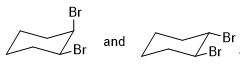
4. What is the relationship between the structures shown below? (A) Enantiomers (B) diastereomers (C) configurational isomers(D) identical compounds (E) constitutional isomers
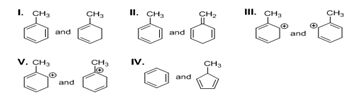
5. Which of the following pairs are resonance structures? (A) I (B) II (C) III (D) IV (E) V
6. Which of the following is the most stable cation?(A) I (B) II (C) III (D) IV (E) V
7. Which of the following SN2 reactions is the fastest?(A) CH3CH(Br)CH3 + HO- → CH3CH(OH)CH3 + Br- (B) CH3CH2CH2I + HO- → CH3CH2CH2OH + I- (C) CH3CH(I)CH3 + HO- → CH3CH(OH)CH3 + I- (D) CH3CH2CH2Br + HO- → CH3CH2CH2OH + Br- (E) CH3CH2CH2I + H2O → CH3CH2CH2OH + HI
8. Which of the following can’t undergo nucleophilic substitution reactions?(A) I (B) II (C) III (D) IV (E) V
9. Which of the following alcohols dehydrates with the fastest rate? (A) I (B) II (C) III (D) IV (E) V
10. Which of the following compounds reacts most slowly during nitration? (A) I (B) II (C) III (D) IV (E) V
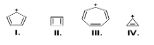
11. Which of the structure below would be aromatic? (A) I and IV (B) I, III, and IV (C) III and IV (D) II (E) I and III
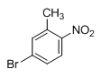
12. What is the name of the following compound? (A) o-nitro-m-bromotoluene (B) 3-bromo-6-nitrotoluene (C) m-bromo-o-nitro- toluene (D) 5-bromo-2-nitrotoluene (E) 2-nitro-5-bromo-toluene
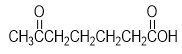
13. Which of the following compounds is most reactive toward nucleophilic acyl substitution?(A) (B) (C) (D) (E)
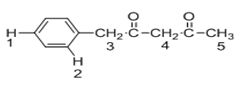
14. Which of is the labeled hydrogen atoms in the following structure is the most acidic? (A) 1 (B) 2 (C) 3 (D) 4 (E) 5
15. What type of bonding is most important in CH3CH2CH2CH2CH3? (A) ionic (B) hydrogen (C) covalent (D) polar (E) none
16. What configurations are found in the product(s) of the reaction below?(A) 1R, 2R only (B) 1S, 2S only (C) 1R, 2S only (D) an equal mixture of 1R, 2R and 1S, 2S (E) an equal mixture of 1R, 2R and 1R, 2S
17. Which of the following is the weakest base? (A) phenolate ion (C6H5O-) (B) ethoxide ion (CH3CH2O-) (C) hydroxide ion (HO-) (D) acetate ion (CH3CO2-) (E) methoxide ion (CH3O-)
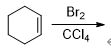
18. Give the major product for the following reaction.(A) (B) (C)(D) (E)no reaction
19. Given the bond dissociation energies below (in kcal/mol), estimate the ΔH° for the propagation step (A) -22 kcal/mol (B) +22 kcal/mol (C) -40 kcal/mol(D) +45 kcal/mol (E) -45 kcal/mol
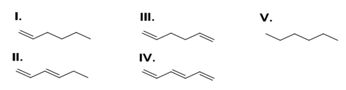
20. Which of the following compounds exhibits the highest λmax in UV spectra? (A) I (B) II (C) III (D) IV (E) V
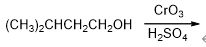
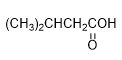
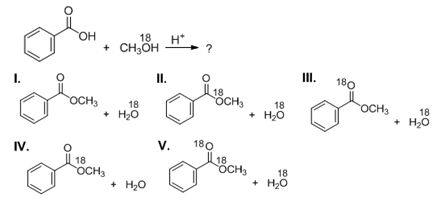
21. What is the product obtained from the following reaction?(A) I (B) II (C) III (D) IV (E) V
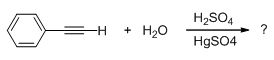
22. Which of the following is the final and major product of this reaction?(A) (B) (C) (D) (E)
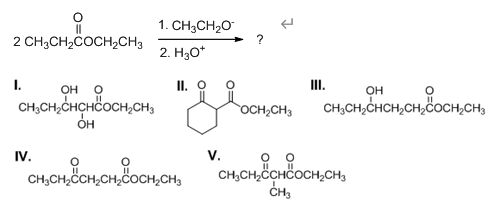
23. What is the major product of the following condensation?(A) I (B) II (C) III (D) IV (E) V
24. Which of the following reducing agents can cause the formation of cis-2-butene as a major product of the reaction shown below?(A) H2/Lindlar's Catalyst (B) Na/NH3 (C) Li/NH3(D) 1. LiAlH4 / 2. H3O+ (E) 1. NaBH4 / 2. H3O+
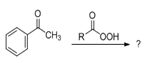
25. What is the major organic product of the following reaction?(A) (B) (C) (D) (E)
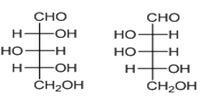
26. At which carbon are the following sugars epimers of each other?(A) C-1 (B) C-2 (C) C-3 (D) C-4 (E) C-5
27. Which of the following best represents the structure of an amino acid in basic solution (pH = 11)?(A) (B) (C) (D) (E)
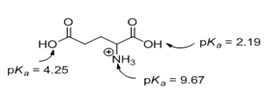
28. Calculate the isoelectric point for the following compound.(A) 3.22 (B) 5.34 (C) 5.93 (D) 6.91 (E) 9.67
29. Which of the following compounds will undergo an SN1 reaction most readily? (A) (CH3)3Cl (B) (CH3)3CCl (C) (CH3)3CHI (D) (CH3)2CHCH2CH2CH2Cl (E) (CH3)2CHCH2CH2CH2I
30. An unknown alkene was treated with ozone, and then with H2O2 forming the following product:(A) (B) (C) (D) (E)
 阿摩線上測驗
登入
阿摩線上測驗
登入

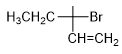 (B)
(B)  (C)
(C)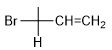 (D)
(D)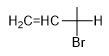
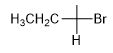




 (B)
(B)  (C)
(C) (D)
(D) (E)
(E)
 (B)
(B)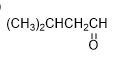 (C)
(C)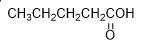
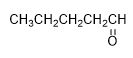 (E)
(E)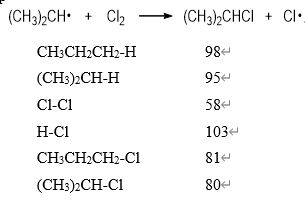
 (B)
(B) (C)
(C)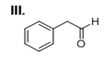 (D)
(D) (E)
(E)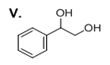
 (A) I (B) II (C) III (D) IV (E) V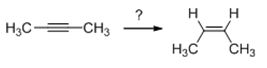
 (B)
(B) 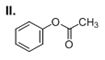 (C)
(C)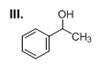 (D)
(D)  (E)
(E)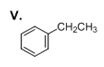
 (B)
(B)  (C)
(C)  (D)
(D) (E)
(E)
 (B)
(B) (C)
(C)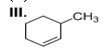 (D)
(D)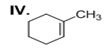 (E)
(E)