所屬科目:研究所、轉學考(插大)◆經濟學原理
1. When an economist uses the term "cost" referring to a firm, the economist refers to the (A) price of the good to the consumer. (B) explicit cost of producing a good or service but not the implicit cost of producing a good or service. (C) implicit cost of producing a good or service but not the explicit cost of producing a good or service. (D) opportunity cost of producing a good or service, which includes both implicit and explicit cost. (E) cost that can be actually verified and measured.
2. Suppose that marginal revenue for a perfectly competitive firm is $20. When the firm produces 10 units, its marginal cost is $20, its average total cost is $22, and its average variable cost is $17. Then to maximize its profit in the short run, the firm (A) should stay open and incur an economic loss of $20. (B) must increase its output to increase its profit. (C) must decrease its output to increase its profit. (D) should shut down. (E) should not change its production because it is already maximizing its profit and is making an economic profit.
3. Alice, Bud, and Celia can produce rubber bands in a perfectly competitive market. If they enter the market, the minimum average total cost for a bundle of rubber bands, for the three of them is $2, $3, and $4, respectively. If the market price is $2.10 per bundle, then (A) all three of them will enter the market. (B) only Alice will enter the market. (C) Alice and Bud will enter the market. (D) Bud and Celia will enter the market. (E) Alice and Celia will enter the market.
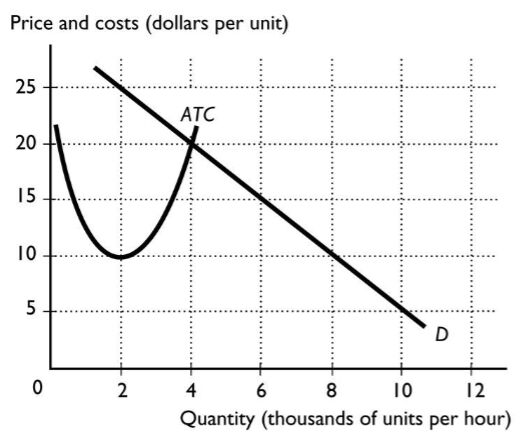
4. Figure 1 shows the market demand curve and the ATC curve for a firm. If all firms in the market have the same ATC curve, the efficient scale for one firm is ________ units per hour. (A) 2,000 (B) 4,000 (C) 8,000 (D) 10,000 (E) more than 10,000
5. Figure 1 shows the market demand curve and the ATC curve for a firm. If all firms in the market have the same ATC curve, the lowest price at which a firm could stay in business in the long run is ________ per unit and the quantity demanded in the market at that price is ________ units per hour. (A) $20; 4,000 (B) $10; 8,000 (C) $10; 4,000 (D) $20; 2,000 (E) $20; 8,000
6. Figure 1 shows the market demand curve and the ATC curve for a firm. If all firms in the market have the same ATC curve, the figure shows a ________ can profitably operate. (A) natural monopoly in which 1 firm (B) natural oligopoly in which 2 firms (C) natural oligopoly in which 3 firms (D) natural oligopoly in which 4 firms (E) natural oligopoly in which 5 or more firms
7. Figure 1 shows the market demand curve and the ATC curve for a firm. If all firms in the market have the same ATC curve, economies of scale limit the market to ________ firm(s). (A) 1 (B) 2 (C) 3 (D) 4 (E) 8
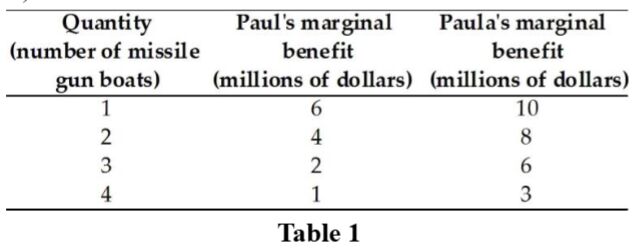
8. In Table 1, Paul and Paula are the only members of society. The table above gives their marginal benefits from missile gunboats, a public good. Determine the marginal benefit to society of the second missile gunboat. (A) $16 million (B) $8 million (C) $12 million (D) $10 million (E) $4 million
9. In Table 1, Paul and Paula are the only members of society. The table above gives their marginal benefits from missile gunboats, a public good. Determine the marginal benefit to society of the fourth missile gunboat. (A) $8 million (B) $4 million (C) $2 million (D) $1 million (E) $40 million
10. In Table 1, Paul and Paula are the only members of society. The table above gives their marginal benefits from missile gunboats, a public good. Suppose the marginal cost of a missile gunboat is $8 million. What is the efficient quantity of missile gunboats? (A) 1 boat (B) 2 boats (C) 3 boats (D) 4 boats (E) More information about whether the services provided by missile gunboats are rival or not is needed.
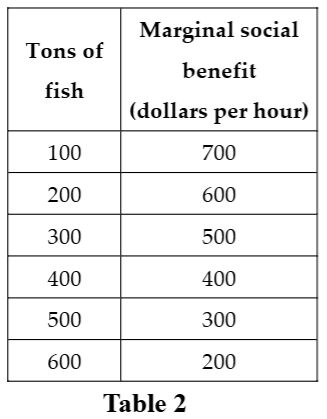
11. Table 2 shows the marginal social benefit of fishing in Mediterranean Sea. The marginal private cost of operating a fishing boat is the same for all producers, $300 per hour. The marginal social cost is twice the marginal private cost. With no government intervention, the equilibrium quantity of fish caught is ________ tons. (A) 100 (B) 200 (C) 300 (D) 400 (E) 500
12. Table 2 shows the marginal social benefit of fishing in Mediterranean Sea. The marginal private cost of operating a fishing boat is the same for all producers, $300 per hour. The marginal social cost is twice the marginal private cost. The efficient quantity of fish caught is ________ tons. (A) 100 (B) 200 (C) 300 (D) 400 (E) 500
13. Table 2 shows the marginal social benefit of fishing in Mediterranean Sea. The marginal private cost of operating a fishing boat is the same for all producers, $300 per hour. The marginal social cost is twice the marginal private cost. With no government intervention, the market is (A) catching the efficient quantity of fish. (B) underproducing by 100 tons of fish. (C) underproducing by 300 tons of fish. (D) overproducing by 300 tons of fish. (E) overproducing by 200 tons of fish.
14. Table 2 shows the marginal social benefit of fishing in Mediterranean Sea. The marginal private cost of operating a fishing boat is the same for all producers, $300 per hour. The marginal social cost is twice the marginal private cost. If the government sets a production quota, to have the efficient quantity of fish caught, the quote should equal ________ tons of fish. (A) 100 (B) 200 (C) 300 (D) 400 (E) 500
15. Suppose that the CPI basket contains only 40 heads of cauliflower and 60 bunches of broccoli. If the price of cauliflower goes down by $1 per head and the price of broccoli goes up by $1 per bunch, then (A) the CPI does not change. (B) the CPI increases. (C) the CPI decreases. (D) the CPI might increase or decrease depending how the quantities are affected by the price changes. (E) There is not enough information to answer this question.
16. Suppose the working-age population is 500 million, the labor force is 200 million, and the unemployment rate is 15 percent. The number of unemployed people is (A) 30 million. (B) 75 million. (C) 45 million. (D) 105 million. (E) 15 million.
17. Andrew is not working, but is available and willing to work after finishing a month-long mission trip for his church. While on his mission, Andrew did not look for work. Andrew is considered (A) unemployed. (B) part of the labor force. (C) a marginally attached worker. (D) a discouraged worker. (E) Both answers A and B are correct.
18. Which of the following is true regarding the measurement of GDP? (A) Wages and profit income are used in the income approach to GDP. (B) Wages and consumption are used in the expenditure approach to GDP. (C) Consumption and investment are used in the income approach to GDP. (D) Government expenditure is only counted in the income approach to GDP. (E) Investment and wages are expenditures, and are therefore are used in the expenditure approach to GDP.
19. Real GDP can increase if the i. quantities of goods and services produced decrease and prices fall by a smaller percentage. ii. quantities of goods and services produced decrease and prices fall by a larger percentage. iii. quantities of goods and services produced decrease and prices do not change. iv. quantities of goods and services produced increase. (A) i only (B) iii only (C) iv only (D) i and iii (E) i, ii, and iii
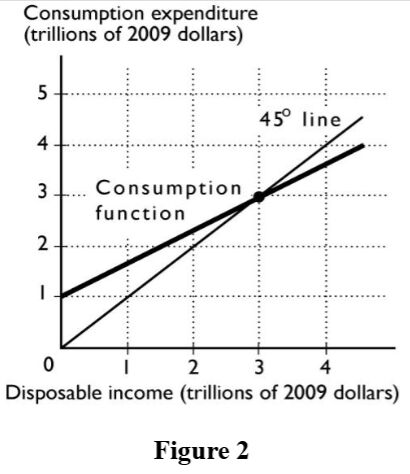
20. Figure 2 shows a nation's consumption function. The amount of autonomous consumption expenditure is (A) $0. (B) $1 trillion. (C) $2 trillion. (D) $3 trillion. (E) more than $3 trillion.
21. Figure 2 shows a nation's consumption function. If disposable income is $2 trillion, then the MPC is ________ and saving is ________. (A) positive; positive (B) positive; negative (C) negative; positive (D) negative; negative (E) positive; zero
22. A bank has $250 in checking deposits, $1,000 in savings deposits, $1,200 in time deposits, $1,000 in loans to businesses, $400 in outstanding credit card balances, $800 in government securities, $25 in currency in its vault, and $25 in deposits at the Fed. The bank's reserves are equal to (A) $25. (B) $275. (C) $2,225 (D) $50. (E) $350.
23. If Bulge Bank has a desired reserve ratio of 10 percent, loans of $25,000, deposits of $100,000, vault cash of $10,000, and reserves at the Fed of $65,000, then the bank (A) has no remaining capacity to make loans. (B) does not have enough reserves to meet its requirement. (C) has excess reserves of $65,000. (D) has excess reserves of $55,000. (E) has excess reserves of $75,000.
24. Lulu purchased a security that promises to pay $50 twice a year from January 15, 2012 to January 15, 2016 and then pay $1,000 on January 15, 2016. The security is a debt to the company that issued it. The security is a (A) depreciating asset. (B) bond. (C) share of stock. (D) physical capital. (E) net investment to the company that issued it.
25. The "crowding-out effect" refers to how a government budget deficit (A) shifts only the supply of loanable funds curve leftward. (B) shifts only the demand for loanable funds curve leftward. (C) shifts both the demand for and the supply of loanable funds curves leftward. (D) decreases the equilibrium quantity of investment. (E) increases the equilibrium quantity of investment.
 阿摩線上測驗
登入
 (A) all three of them will enter the market. (B) only Alice will enter the market. (C) Alice and Bud will enter the market. (D) Bud and Celia will enter the market. (E) Alice and Celia will enter the market.
 (A) 1 (B) 2 (C) 3 (D) 4 (E) 8
 (A) 100 (B) 200 (C) 300 (D) 400 (E) 500
 (A) $0. (B) $1 trillion. (C) $2 trillion. (D) $3 trillion. (E) more than $3 trillion.