所屬科目:轉學考-普通化學
1. A system at a state of chemical equilibrium is (A) microscopically dynamic and macroscopically static (B) microscopically dynamic and macroscopically dynamic (C) microscopically static and macroscopically static (D) microscopically static and macroscopically dynamic (E) none of these
2. The value of the equilibrium constant K depends on: I: the initial concentrations of the reactants; II: the initial concentrations of the products, III: the final concentrations of the reactants, IV: the final concentrations of the products. (A) I and II only (B) II and III only (C) III and IV only (D) three of these (E) none of these
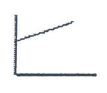
3. The number of wall impacts per second versus the square root of Kelvin temperature for 1 mol of an ideal gas at constant volume. Which graph represents the plot? (A) (B) (C) (D) (E) none of these
4. Which statement about kinetic energy (K.E.) is true? (A) all objects moving with the same velocity have the same KE (B) as the velocity of a body increases, its K.E. decreases (C) the K.E. of a body will double if its velocity doubles (D) the K.E. of a body is independent of its mass (E) none of these statements is true
5. Aqueous solutions of lead nitrate and potassium chloride are mixed and a precipitate forms. Which pair of ions are spectator ions? (A) (B) (C) (D) (E) all of above
6. Balance the reaction below in acidic aqueous solution, using the oxidation number method. In the balanced equation, what is the coefficient of ? (A) 1 (B) 4 (C) 5 (D) 7 (E) 8
7. You have separate aqueous solutions of NaOH and Ca(OH)2 with the same concentrations. You wish to neutralize an aqueous solution of HCl. Which basic solution would require more volume to neutralize the acid? (A) the NaOH solution (B) the Ca(OH)2 solution (C) you need to know the concentrations of the basic solutions to answer this question (D) you need to know the volume and concentration of the HCl solution to answer this question (E) you need to know the concentrations of the acid and bases and the volume of the acid to answer this question
8. As water is heated, its pH decreases. This means that (A) the water is no longer neutral (B) (C) two of these are correct (D) none of these is correct
9. The acids HC2H3O2 and HF are both weak, but HF is a stronger acid than HC2H3O2. HCl is a strong acid. Order the following according to base strength. (A) (B) (C) (D) F¯ > (E) none of these
10. For which of the following reaction(s) is the enthalpy change for the reaction not equal to of the product?
I: 2H(g) → H2(g), II: H2(g) + O2(g) → H2O2(1), III: H2O(l) + O(g) → H2O2(1) (A) I only (B) II only (C) III only (D) I and III (E) II and III
11. For a particular process q = -10 kJ and w = 25 kJ. Which of the following statements is true? (A) heat flows from the surroundings to the system (B) the system does work on the surroundings (C) ΔΕ = −35 kJ (D) all of these are true (E) none of these is true
12. For a spontaneous endothermic process, which conditions must hold?
(1) = △G (2) > 0 (3) △S cannot be negative (4) △S is positive. (A) all (B) none (C) 1 and 3 only (D) 1, 2, and 4 only (E) 3 and 4 only
13. Choose the correct statement. (A) exothermic reactions are always spontaneous (B) free energy is independent of temperature (C) a reaction that exhibits a negative value of AS cannot be spontaneous (D) at constant pressure and temperature, a decrease in free energy ensures an increase in the entropy of the system (E) none of these
14. When the equation for the following reaction in basic solution is balanced, what is the sum of the coefficients?
(A) 11 (B) 31 (C) 14 (D) 9 (E) 18
15. From the following list of observations, choose the one that most clearly supports the conclusion that electrons have wave properties. (A) the emission spectrum of hydrogen (B) the photoelectric effect (C) the scattering of alpha particles by metal foil (D) diffraction (E) cathode "rays"
16. Which of the following statements is true? (A) we can determine the exact location of an electron if we know its energy (B) an electron in a 2s orbital can have the same n, l, and m₁ quantum numbers as an electron in a 3s orbital (C) Ni has 2 unpaired electrons in its 3d orbitals (D) in the building up of atoms, electrons occupy the 4f orbitals before the 6s orbitals (E) only three quantum numbers are needed to uniquely describe an electron
17. Which of the following combinations of quantum numbers do not represent permissible solutions of the Schrodinger equation for the electron in the hydrogen atom? (In other words, which combination of quantum numbers is not allowed?) (Combinations are listed as follows: n, l, m(1), M(s).) (A) 9, 8, 4, 1/2 (B)8, 2, 2, 1/2 (C) 6, -5, -1, 1/2 (D) 6, 5, −5, 1/2 (E) all are allowed
18. For which element are the d orbitals completely filled in the neutral atom? (A) potassium (B) vanadium (C) phosphorus (D) iron (E) bromine
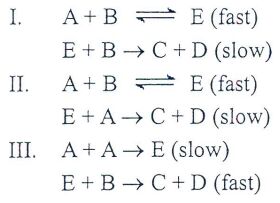
19. The rate law for a reaction is found to be Rate = k〔A〕2〔B〕. Which of the following mechanisms gives this rate law?
(A) I only (B) II only (C) III (D) two of these (E) none of these
20. Rank the following compounds according to increasing solubility in water.
I: CH3-CH2-CH2-CH3, II: CH3-CH2-O-CH2-CH3, III: CH3-CH2-OH, IV: CH3-OH (A) I < III < IV < II (B) I < II < IV < III (C) III < IV < II < I (D) I < II < III < IV (E) none is correct
21. Solid KF has a lattice energy of -804 kJ/mol and a heat of solution (in water) of -15 kJ/mol. RbF has a lattice energy of -768 kJ/mol and a heat of solution (in water) of -24 kJ/mol. Which salt forms stronger attractions with water? (A) KF, because it has a more exothermic lattice energy (B) RbF, because it has a less exothermic lattice energy (C) KF, because it has a more negative heat of hydration (D) RbF, because it has a more negative heat of hydration (E) they form equally strong attractions with water, because they both have negative heats of mixing
22. Liquid A has vapor pressure x. Liquid B has vapor pressure y, and x > y. What is the mole fraction of A in the liquid mixture if the vapor above the solution is 30% A? (A) 0.3y/(0.7x + 0.3y) (B) 0.7y/(0.3x + 0.7y) (C) 0.3x/(0.3x + 0.7y) (D) 0.7x/(0.7x + 0.3y) (E) none of these
23. When a nonvolatile solute is added to a volatile solvent, the solution vapor pressure , the boiling point _, the freezing point _, and the osmotic pressure across a semipermeable membrane . (A) decreases, increases, decreases, decreases (B) increases, increases, decreases, increases (C) increases, decreases, increases, decreases (D) decreases, decreases, increases, decreases (E) decreases, increases, decreases, increases
24. The destruction of a colloid is called (A) degeneration (B) coagulation (C) denaturation (D) reconfiguration (E) none of these
25. How many of the following molecules have all of their atoms in the same plane?
H2C=CH2, F2O, H2CO, NH3, CO2, BeCl2, H2O2 (A) 3 (B) 4 (C) 5 (D) 6 (E) 7
26. What is the shape of the ICl5 molecule? (A) square pyramid (B) trigonal bipyramid (C) octahedral (D) see-saw (E) none of these
27. Draw the Lewis structures of the molecules below, and use them to answer the following questions. How many of the molecules have no dipole moment?
I: BH3, II: NO2, III: SF6, IV: O3, V: PC15 (A) 1 (B) 2 (C) 3 (D) 4 (E) they are all polar
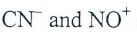
28. Which of the following statements about the species N2, CO, is false? (A) all are isoelectronic (B) each contains a triple bond (C) all are linear. (D) the bond in each species is polar (E) all incorrect
29. The Cl-Kr-Cl bond angle in KrCl4 is closest to (A) 90° (B) 109° (C) 120° (D) 150° (E) 360°
30. In the molecular-orbital description of CO, (A) the highest energy electrons occupy antibonding orbitals (B) six molecular orbitals contain electrons (C) there are two unpaired electrons (D) the bond order is 3 (E) all of these are false
31. Which of the following is diamagnetic? (A) (B) (C) B2 (D) F2 (E) ВО
32. Which of the following statements is true? (A) electrons are never found in an antibonding MO (B) all antibonding MOs are higher in energy than the atomic orbitals of which they are composed (C) antibonding MOs have electron density mainly outside the space between the two nuclei (D) none of these statements is true (E) two of these statements are true
33. Based on intermolecular forces, which of the following will have the highest boiling point? (A) PF5 (B) SF4 (C) AsF5 (D) more information is needed to answer the question (E) all are liquids
34. The triple point of CO2 is at 5.2 atm and -57°C. Under atmospheric conditions present in a typical Boulder, Colorado, laboratory (P = 630 torr, T = 23° C), solid CO2 will (A) remain solid (B) boil (C) melt (D) sublime (E) none of these
35. A crystal of NaCl is (A) soft, low-melting, and a good electrical conductor (B) hard, high-melting, and a good electrical conductor (C) soft, low-melting, and a poor electrical conductor (D) hard, high-melting, and a poor electrical conductor (E) soft, high-melting, and a poor electrical conductor
36. The unit cell in a certain lattice consists of a cube formed by an anion at each corner, an anion in the center, and a cation at the center of each face. The unit cell contains a net (A) 5 anions and 6 cations (B) 5 anions and 3 cations (C) 2 anions and 3 cations (D) 3 anions and 4 cations (E) 2 anions and 2 cations
37. How many unpaired electrons are there in ? (A) 4 (B) 3 (C) 2 (D) 1 (E) 0
38. Which of the following statements is true of the crystal field model? (A) the interaction between metal ion and ligand is treated as a Lewis acid-base interaction (B) the ligands are treated as negative point charges (C) the metal ion-ligand bonds are considered completely ionic (D) the electrons are assumed to be localized (E) none of these statements is true
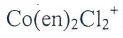
39. Which of the following statements about the complex ion is true? (A) the complex ion contains Co(I) (B) The complex ion exhibits cis and trans geometric isomers, but no optical isomers (C) the complex ion exhibits two geometric isomers (cis and trans) and two optical isomers (D) because en is a strong field ligand, the complex ion is paramagnetic (E) the geometric isomers of the complex ion have identical chemical properties
40. Which of the following is not a structural isomer of 1-pentene? (A) 2-pentene (B) 2-methyl-2-butene (C) cyclopentane (D) 3-methyl-1-butene (E) 1-methyl- cyclobutene
41. Consider the molecule trans-2-butene. Which statement is true? (A) the molecule has two π bonds (B) there is free rotation around every bond in the molecule (C) cis-2-butene is its structural isomer (D) carbon #2 exhibits sp² hybridization (E) none of these
42. Aspirin is formed via a(n) _ reaction. (A) combustion (B) hydrogenation (C) addition (D) condensation (E) substitution
43. The alpha helix of a protein is held in a coiled conformation partly because of (A) hydrogen bonding (B) optical activity (C) active sites (D) double bonding (E) none
44. The isotactic, syndiotactic, and atactic forms of polypropylene differ in (A) the functional groups they contain around the carbon backbone (B) the terminating functional groups they contain (C) the positions of the methyl groups around the carbon backbone (D) the number of methyl groups around the carbon backbone (E) both C and D
45. Choose the correct molecular structure for XeF6. (A) trigonal bipyramidal (B) trigonal planar (C) tetrahedral (D) octahedral (E) none of these
46. Phosphorus is found in nature as (A) white phosphorus (B) red phosphorus (C) black phosphorus (D) usually as the ion in phosphate rock (E) in gypsum
47. Compounds containing bismuth in the +5 oxidation state tend to be _ and compounds containing bismuth in the +3 oxidation state tend to be _ (A) ionic, ionic (B) ionic, molecular (C) molecular, molecular (D) molecular, ionic (E) none of these
48. Which of the following elements exhibit(s) the oxidation states +1 and +3? (A) B (B) Al (C) Ga (D) T1 (E) none of these
49. Choose the metal that reacts least vigorously with water. (A) Mg (B) Ca (C) Sr (D) Ba (E) all of these react equally vigorously with water
50. How many of the following statements are false?
I: the Group 3A elements are all metals, II: alkaline earth metals react less vigorously with water than do alkali metals, III: salts can consist of hydrogen, IV: because Li is the strongest reducing agent among the alkali metals, it reacts most quickly with water of the alkali metals (A) 0 (B) 1 (C) 2 (D) 3 (E) 4
 阿摩線上測驗
登入
 (B)
 (C)
 (D)
 (E) none of these
 (B)
 (C)
 (D)
 (E) all of above
 ?
 (A) 1 (B) 4 (C) 5 (D) 7 (E) 8
 (C) two of these are correct (D) none of these is correct
 (B)
 (C)
 (D) F¯ >
 (E) none of these
 of the product?
 = △G (2)
 > 0 (3) △S cannot be negative (4) △S is positive. (A) all (B) none (C) 1 and 3 only (D) 1, 2, and 4 only (E) 3 and 4 only
 (A) 11 (B) 31 (C) 14 (D) 9 (E) 18
 (A) I only (B) II only (C) III (D) two of these (E) none of these
 is false? (A) all are isoelectronic (B) each contains a triple bond (C) all are linear. (D) the bond in each species is polar (E) all incorrect
 (B)
 (C) B2 (D) F2 (E) ВО
 ? (A) 4 (B) 3 (C) 2 (D) 1 (E) 0
 is true? (A) the complex ion contains Co(I) (B) The complex ion exhibits cis and trans geometric isomers, but no optical isomers (C) the complex ion exhibits two geometric isomers (cis and trans) and two optical isomers (D) because en is a strong field ligand, the complex ion is paramagnetic (E) the geometric isomers of the complex ion have identical chemical properties
 ion in phosphate rock (E) in gypsum