所屬科目:駕照◆機車法規(英文)
651.On roads with frequent urban traffic, (A) after sounding the horn with two longblasts, overtaking is allowed; (B) after sounding the horn with two short blasts,overtaking is allowed; (C) sounding the horn or overtaking is not allowed.
652.While driving, upon seeing a railroad crossing sign or marking, the drivershould immediately reduce speed to (A) below 15 km/h; (B) below 20 km/h; (C)below 30 km/h.
653. For a yellow “No Parking” line, the prohibited parking time period is: (A) From7:00 a.m. to 8:00 p.m. daily (B) From 7:00 p.m. to 8:00 a.m. (C) 24 hours aday. If there is any need to extend or shorten the restriction period, it must beclearly indicated with road markings, signs, or additional plates.
654.In no parking zones, (A) temporary stopping is prohibited, but parking isallowed; (B) parking is prohibited, but temporary stopping is allowed; (C)neither parking nor temporary stopping is allowed.
655.In no temporary stopping zones, (A) temporary stopping is prohibited, butparking is allowed; (B) parking is prohibited, but temporary stopping isallowed; (C) neither temporary stopping nor parking is allowed.
656. A lane designated exclusively for (A) pedestrians (B) vehicles (C) bothpedestrians and vehicles to travel.
657. When changing lanes, you should: (A) yield to vehicles going straight first (B)yield to turning vehicles first (C) no need to yield.
658. Traffic signals regulate: (A) warning and movement (B) prohibition andmovement (C) instructions such as caution, movement, and stop.
659.Except when driving on a one-way street or designated to drive in the leftlane, on roads without lane dividing lines or lane restriction lines, you should:(A) keep to the right (B) keep to the left (C) drive in the middle of the road.
660.On roads without lane markings, at railroad crossings, or when passing onpoor road conditions, you should: (A) accelerate and proceed quickly (B) slowdown and proceed cautiously (C) proceed as usual.
661.When two vehicles meet on a steep and narrow slope, you should: (A) The vehicle going down hill yields to the vehicle going up hill first (B) The vehicle going up hill yields to the vehicle going down hill first (C) No need to yield.
662.At road sections marked with curve, slope, narrow bridge, tunnel signs, or atrailway level crossings: (A) U-turns are allowed (B) Reduce speed to about 5km/h before making a U-turn (C) U-turns are prohibited.
663. Within how many meters of an intersection or a bus stop is temporary parkingprohibited: (A) 10 meters (B) 20 meters (C) 30 meters.
664.When passing road sections marked with school or hospital signs, you should:(A) Slow down and be prepared to stop at any time (B) Honk frequently to alertpedestrians (C) Speed up to avoid congestion of people and vehicles.
665.When driving on road sections marked with curve, slope, or narrow roadsigns, you should: (A) Speed up to avoid vehicle congestion (B) Honk to urgethe vehicle ahead to speed up if it is driving too slowly (C) All should slowdown and be prepared to stop at any time.
666.When approaching places such as schools or hospitals: (A) Honk the hornfrequently to alert students or patients (B) Except in emergency or dangeroussituations, do not honk the horn (C) Only honk the horn once briefly.
667. Drivers who have any of the following situations shall be required to attend aroad traffic safety lecture: (A) Crossing a railway level crossing illegally (B)Temporarily parking within 10 meters of an intersection (C) Failing to maintaina safe distance when changing lanes.
668.If a driver violates road traffic safety regulations and causes an accidentresulting in death: (A) Suspension of the vehicle registration (B) Suspension ofthe driver's license (C) Revocation of the driver's license.
669.When two or more motorcycles race or compete on the road, in addition to afine of NTD 30,000 to 90,000 and immediate prohibition from driving on site,the authorities shall also: (A) Suspend the driver's license (B) Revoke thevehicle registration (C) Revoke the driver's license.
670.If a driver fails to yield or slow down as required for a child-specific vehicle orschool bus and is fined on the spot, in addition to demerit points, the drivershall also be subject to: (A) A fine (B) Revocation of the driver's license (C)Suspension of the driver's license.
671.Prolonged continuous use of the brakes can cause the brake pads tooverheat, resulting in the braking effect being (A) enhanced (B) weakened (C)unchanged.
672. When starting a motorcycle engine, you must first (A) turn on the headlight (B)turn on the hazard warning lights (C) hold the brake lever.
673.The principle of driving safety guidance is: (A) the slower the speed, the safer(B) maintain a safe distance from the vehicle in front and beside (C) closelyfollow the vehicle ahead to reduce errors.
674.The safe distance to be maintained between a motorcycle and adjacentvehicles while driving is (A) more than 0.5 meters (B) more than 1 meter (C) adistance that allows overtaking at any time.
675.When a motorcycle passes beside a parked car on the roadside, the safedistance to be maintained is (A) a distance that allows stopping at any time (B)more than 1 meter (about the width of one car door) (C) more than 0.5 meters.
676.A proper riding posture is one of the guarantees for riding safety. The eyesshould (A) keep looking straight ahead (B) occasionally check thespeedometer to avoid speeding (C) pay attention to the surroundings.
677.A proper riding posture is one of the guarantees for riding safety. The soles ofthe feet should (A) hang naturally downward (B) rest flat on the footrests (C)one foot hanging naturally downward, the other foot resting flat on thefootrest.
678. The higher the driving speed, the driver\'s reaction distance is (A) longer (B)shorter (C) unchanged.
679. The minimum safe following distance must be (A) greater than (B) less than(C) equal to the stopping distance.
680. An appropriate following distance can prevent accidents because (A) there isfriction (B) there is traction (C) there is sufficient reaction time and space.
681.When passing through an uncontrolled intersection without traffic signals, thesafer practice is: (A) look right first, then left, then right again (B) look left first,then right, then left again (C) it does not matter which side you look first.
682. During emergency braking, wheels are prone to locking, causing the brakingdistance to (A) increase (B) decrease (C) remain unchanged.
683.Which of the following is NOT a correct braking method for motorcycles? (A)Use both front and rear brakes simultaneously (B) Keep the throttle openwhile braking (C) Gradually increase braking force according to brakecharacteristics until maximum.
684.Which of the following behaviors is detrimental to driving safety? (A) Using lowbeam headlights when driving in urban areas at night (B) Accelerating throughcurves to maintain vehicle balance (C) Controlling the throttle at low speeds tomaintain balance.
685.Overtaking on a motorcycle is very dangerous. Which of the following is anincorrect behavior? (A) Confirm that overtaking is allowed on the road section(B) Lightly honk to warn the vehicle ahead and signal left turn indicator to warnvehicles behind (C) Overtake the motorcycle ahead on its right side at anappropriate speed.
686.Which of the following is NOT a correct behavior when riding a motorcycle?\(A) Yield to vehicles outside the roundabout when passing through it\ (B) Mostgas station exits have no traffic signals; drivers should slow down and payattention to vehicle movements\ (C) When riding in alleys, reduce speed anduse mirrors to check for oncoming vehicles
687.When riding a motorcycle and encountering strong wind blowing from the leftside, you should\ (A) Accelerate to pass through\ (B) Lean the motorcyclebody to the left\ (C) Hold the handlebars firmly with both hands
688.When riding a motorcycle and a mosquito or insect flies into your eye, themost appropriate first reaction is\ (A) Immediately brake in the current lane\ (B)Slow down and safely pull over to the roadside\ (C) Turn on the headlights
689.When riding a motorcycle and encountering a manhole cover ahead, youshould\ (A) Ride into the opposite lane\ (B) Hold the handlebars firmly whilepassing over\ (C) Accelerate to pass over
690.When riding a motorcycle over rough road sections, you should\ (A) Hold thehandlebars firmly to prevent vehicle deviation\ (B) Slow down and be preparedto stop at any time\ (C) All of the above
691.When riding a motorcycle through a construction zone and seeing steel plateslaid on the ground, you should (A) slow down and pass (B) speed up and pass(C) temporarily swerve.
692.When riding a motorcycle and seeing a detached tire tread ahead, which ofthe following is an incorrect response? (A) Pass quickly (B) Hold themotorcycle handlebars tightly (C) Slow down and proceed cautiously.
693.When riding a motorcycle on a general road, except when overtaking avehicle in the same lane, what distance should be maintained between thefollowing motorcycle and the vehicle ahead? (A) Able to stop at any time (B)One vehicle length (C) Two vehicle lengths.
694.When riding a motorcycle past roadside vendors, signs, large obstacles, orparked cars, you should (A) slow down and proceed cautiously (B) maintain aproper distance (C) all of the above.
695.When riding a motorcycle on mountain roads and noticing falling rocks on thecliff, you should (A) stop moving forward or take a detour (B) sincemotorcycles are small and highly maneuverable, you can swerve to avoid andcontinue (C) if wearing a full-face helmet, you can continue forward.
696.When driving at high speed, the driver\'s physiological response to emergencysituations is (A) slower than usual, with reduced ability to respond (B) thesame as under normal conditions (C) enhanced ability to respond compared tonormal conditions.
697.On a deserted suburban road late at night with no other vehicles, riding amotorcycle (A) you may speed (B) you should still follow the speed limit (C)you may slightly exceed the speed limit within safe limits, but should not gotoo fast.
698.When riding a manual transmission motorcycle and pulling the clutch lever:(A) the vehicle will coast due to inertia (B) the wheels will spin freely (C) both ofthe above.
699.
(A) Right turn (B) Left turn (C) Continuous curves, first turn right.
700.
(A) Left turn (B) Right turn (C) Continuous curves, first turn left.
 阿摩線上測驗
登入
阿摩線上測驗
登入
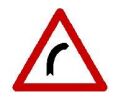 (A) Right turn (B) Left turn (C) Continuous curves, first turn right.
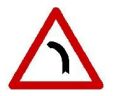 (A) Left turn (B) Right turn (C) Continuous curves, first turn left.