阿摩線上測驗
登入
首頁
>
電磁學與電磁波
>
113年 - 113 專技高考_電子工程技師:電磁學與電磁波#123977
> 申論題
題組內容
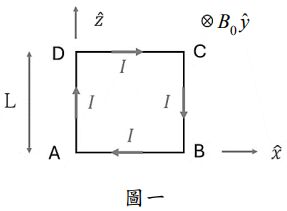
三、本題考慮在均勻磁場中的電流導線與電流迴路所受的磁力與磁力矩問題。
(三)繼續子題(二),請計算上、下兩段導線(
)所受的磁力,再計算這四段導線所受磁力的合力與合力矩。(14 分)
〔提示〕:力矩
的公式
相關申論題
四、考慮純量場 G=∇• (Φ ) ,其中Φ是任意可微分之純量場,且∇2Φ=0(稱Φ為調和函數);又是靜電場,滿足 ∇✖=0 。假設某一區域 V 是邊長為 a 的立方體,該立方體的邊界外表面為 S,且假設邊界S上電位φ為零,請計算純量場 G 在區域 V 的體積分值Gdv。(25 分)〔說明〕:必須利用以下散度定理和電磁學基本定律等進行推導與計算,否則不予計分。・散度定理:・電場與電位的關係: = -∇φ・靜電場滿足高斯定律: ∇ • = =0 (設區域 V 內無電荷)・向量恆等式:
#527033
一、圖一放大器 VCC = +5.5 V,電晶體β = 24,ro → ∞,電晶體熱電壓(thermal voltage)VT = 24 mV,Rs = 2 kΩ,RB = 25 kΩ,RC = 1.2 kΩ,RE = 1 kΩ,RL = 6 kΩ。求算偏壓電流 ICQ 以及小訊號電壓增益 Av = vo/vs。(20 分)
#527034
二、積體電路(IC)放大器含三級放大器如圖二,圓圈內數字為接腳編號。電壓增益 A1 = –10 V/V,A2 = –999 V/V,A3 = +1 V/V,Rin = 1 MΩ,Zo1 = Ro1//Co1,Zo2 = Ro2//Co2,Ri2 = 4Ro1 = 100 kΩ,Ri3 = 4Ro2 = 10 kΩ,Ro3 = RL= 1kΩ,Co1= 5Co2= 5 pF。以最小值之外接電容 C,設計Av = vo/vin 頻率響應之高頻 3dB 極點落於 ωp = 105rad/sec。求算低頻之電壓增益 Av = vo/vin。電容 C 應接於何處?說明其理由,並求算該電容之值。(20 分)
#527035
三、圖三(a) MOSFET kn' = 2.5kp' = 250 μA/V2,Vtn = –Vtp = 0.5 V,各晶體之(W/L)值以及 NMOS 電流 iD 公式如圖三(b)。VDD = VSS = 2.5 V,vS 為小訊號輸入。當 vS = 0,求算 iD1、iD5,與 Q5、Q6 閘極之電位差 VGG = VG5 – VG6。當 vS> 0且 iL = 9 mA,此電流全由 Q5供應,所對應 vO 之上限值為何?(20 分)
#527036
四、運算放大器(OPAmp)之輸出電阻 Ro= 0,開路增益 A,輸入電阻 Ri,並以此 OPAmp 設計回授放大器如圖四(a),其閉迴路增益 Av 與輸入電阻Zs(不含 R1)之定義如圖四(b)。此放大器之回授為正或負?推導圖四(b)中 Ax 與 Rx 之數學式,兩者均為A 與 Ri 的函數。(20 分)
#527037
五、圖五(a)與圖五(b)之數位輸入分別為 A 、 B 與 X 、 Y,兩電路之輸出Q 與。請建立 A、B 與 Q 關係之真值表。請建立 X、Y 與 Q 關係之真值表。兩電路的操作功能類似 SR 閂鎖(SR latch),S = set(設定),R = reset(重置)。選定圖五(a)、(b)兩電路的輸出 Q 與 SR latch 的輸出 Q 完全相同,則 A、B、X、Y 各與 S、R 的關係為何?(20 分)
#527038
(2) 記述編目(15 分)
#527039
(2) 記述編目(15 分)
#527040
(2) 記述編目(15 分)
#527041
一、英文寫作(50%)Some of you are not sure if you are cut out to be a translator and/or an interpreter. This uncertainty grows into self-doubt as you receive rigorous and intense T/I training at the graduate level. You put a lot of time and effort into practice, but your classmates seem to always outperform you. You think to yourself: If I can't even stand out from my peers, how can I compete with seasoned T/I veterans? The nagging worry is exacerbated by the possibility of AI phasing out human translators/interpreters. The undercurrent of fear and frustration compromises the energy that otherwise could be devoted to your daily practice.A way out of this mental trap is to approach the idea of a translator/interpreter, or any profession, from a verb-oriented perspective. This is what career coach Jean-Philippe Michel does when helping his young clients prepare for the future, according to a BBC article titled "The next generation of jobs won't be made up of professions" by Alina Dizik. Rather than encourage students to choose a profession they want to grow up into, such as teacher or engineer, Jean-Philippe Michel guides students to talk about the skills they want to acquire and the goals they want to achieve. For example, "I want to be a doctor" can be rephrased as "I want to use empathy in a medical setting." This is how a noun-based profession is reconceptualized from a verb-based perspective.Purpose Learning program initiated by Stanford University is another example of using a verb-based approach to helping students redesign their learning experience, as can be seen from their mission statement:"A look back from 2100 to the era when Stanford students began declaring missions, not majors."As Stanford graduates would soon be called upon to lead in a world in which economic, political, social and technological disruptions created some of the largest collective risks that humans had yet faced, the University established Purpose Learning, whereby students declared a mission, not a major. The intent was that students couple their disciplinary pursuit with the purpose that fueled it."I'm a biology major" was replaced by "I'm learning human biology to eliminate world hunger." Or "I'm learning Computer Science and Political Science to rebuild how citizens engage with their governments."The goal was to help students select a meaningful course of study while in school, and then scaffold a clear arc for the first 10 - 15 years of their professional lives. It wasn't about the career trajectory, but the reasons behind it.One sign that the shift toward connecting meaning or "the why" behind one's studies and actions came when the phrase "what's your verb?" started to creep into the Stanford lexicon. A cross between "how are you doing today," "what classes are you taking this quarter" and "why?", this new idiom spun off into a variety of media.Inspired by the work they were doing to investigate the kind of impact they were most interested in working toward, students started wearing Stanford t-shirts that just said, "To Ignite." "To Build." "To Challenge." "To Persuade." Soon, this unofficial tagline became the organizing principle for the new portfolios students had to create to graduate. Demonstrating evidence of clarity of purpose and experience creating impact, along with mastery of subject matter was key.http://www.stanford2025.com/purpose-learningPlease redefine the profession of a translator/interpreter from a verb-based perspective and write a five-paragraph essay of around 300 words with "your verb" as the thesis statement.●Paragraph 1: Introduction. Begin this paragraph by summarizing the mission statement of Stanford University Purpose Learning program with four to six sentences before presenting your thesis statement.●Paragraph 2: Describe how this verb encapsulates who you are as a person.●Paragraph 3: Describe how this verb encapsulates your mission/purpose in life.●Paragraph 4: Describe how T/I training might help you to be that verb.●Paragraph 5: Conclusion. End your essay with a verb-oriented take on being a translator/interpreter.
#527042
相關試卷
114年 - 114 專技高考_電子工程技師:電磁學與電磁波#133706
114年 · #133706
113年 - 113 專技高考_電子工程技師:電磁學與電磁波#123977
113年 · #123977
112年 - 112 專技高考_電子工程技師:電磁學與電磁波#117670
112年 · #117670
111年 - 111 專技高考_電子工程技師:電磁學與電磁波#111953
111年 · #111953
110年 - 110 專技高考_電子工程技師:電磁學與電磁波#104065
110年 · #104065
109年 - 109 專技高考_電子工程技師:電磁學與電磁波#93139
109年 · #93139
108年 - 108 專技高考_電子工程技師:電磁學與電磁波#80692
108年 · #80692
107年 - 107 專技高考_電子工程技師:電磁學與電磁波#73009
107年 · #73009
106年 - 106 專技高考_電子工程技師:電磁學與電磁波#66514
106年 · #66514
104年 - 104 專技高考_電子工程技師:電磁學與電磁波#41840
104年 · #41840