阿摩線上測驗
登入
首頁
>
研究所、轉學考(插大)◆生物統計學
>
110年 - 110 國立高雄科技大學_碩士班招生考試_漁業生產與管理系:生物統計學#104356
> 申論題
題組內容
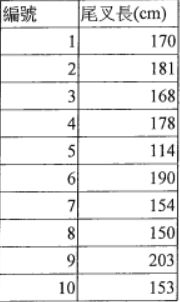
二、下表為南方澳漁港隨機量测之灰鯖尾叉長(Forklength)。
(2)試依此量測責料繪製盒形圖(Boxplot).並末出最大值、最小值、中位數、第一個四分位數問距.
相關申論題
三、某養殖場養了一批新品種的午仔魚,該養殖場主人隨機抓取20尾新品種的午仔魚,測得平均體重為1.5Kg,標準差為0.5Kg·已知現有品種的午仔魚平均重量為1.2Kg,請問新品的午仔鱼在Q=0.05的顯著水準下,是否平均重量大於现有的品種?
#441785
四、某教授懷疑學生家庭作業互相抄製·因此家庭作業成績的標準差很小·根據以往的經驗, 標準差約為10分・作業成绩呈常態分配。上個星期該班共有30位學生缴交作業,作業成績的標準差為6分,試問在顯著水準為5%時,這位教授的懷疑是否獲得證實?
#441786
五、:某學生想要探討溪魚數量與所棲息的溪岸深度的關係,得列以下資料(一)計算深度與數量最佳直線退歸方程式(二)當深度為1.8m時,溪魚數量約有多少?
#441787
1. The ability to engineer biological systems and organisms holds enormous potential for applications across basic science, medicine and biotechnology. Programmable sequence-specific endonucleases that facilitate precise editing of endogenous genomic loci are now enabling systematic interrogation of genetic elements and causal genetic variations in a broad range of species, including those that have not previously been genetically tractable. A number of genome editing technologies have emerged in recent years, including zinc-finger nucleases (ZFNs), transcription activator-like effector nucleases (TALENs) and the RNA-guided CRISPR-Cas nuclease system. The first two technologies use a strategy of tethering endonuclease catalytic domains to modular DNA-binding proteins for inducing targeted DNA double-stranded breaks (DSBs) at specific genomic loci. By contrast, Cas9 is a nuclease guided by small RNAs through Watson-Crick base pairing with target DN'A, representing a system that is markedly casier to design, highly specific, eficient and well-suited for high-throughput and multiplexed gene editing for a variety of cell types and organisms (8 分).
#441788
2.Zika virus (ZIKV) is a mosquito-borne flavivirus (FLAV) that emerged in Brazil in 2015 and has rapidly spread to more than SO countries worldwide. However, early, accurate, and specific point-of- care (POC) diagnosis of ZIKV is very difficult because most infected patients are asymptomatic or display nonspecific symptoms similar to those of other viral infections, and most of the analysis also requires instruments. Herein, an instrument-free ZIKV POC test using a drop of blood comprising a vial immunosensor, artificial nanozyme platinum/gold core-shell nanoparticles (Pt@Au NPs) as a signal probe, and a smartphone was developed to specifically detect ZIKV without cross-reaction with other FLAVs. A high sensitivity of 1 pg/mL ZIKV, desirable specificity, data storage, and geographic location surveillance were simultaneously achieved for the proposed POC test. Our POC test suitably met the urgent needs of ports of entry, airports, and endemic regions with stressed resources, as well as strict clinical requirements for ZIKV detection (8 分).
#441789
3.One is the rapid emergence of virtual care through digital tools such as telehealth and remote monitoring that have made it safer and more convenient for patients to connect with their doctors during the pandemic, and that is empowering individuals to take charge of their health in entirely new ways. Virtual care has the capacity to personalize, accelerate, and augment treatment and prevention, saving time and money while improving outcomes. The ability to engage patients without requiring an in- person visit to a clinic will help ensure that they receive the right level of care and enable healthcare facilities to better manage the flow of patients into clinics and emergency rooms (9 分).
#441790
一、英翻中 1. Fish are cold-blooded animals, typically with backbones, gills, and fins, and are primarily dependent on water as a medium in which to live. Fishes are also the most numerous of the vertebrates. Best estimates are from 15,000 to 17,000 recent species. At present, more than 70 percent of the earth's surface is covered with water. For the fish, the most important aspects of water are dissolved oxygen, light penctration, temperature, toxic substances, concentrations of disease organisms, and opportunity to escape enemies. Most species of fish have relatively small home ranges to which they restrict most of their movements. However, some fishes are great travelers and seem to be continually on the move. Very mobile are pelagic fishes and others which often travel great distances between fresh and marine waters. Generally, a migration is a more or less continuous and direct movement from one location to another. Such movement is under the control of the fish, genetically determined, and is influenced by environmental factors. Migrations are mostly for spawning or feeding and are generally time oriented, although sometimes they take place when fishes actively flee adverse conditions.
#441791
2. In the coastal waters of Taivan, the northwand fow of the Kinoshio Curent (KC provides a continuous, year-round addition to the abundant fish resources of Taiwan, influencing the year-round oceanic regime. During the winter north-casterly monsoon period (September to April), the China Coastal Current (CCC) brings cold water from the Yellow Sea and the East China Sea into the Taiwan Strait (TS). Water circulation in the TS varies seasonally due to changes in wind direction. Furthermore, the CCC and KC are tied closely to sea surface temperature (SST) variations in the coastal waters of Taiwan. In recent years, the rate of SST increase in Taiwan waters has accelerated, and the variability has increased. The increase in SST has been accompanied by a shift in ocean currents. The mechanisms behind these changes are the decline of the CCC and the enhancement of the KC. The ocean environment changes contribute to modifications in the productivity, distribution and phenology of marine species, affecting ecosystem processes and altering food webs. (30分)
#441792
3. Fishery management aims to protect and conserve fishery resources and ecosystems, and to provide a rationale for their sustainable utilization. Current fishery management tools and measures include information gathering (for example, catch production and environmental data (including salinity, ocean currents, etc.)), input controls (for example, total allowable effort and individual effort restrictions and vessel and gear restrictions, etc.), output controls (for example, total allowable catch (TAC), etc.), technical measures (e.g., marine protected area (MPAs), marine spatial planning (MSP), and size and sex selectivity restrictions), and monitoring and enforcement (vessel monitoring systems (VMSs) and voyage date recorders(VDRs)). This management tools can be expected to meet the objectives of sustainable fishery management and to respond to the challenges posed by global change. All countries around the world have specific institutions for exercising such management authority within their exclusive economic zones, and many are part of regional and international fisheries bodies and management organizations to manage shared stocks and fisheries in areas beyond national jurisdictions.
#441793
I. Paraphrase : Read the following passage and rephrase it in your own words(while keeping the original meaning) in 250 words.Social media companies have been under tremendous pressure to do something about the proliferation of misinformation on their platforms. Companies like Facebook and YouTube have responded by applying anti-fake-news strategies that seem as if they would be effective. As a public-relations move, this is smart: The companies demonstrate that they are willing to take action, and the policies sound reasonable to the public.But just because a strategy sounds reasonable doesn't mean it works. Although the platforms are making some progress in their fight against misinformation, recent research by us and other scholars suggests that many of their tactics may be ineffective - and can even make matters worse, leading to confusion, not clarity, about the truth. Social media companies need to empirically investigate whether the concems raised in these experiments are relevant to how their users are processing information on their platforms.One strategy that platforms have used is to provide more information about the news' source. YouTube has "information panels" that tell users when content was produced by government-funded organizations, and Facebook has a "context" option that provides background information for the sources of articles in its News Feed. This sort of tactic makes intuitive sense because well-established mainstream news sources, though far from perfect, have higher editing and reporting standards than, say, obscure websites that produce fabricated content with no author attribution. But recent research of ours raises questions about the effectiveness of this approach. We conducted a series of experiments with nearly 7,000 Americans and found that emphasizing sources had virtually no impact on whether people believed news headlines or considered sharing them. People in these experiments were shown a series of headlines that had circulated widely on social media - some of which came from mainstream outlets such as NPR and some from disreputable fringe outlets like the now-defunct newsbreakshere.com. Some participants were provided no information about the publishers, others were shown the domain of the publisher's website, and still others were shown a large banner with the publisher's logo. Perhaps surprisingly, providing theadditional information did not make people much less likely to believe misinformation.The obvious conclusion to draw from all this evidence is that social media platforms should rigorously test their ideas for combating fake news and not just rely on common sense or intuition about what will work. We realize that a more scientific and evidence-based approach takes time. But if these companies show that they are seriously committed to that research - being transparent about any evaluations that they conduct internally and collaborating more with outside independent rescarchers who will publish publicly accessible reports ㅡ the public, for its part, should be prepared to be patient and not demand instant results. Proper oversight of these companies requires not just a timelyresponse but also an effective one.SourceNew York Timeshttps://www.nytimes.com/2020/03/24/opinion/fake-news-social-media.htmlAdapted from an article by Dr. Pennycook and Dr. Rand on March 24, 2020.Authors: Gordon Pennycook is an assistant professor at the Hill and Levene Schools of Business at the University of Regina, in Saskatchewan. David Rand is a professor at the Sloam School of Management and in the deparment of brain and cognitive sciences at M.I.T.
#441794
相關試卷
110年 - 110 國立高雄科技大學_碩士班招生考試_漁業生產與管理系:生物統計學#104356
110年 · #104356
110年 - [非官方正解]110長庚大學_碩士班招生考試_臨床醫學研究所(臨床資訊組)︰生物統計學#101175
110年 · #101175
110年 - [非官方正解]110輔仁大學_碩士班招生考試_公共衛生學系︰生物統計學#100184
110年 · #100184
109年 - 109 輔仁大學_碩士班招生考試_公共衛生學系:生物統計學#105702
109年 · #105702
 阿摩線上測驗
登入
阿摩線上測驗
登入