阿摩線上測驗
登入
首頁
>
研究所、轉學考(插大)◆社會研究方法
>
110年 - 110 國立臺灣大學_碩士班招生考試_社會學研究所:社會研究方法(包括社會統計)#100275
> 申論題
題組內容
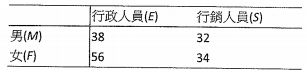
二、捷進公司有員工160人,按性別及工作性質來分類的資料如下:
1. 請用實際數據說明性別與工作性是否相關或無關?(5%)
相關申論題
2.該公司的行銷人員是男性的可能性是多少?(5%)
#419601
3.“該公司的行銷人員較可能由男性擔任,這樣的說法是否能成立?(5%)
#419602
三、有位社會學家調查了100位大學生,並問他(她)們對於新冠病毒肆虐後社會的未來發展所抱持的態度,其結果如下表,檢定抱持五種看法的人數是否無異?請寫出研究假設並執行完整的檢定過程(顯著水準a=0.05)(10%)
#419603
Article 1:A few weeks ago, I participated in a webinar with K-12 students, parents and teachers about howonline learning is going. The students, in particular, had some good things to say about theirvirtual experience: They liked that teachers were focusing more on everyone's mental health andwellbeing, and less on grades. They liked that the standardized tests for the year had beencancelled.The gift of a crisis is that it reveals to us what really matters. And this particular crisis has revealedwhat matters in education, and what doesn't. At a time when we are trying to do the best we canwith Iimited resources, the things that aren't critical have fallen away out of necessity. If the testwas really important, we'd be holding on to it.This pandemic may be unprecedented in its nature and scale. But the problems it has exposed arenot. Here are the things we have learned are actually the most important.First of all, children cannot learn without access to adequate food. For many students, school waspreviously their only source of breakfast and lunch, and school districts around the country set upfood pickups for families who need it during remote learning. Access to technology, we havelearned, is also critical. Millions of children don't have reliable access to the internet on acomputer or tablet that can be used for schoolwork. Without these basic needs met, learningcannot take place--and that was true before the pandemic.A focus on social and emotional wellbeing, previously considered a nice add-on to the school day,is now understood to be critical. When children are scared and gricving, when their lives are in astate of upheaval, it's very difficult for them to learn what a simile is, or how to add fractions. Andif the adults are not doing well socially and emotionally, the children cannot do well either.All of us can benefit from strengthening our skills to express what we are feeling and manage ouremotions in a healthy way. Effective social and emotional learning in the classroom, though,cannot occur in a vacuum. It has to apply an equity lens to ensure the wellbeing of allchildren--particularly Black, Latinx, Indigenous, low-income, and other historically marginalizedstudents, many of whom have suffered disproportionately during the pandemic.We learned that educating our children requires a collective effort. Parents, teachers, school anddistrict administrators, community members, and local politicians and business owners have hadto depend on each other and work together. When we allowed and forgave mistakes, participatedin collective brainstorming, and pooled our resources, we could work as a team to create a tapestryof support for them.As it turns out, many of the things that educators and community members have spent yearsadvocating for are not just "nice to have."' They are essential to the health and wellbeing of all ofus, especially our children. We learned that we cannot pay lip service to centering equity andanti-racism, because when a crisis hits, we are left with gaping holes that privilege some anddisadvantage others.Above all, 2020 has taught us the wisdom in the African proverb that it takes a village to raise achild, and in the Chinese proverb that a child's life is like a piece of paper on which every personleaves a mark. We've realized just how much we need cach other. That's what truly matters.(Condensed from an article by Kamilah Drummond-Forrester. EdSurge. Jan. 6, 2021)
#419604
Article 2:The COVID-19 pandemic has exacerbated food insecurity and disrupted food systems and foodsupply chains in developed and developing countries alike. In the United States, millions ofAmericans struggle to put food on the table. Around the world, according to the UnitedNations, over 270 million are hungry, and this is expected to continue to increase.As a brand new year begins, I can't help but think what must be done to mitigate these worryingtrend?First and foremost, there should be continued monitoring of the food insecurity statistics. Realtime data to know where food insecurity is highest, and interventions are needed the most shouldcontinue to be collected by agencies like United States Department of Agriculture Food andNutrition Service, Feeding America, United Nations World Food Program.Moreover, collecting real time data and using data intelligence to tackle food insecurity can beextended to cover the entire agricultural food chain-from production, distribution, processing,supply and consumption.As an example, Johns Hopkins Center for a Livable Future has real time mapping platform thatshows production, distribution, processing and consumption within Maryland's food system viaits Maryland Food System Map Project. Around the world, the United Nations World FoodProgram continues to track and monitor hunger and food insecurity through its realtimc HungerMap.In the end, this kind of real time collected data should be used to identify gaps. In addition,insights obtained should be used to inform decision makers in country govemments, nonprofitinstitutions, food banks and other people responsible for designing programs and policies toaddress food insecurity in 2021 and beyond. In the long-term, data obtained from real timemapping of food insccurity can be used to distribute food more equitably and reliably.Accompanying data and on the ground reality should be the continuation of actions that haveproven to be critical in 2020 in efTorts to address hunger. Throughout 2020, Feeding America andmany foodbanks and food pantries have stepped up to the challenge of feeding everyday people.It is important that they are restocked and the people working there enumerated well. Restockingfoodbanks can be achieved through govemnment funding and donations by businesses andindividuals who are in a position to do so.Among the strategies that proved important in 2020 were home and community gardens. Thesegardens flourished for the best part of the year across many states, with many people venturinginto planting their own gardens. In 2021 and beyond, citizens who want to garden come springshould be encouraged and supported with resources and knowiedge about how to successfullygrow the crops they choose to.Luckily, many states have Land-Grant Universities such as the University of Illinois at UrbanaChampaign and Purdue University that can assist through the Cooperative Extension Service. Assuch, Universities should find ways to unpack uscful and guiding knowledge in formats that cancasily be used by citizens as they look to start gardening.Consistently, throughout the pandemic, many citizens relied on local food solutions and their localfarmers and producers to meet their food needs. Moving on in 2021, everyday people shouldcontinue to think locally whenever possible.Of course, thinking locally when it comes to meeting food insecurity may not always be possible,cspecially with food deserts in many under-resourced areas and with usually higher prices atfarmers markets.Finally, there is room for more innovative solutions such as food dispensing ATM machines, foodfinding and food redistribution apps, and as such, we should continue to look for solutions fromfood security experts and everyday people that are facing food insecurity challengeand highlight those that are making an impact.Tackling food insecurity will continue to need all of us to step up. Every action, every strategycounts.(Condensed from an article by Esther Ngumbi. IPS. Jan. 13. 2021)
#419605
1.
#419606
2.
#419607
3.
#419608
4.
#419609
5.
#419610
相關試卷
110年 - 110 國立臺灣大學_碩士班招生考試_社會學研究所:社會研究方法(包括社會統計)#100275
110年 · #100275
 阿摩線上測驗
登入
阿摩線上測驗
登入