所屬科目:研究所、轉學考(插大)◆普通物理學
1. Assuming that you accelerate your car from $10\mathrm{m/s}$ to $25\mathrm{m/s}$ in a distance of $87.5\mathrm{m}$ with a constant acceleration, then the force your body exerts on the car seat (let your mass be $75\mathrm{kg}$) is(A)$550\mathrm{N}$(B)$1100\mathrm{N}$(C)$225\mathrm{N}$(D)$112.5\mathrm{N}$(E)$337.5\mathrm{N}$
2. The initial temperature and volume of an ideal gas are $127^{\circ}\mathrm{C}$ and $23.6\mathrm{L}$ respectively. After an adiabatic expansion, the final temperature and volume of the gas are $27^{\circ}\mathrm{C}$ and $56\mathrm{L}$ respectively. The constant-volume and constant-pressure heat capacities of this ideal gas are(A)$C_V = 1.5R, C_P = 2.5R$(B)$C_V = 2.0R, C_P = 3.0R$(C)$C_V = 2.5R, C_P = 3.5R$(D)$C_V = 3.0R, C_P = 4.0R$(E)$C_V = 3.5R, C_P = 4.5R$
3. The molecular bonding in a diatomic molecule such as the nitrogen $(\mathbf{N}_2)$ molecule can be modeled by the Lennard-Jones potential, which has the form $U(x) = 4U_0\left(\left(\frac{x_0}{x}\right)^{12} - \left(\frac{x_0}{x}\right)^6\right)$, where $x$ is the separation distance between the two nuclei and $x_0$, and $U_0$ are constants. The equilibrium separation $x_0$, which is the value of $x$ for which the two atoms experience zero force from each other, is equal to(A)$2^{-1/6}x_0$(B)$3^{1/6}x_0$(C)$3^{1/3}x_0$(D)$3^{-1/6}x_0$(E)$2^{1/6}x_0$
4. Let us suppose that $n$ mole of ideal gas has gone through a free expansion $(T_i = T_f)$ from an initial volume $V_i$ to the final volume $V_f$. The entropy change in such a process can be expressed as a function $\Delta S(n, V_i, V_f)$. One has $\Delta S(3, 200\mathrm{cm}^3, 600\mathrm{cm}^3)$ closest to
(A)4.50 R(B)1.65 R(C)2.25 R(D)3.30 R(E)6.60 R
5. A liquid of density $900\mathrm{kg/m^3}$ flows through a horizontal pipe that has a cross-sectional area of $1.90\times 10^{-2}\mathrm{m^2}$ in region A and a cross-sectional area of $9.50\times 10^{-2}\mathrm{m^2}$ in region B. The pressure difference between two regions is $7.20\times 10^3$ Pa. The volume flow rate $R_V$ of the liquid is(A)$0.776\mathrm{m^3/s}$(B)$0.0776\mathrm{m^3/s}$(C)$1.552\mathrm{m^3/s}$(D)$0.1552\mathrm{m^3/s}$(E)$0.3104\mathrm{m^3/s}$
6. The mass and radius of a spherical planet with a uniform density are M and R respectively. The planet constantly rotates with a period T. The free-fall acceleration $g_{p}$ at the pole of the planet (where the rotation axis passes through) and the free-fall acceleration $g_{e}$ at the equator of the planet are related to each other by(A)$g_{e} - g_{p} = \frac{4\pi^{2}R}{T^{2}}$(B)$g_{e} - g_{p} = \frac{2\pi^{2}R}{T^{2}}$(C)$g_{e} - g_{p} = -\frac{2\pi^{2}R}{T^{2}}$(D)$g_{e} - g_{p} = -\frac{4\pi^{2}R}{T^{2}}$(E)None of the above
7. One end of a $2.0\mathrm{m}$ long uniform meter stick is initially held at rest at $\theta = 40^{\circ}$ while the other end of the stick is on the floor. The meter stick is then released. Assuming the end on the floor does not slip, then the angular speed of the stick at the time when the stick is about to hit the floor is closest to
(A)3.1 rad/s(B)6.2 rad/s(C)4.5 rad/s(D)9.0 rad/s(E)13.5 rad/s
8. A rigid body rotates at 300 revolutions per minute around an axis which goes through the origin and points into the first octant, making an angle of $60^{\circ}$ with both the x- and y-axis. The velocity of a point $\vec{r} = (0,0,2)\mathrm{cm}$ is
(A)$\vec{v} = (0,0,600)\mathrm{cm/s}$(B)$\vec{v} = (0,19.7,14.8)\mathrm{cm/s}$(C)$\vec{v} = (-31.4,31.4,0)\mathrm{cm/s}$(D)$\vec{v} = (31.4,31.4,0)\mathrm{cm/s}$(E)$\vec{v} = (31.4,-31.4,0)\mathrm{cm/s}$
9. The speed of sound in oxygen, at $0^{\circ}\mathrm{C}$, is $317\mathrm{m/s}$. At the same temperature and pressure, the speed of sound in hydrogen, in $\mathrm{m/s}$, is closest to which one of the following?(A)79(B)159(C)634(D)317(E)1268
10. Suppose that a simple pendulum consists of a small $60.0\mathrm{g}$ at the end of a cord of negligible mass. If the angle $\theta$ between the cord and the vertical is given by $\theta = (0.080\mathrm{rad})\cos[(4.43\mathrm{rad/s})x + \phi]$, then the pendulum's length is(A)$314\mathrm{cm}$(B)$50\mathrm{cm}$(C)$100\mathrm{cm}$(D)$157\mathrm{cm}$(E)$628\mathrm{cm}$
11. The figure in the bottom of the page shows particles 1 and 2, each of mass m, attached to the ends of a rigid massless rod of length $L_{1} + L_{2}$, with $L_{1} = 20\mathrm{cm}$ and $L_{2} = 80\mathrm{cm}$. The rod is held horizontally on the fulcrum and then released. As a consequence, the magnitude of the initial acceleration of particle 2 is
(A)$\frac{6}{17}g$(B)$\frac{3}{17}g$(C)$\frac{12}{17}g$(D)$\frac{3}{34}g$(E)None of the above
12. The Maxwell speed distribution P(v) is a function such that P(v)dv gives the fraction of molecules with speeds in the interval dv at speed v. One has$P(v) = 4\pi \left(\frac{M}{2\pi RT}\right)^{3/2} v^2 e^{-Mv^2 / 2RT}$. The root-mean-square speed of the molecule is defined as $v_{rms}^2 \equiv \int v^2 P(v) dv$, while the average speed of the molecule is defined as $v_{avg} \equiv \int v P(v) dv$. Furthermore the most probable speed $v_p$ is the speed at which $P(v)$ is maximum. We have
(A)$v_{p} > v_{rms} > v_{avg}$(B)$v_{p} > v_{avg} > v_{rms}$(C)$v_{rms} > v_{p} > v_{avg}$(D)$v_{avg} > v_{rms} > v_{p}$(E)None of the above
13. A point charge -q with mass m is placed on the axis of a thin ring at a distance x from its center. The ring has radius R and uniformly distributed charge Q. If the point charge is allowed to move along the axis of the ring, what is its oscillating frequency due to electrostatic force? Assume R >> x.
(A)$\frac{1}{2\pi} \sqrt{\frac{qQ}{\varepsilon_0 m R^3}}$(B)$\frac{1}{2\pi} \sqrt{\frac{qQ}{4\pi \varepsilon_0 m R^3}}$(C)$\frac{1}{4\pi \varepsilon_0} \sqrt{\frac{qQ}{m R^3}}$(D)$\frac{1}{\varepsilon_0} \sqrt{\frac{qQ}{m R^3}}$(E)None of the above
14. Two solid spherical metal balls A and B have radius a and b respectively. Ball A initially has total charge Q and ball B is neutral. They are now connected by a conducting wire. How much charge will flow from ball A to ball B?(A)$\left(\frac{b^2}{a^2 + b^2}\right) Q$(B)$\left(\frac{b}{a}\right) Q$(C)$\left(\frac{b}{a + b}\right) Q$(D)$\left(\frac{b^2}{a^2}\right) Q$(E)None of the above
15. Four identical large thin metal plates are separated by three layers of dielectric material with dielectric constant K. Each metal plate has area A and the thickness of each dielectric layer is d. The outer two plates are connected to point a, and the inner two plates are connected to point b. Find the capacitancebetween point a and b.(A)\(\frac{K\varepsilon_0A}{d}\)(B)\(\frac{K\varepsilon_0A}{2d}\)(C)\(\frac{3K\varepsilon_0A}{d}\)(D)\(\frac{2K\varepsilon_0A}{d}\)(E)None of the above
16. A square pyramid consists of eight equal-length edges as shown in the figure. Each edge has resistance R. Find the equivalent resistance between point A and B.
(A)\(\frac{1}{2} R\)(B)\(\frac{3}{4} R\)(C)\(\frac{1}{6} R\)(D)R(E)None of the above
17. The Hall effect is used in solid-state physics to measure(A)charge to mass ratio(B)Fermi energy(C)magnetic susceptibility(D)the sign of charge carrier(E)None of the above
18. The wire shown in the right figure is infinitely long. It is bent at right angle and carries current I. Find the magnitude of the magnetic field at point P which is at a distance a from the wire.
(A)\(\frac{\mu_0 I}{4\pi a} (1 + \sqrt{2})\)(B)\(\frac{\mu_0 I}{2\pi a} (1 + \sqrt{2})\)(C)\(\frac{\sqrt{2} \mu_0 I}{4\pi a}\)(D)\(\frac{\mu_0 I}{2\pi a}\)(E)None of the above
19. The soap-bubble film has index of refraction $n = 1.5$. There is air both inside and outside the bubble. What wavelength (in air) of visible light is most strongly reflected from a point on a soap bubble where its thickness is 100 nm? (Assume normal incidence)
(A)400 nm(B)500 nm(C)600 nm(D)450 nm(E)None of the above
20. A spectrometer with a grating spacing \(d_{\lambda}\) is used to separate two laser beams of wavelengths \(\lambda\) and \(\lambda + \Delta \lambda\) (\(\Delta \lambda << \lambda\)) by the 2nd order diffraction. The difference of the diffraction angles \(\Delta \theta\) is
(A)\(\frac{2\Delta\lambda}{d\cos\theta}\)(B)\(\frac{\Delta\lambda\sin\theta}{2d}\)(C)\(\frac{\Delta\lambda\tan\theta}{2d}\)(D)\(\frac{4\Delta\lambda}{d\sin\theta}\)(E)None of the above
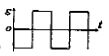
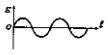
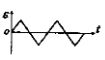
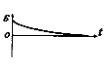
21. A uniform and constant magnetic field B is directed into the page within a rectangular region as shown in the figure. A wire in the shape of a quarter-circle is rotated at a constant angular velocity about an axis A. Which of the following graph represents the emf $\varepsilon$ induced in the wire as a function of time?(A)(B)(C)(D)(E)None of the above
22. In the $R-L$ circuit, the switch S is closed (connected) for a long time, and is then suddenly opened (disconnected). Just after the switch is opened, what is the potential difference across the inductor $L$?
(A)$\varepsilon$(B)$\varepsilon \left(\frac{R_{1} + R_{2}}{R_{2}}\right)$(C)$\varepsilon \left(\frac{R_{2}}{R_{1} + R_{2}}\right)$(D)$\varepsilon \left(\frac{R_{2}}{R_{1}}\right)$(E)None of the above
23. Two parallel light rays separated by a distance $d$ in the air enter a region with index of refraction $n = 1.5$. The incident angle is $45^{\circ}$ as shown in the figure. What is the separation of the two rays inside the region?
(A)$1.5d$(B)$\sqrt{3} d$(C)$\frac{\sqrt{14}}{3} d$(D)$\frac{\sqrt{7}}{2} d$(E)None of the above
24. Taiwan High Speed Rail travels from Taipei to Kaohsiung (distance = 300 km) at a speed of 60 m/s. The travel time is measured by an observer on the ground and a passenger on the train.Calculate the difference in travel time as measured by the two people. Use $(1 - \varepsilon)^{1/2} \approx 1 - \frac{1}{2}\varepsilon$when $\varepsilon \ll 1$.(A)$10^{-10}$ sec(B)$10^{-6}$ sec(C)$2\times 10^{-8}$ sec(D)$5\times 10^{-6}$ sec(E)None of the above
25. The hypothesis that an electron possesses spin is important for the explanation of which of the following topics?(A)Deflection of a moving electron by a uniform magnetic field(B)The photoelectric effect(C)The existence of isotopes(D)The structure of periodic table(E)None of the above
 阿摩線上測驗
登入


 (A)
 (B)
 (C)
 (D)
 (E)None of the above

