所屬科目:研究所、轉學考(插大)◆普通物理學
1. Consider a power supply with fixed emf \( \varepsilon \) and internal resistance \( r \) causing current in a load resistance \( R \). In this problem, \( R \) is fixed and \( r \) is a variable. The efficiency is defined as the energy delivered to the load divided by the energy delivered by the emf. (a) When the internal resistance is adjusted for maximum power transfer, what is the efficiency? (b) What should be the internal resistance for maximum possible efficiency? (c) When the electric company sells energy to a customer, does it have a goal of high efficiency or of maximum power transfer? Explain. (d) When a student connects a loudspeaker to an amplifier, does she most want high efficiency or high power transfer? Explain. (20%)
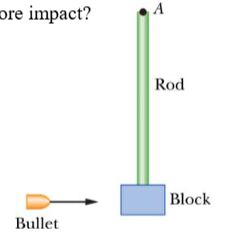
2. A \( 1.0\mathrm{g} \) bullet is fired into a \( 0.50\mathrm{kg} \) block attached to the end of a \( 0.60\mathrm{m} \) nonuniform rod of mass \( 0.50\mathrm{kg} \) as shown. The block-rod-bullet system then rotates in the plane of the of the figure, about a fixed axis at \( A \). The rotational inertia of the rod alone about that axis at \( A \) is \( 0.060\mathrm{kg}\cdot \mathrm{m}^2 \). Treat the block as a particle. (a) What then is the rotational inertia of the block-rod-bullet system about point \( A \)? (b) If the angular speed of the system about \( A \) just after impact is 4.5 rad/s, what is the bullet's speed just before impact? (12%)
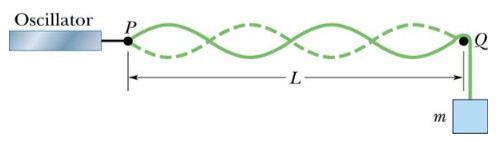
3. A string, tired to a sinusoidal oscillator at P and running over a support at Q, is stretched by a block of mass m as shown. The separation L between P and Q is 1.20 m, and the frequency f of the oscillator is fixed at 120 Hz. The amplitude of the motion at P is small enough for that point to be considered a node. A node also exists at Q. A standing wave appears when the mass of the hanging block is 286.1 g or 447.0 g, but not for any intermediate mass. What is the linear density of the string? (10%)
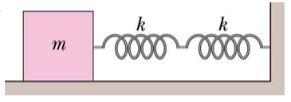
4. Two springs are joined and connected to a block of mass 0.250 kg that is set oscillating over a frictionless floor as shown. The springs each have spring constant $k = 6400 \, \mathrm{N/m}$. What is the frequency of the oscillations? (10%)
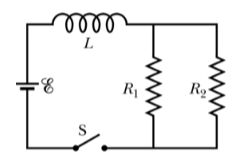
5. In the circuit as shown, \( R_1 = 20 \text{ k}\Omega \), \( R_2 = 20 \text{ }\Omega \), \( L = 50 \text{ mH} \), and the ideal battery has \( \varepsilon = 40 \text{ V} \). Switch S has been open for a long time when it is closed at time \( t = 0 \). Just after the switch is closed, what are (a) the current \( i_{\text{bat}} \) through the battery and (b) the rate \( di_{\text{bat}}/dt \)? At \( t = 3.0 \text{ }\mu\text{s} \), what are (c) \( i_{\text{bat}} \) and (d) \( di_{\text{bat}}/dt \)? A long time later, what are (e) \( i_{\text{bat}} \) and (f) \( di_{\text{bat}}/dt \)? (24%)
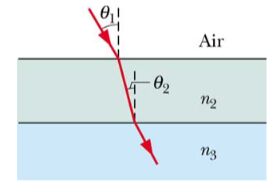
6. In the figure as shown, a light ray in air is incident on a flat layer of material 2 that has an index of refraction $n2 = 1.5$. Beneath material 2 is material 3 with an index of refraction $n3$. The ray is incident on the air-material 2 interface at the Brewster angle for that interface. The ray of light refracted into material 3 happens to be incident on the material 2-material 3 interface at the Brewster angle for that interface. What is the value of $n_3$? (12%)
7. A light, unstressed spring has length \( d \). Two identical particles, each with charge \( q \), are connected to the opposite ends of the spring. The particles are held stationary a distance \( d \) apart and then released at the same moment. The system then oscillates on a frictionless, horizontal table. The spring has a bit of internal kinetic friction, so the oscillation is damped. The particles eventually stop vibrating when the distance between them is \( 3d \). Assume the system of the spring and two charged particles is isolated. Find the increase in internal energy that appears in the spring during the oscillations. (12%)
 阿摩線上測驗
登入