所屬科目:研究所、轉學考(插大)◆普通物理學
1. A force acting on an object moving along the x axis is given by \( F_x = (14x - 3.0x^2) \) N, where x is in m. How much work is done by this force as the object moves from x = -1 m to x = +2 m?(A)+12J(B)+28J(C)+40J(D)+42J(E)-28J
2. Which of the curves in the right graph best represents the vertical component \( v_y \) of the velocity versus the time t for a projectile fired at an angle of 45° above the horizontal?(A)OC(B)AE(C)AB(D)DE(E)AF
3. The coefficient of static friction between the block and the cart is 0.5. If the mass of the block is m, what is the minimal acceleration of the cart to prevent the block from falling?(A)g(B)0.6g(C)0.3g(D)0.5g(E)2g
4. A rotating wheel requires 3.00 s to rotate through 37.0 revolutions. Its angular speed at the end of the 3.00-s interval is 98.0 rad/s. What is the constant angular acceleration of the wheel?(A)13.7 rad/s²(B)12.7 rad/s²(C)11.7 rad/s²(D)10.7 rad/s²(E)9.7 rad/s²
5. A thin ring of mass M and radius R rotates about an axis through its edge. The ring starts at its highest point and is given a very small push to start its rotation. Its angular velocity at the lowest point is (A)(B)(C)(D)(E)
6. A speedboat moving at 20.6 m/s sounds a signal on its horn, producing a tone of 320 Hz. There is no wind, and the speed of sound in air is 329 m/s. The apparent frequency of the sound heard by an observer in another boat moving in the opposite direction and approaching the first at a speed of 15.4 m/s is(A)282 Hz(B)287 Hz(C)316 Hz(D)357 Hz(E)369 Hz
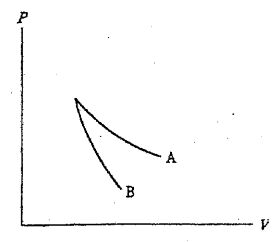
7. The relation PV = nRT holds for all ideal gases. The additional relation \( PV^\gamma \) holds for an adiabatic process. The figure below shows two curves: one is an adiabat and one is an isotherm. Each starts at the same pressure and volume. Which statement is correct? (Note: "∝" means "is proportional to".)(A)Isotherm: \( P \propto \frac{1}{V} \); Adiabat: \( P \propto \frac{1}{V^\gamma} \): A is both an isotherm and an adiabat.(B)Isotherm: \( P \propto \frac{1}{V^\gamma} \); Adiabat: \( P \propto \frac{1}{V} \): B is an isotherm, A is an adiabat.(C)Isotherm: \( P \propto \frac{1}{V} \); Adiabat: \( P \propto \frac{1}{V^\gamma} \): A is an isotherm, B is an adiabat.(D)Isotherm: \( P \propto \frac{1}{V^\gamma} \); Adiabat: \( P \propto \frac{1}{V} \): B is both an isotherm and an adiabat.(E)I cannot answer this without additional information about the starting temperature.
8. A quantity of an ideal gas is compressed to half its initial volume. The process may be adiabatic, isothermal or isobaric. The greatest amount of work is required if the process is:(A)adiabatic(B)isothermal(C)isobaric(D)adiabatic or isothermal (both require the same work; isobaric requires less)(E)isothermal or isobaric (both require the same work; adiabatic requires less)
9. Choose the INCORRECT statement:(A)Gauss's law holds in a vacuum(B)Gauss's law states that the net number of lines crossing any closed surface in an outward direction is proportional to the net charge enclosed within the surface(C)Coulomb's law can be derived from Gauss's law and symmetry(D)Gauss's law applies to a closed surface of any shape(E)according to Gauss's law, if a closed surface encloses no charge, then the electric field must vanish everywhere on the Gaussian surface
10. A satellite revolves around a planet in an elliptical orbit and experiences only the gravitational force. If the satellite's speed at point a is 8000 m/s, the satellite's speed at point c is(A)8000 m/s(B)6000 m/s(C)4000 m/s(D)2000 m/s(E)1000 m/s
11. The mass density of a certain planet has spherical symmetry but varies in such a way that the mass inside every spherical surface with center at the center of the planet is proportional to the radius of the surface. If r is the distance from the center of the planet to a point mass inside the planet, the gravitational force on the mass is(A)not dependent on r(B)proportional to \( r^2 \)(C)proportional to r(D)proportional to \( \frac{1}{r} \)(E)proportional to \( \frac{1}{r^2} \)
12. 10C (Coulomb) of charge are placed on a spherical conducting shell. A particle with a charge of -3C is placed at the center of the cavity. The net charge on the outer surface of the shell is:(A)-7C(B)-3C(C)0C(D)+3C(E)+7C
13. In the circuit shown, both resistors have the same value R. Suppose switch S is initially closed. When it is then opened, the circuit has a time constant \( \tau_a \). Conversely, suppose S is initially open. When it is then closed, the circuit has a time constant \( \tau_b \). The ratio \( \tau_a / \tau_b \) is(A)1(B)2(C)0.5(D)0.667(E)1.5
14. The field just outside the surface of a long conducting cylinder which has a 2.0-cm radius points radially outward and has a magnitude of 200 N/C. What is the charge density on the surface of the cylinder?(A)2.7 nC/m²(B)1.8 nC/m²(C)3.5 nC/m²(D)4.4 nC/m²(E)0.90 nC/m²
15. Positive charge Q is placed on a conducting spherical shell with inner radius \( R_1 \) and outer radius \( R_2 \). A point charge q is placed at the center of the cavity. The magnitude of the electric field at a point outside the shell, a distance r from the center, is(A)\( Q / 4\pi\varepsilon_0 R_2^2 \)(B)\( Q / 4\pi\varepsilon_0 (R_2^2 - r^2) \)(C)\( q / 4\pi\varepsilon_0 r^2 \)(D)\( (q+Q) / 4\pi\varepsilon_0 r^2 \)(E)\( (q+Q) / 4\pi\varepsilon_0 (R_2^2 - r^2) \)
16. A fisherman starts his outboard motor by applying a steady tangential force of 100 N by means of a starter rope. The flywheel has a moment of inertia of 0.05 kg·m² and a diameter of 0.2 m. Ignoring the effects of friction and the opposing torque due to the compression of the motor, what is the angular speed of the flywheel after it has turned through half a revolution starting from rest?(A)35.4 rad/s(B)50.1 rad/s(C)1256.0 rad/s(D)125.6 rad/s(E)24.5 rad/s
17. A magnetic field CANNOT:(A)exert a force on a charge(B)accelerate a charge(C)change the momentum of a charge(D)change the kinetic energy of a charge(E)change the velocity of a charge
18. A charged particle (m = 2.0 g, q = -50 μC) moves in a region of uniform field along a helical path (radius = 4.0 cm, pitch = 8.0 cm) as shown. What is the angle between the velocity of the particle and the magnetic field?(A)27°(B)72°(C)63°(D)18°(E)58°
19. A conductor of radius r, length ℓ and resistivity ρ has resistance R. It is melted down and formed into a new conductor, also cylindrical, with one fourth the length of the original conductor. The resistance of the new conductor is(A)\( \frac{1}{16} \)R(B)\( \frac{1}{4} \)R(C)R(D)4R(E)16R
20. A square loop of wire moves with a constant speed v from a field-free region, through a region of uniform B field as shown. Which of the five graphs correctly shows the induced current I in the loop as a function of time t?(A)(B)(C)(D)(E)
21. The coulomb is the same as (A : ampere, s : second, M : mass, T : temperature)(A)A·s(B)A/s(C)T·A/M(D)T/M(E)none of the above
22. A 2-μF capacitor in series with a 2-k resistor is connected to a 60-Hz ac source. Calculate the impedance of the circuit.(A)1500 ohms(B)1800 ohms(C)2100 ohms(D)2400 ohms(E)8600 ohms
23. The figure shows a cross section of a long cylindrical conductor of radius a = 4 cm containing a long cylindrical hole of radius b = 1.5 cm. The central axes of the cylinder and hole are parallel and are distance d = 2 cm apart; current i = 5.25 A is uniformly distributed over the tinted area. The magnitude of the magnetic field at the center of the hole is(A)7.6 μT(B)15.3 μT(C)24.7 μT(D)35.9 μT(E)51.8 μT
24. A proton is accelerated from rest through a potential difference of 2.5 kV and then moves perpendicularly through a uniform 0.60-T magnetic field. What is the radius of the resulting path?(A)15 mm(B)12 mm(C)18 mm(D)24 mm(E)8.5 mm
25. A 30-μF capacitor is charged to 40 V and then connected across an initially uncharged 20-μF capacitor. What is the final potential difference across the 30-μF capacitor?(A)15 V(B)24 V(C)18 V(D)21 V(E)40 V
二. 計算題 (每題二十五分)A block of mass M is connected to a spring of mass m and oscillates in simple harmonic motion on a horizontal, frictionless track. The force constant of the spring is k, and the equilibrium length is L. Find (a)(10%) the kinetic energy of the system when the block has a speed v, and (b)(10%) the period of oscillation. (Hint: Assume that all portions of the spring oscillate in phase and that the velocity of a segment dx is proportional to the distance x from the fixed end)
 阿摩線上測驗
登入