所屬科目:研究所、轉學考(插大)◆電子學
1. Using the fact that a silicon diode has IS = 10-14 A at 25°C and that IS increases by 15% per 1°C rise in temperature, find the value of “IS” at 30°C. (5%)
2. Assume n = 1, the thermal voltage VTis 25 mV, find the value of the diode small-signal resistance “rd” at bias currents of (a) 0.1 mA, (b) 1 mA, and (c) 10 mA. (15%, each sub-question takes 5%)
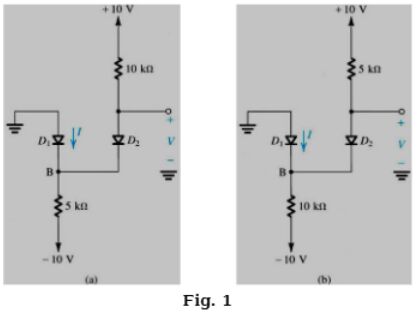
3. Assuming the diodes to be ideal, find the values of “ I ” and “ V ” in the circuits of Fig. 1. (16%, each sub-question takes 8%)
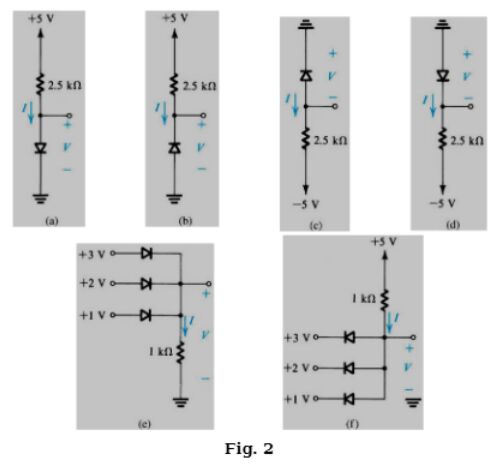
4. Assuming the diodes to be ideal, find the values of “ I ” and “ V ” in the circuits shown in Fig. 2. (36%, each sub-question takes 6%)
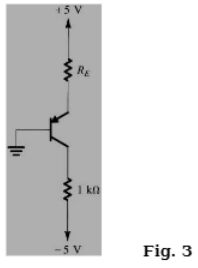
5. For the circuit in Fig. 3 select a value for \( R_B \) so that the transistor saturates with a forced \( \beta \) of 20. Assume \( V_{EB} = 0.7 \text{ V} \) and \( V_{EC,sat} = 0.2 \text{ V} \). (8%)
(a) Design for the largest possible “RD” (for a dc bias current of 1 mA and for the largest possible voltage gain consistent with allowing a 2-V peak-to-peak voltage swing at the drain.) (10%)
(b) Find the value of “RS”. (10%)
 阿摩線上測驗
登入
阿摩線上測驗
登入