所屬科目:研究所、轉學考(插大)◆普通物理學
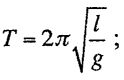
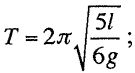
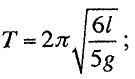
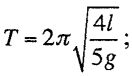
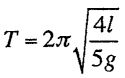
1. An elevator is accelerating upward with a constant acceleration of g/5 (g is the gravitational acceleration). A simple pendulum of length l is suspended from the ceiling of the elevator. What is the period T of the pendulum for small oscillations? (A)(B) (C) (D) (E)
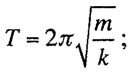
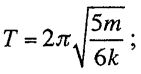
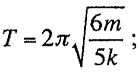
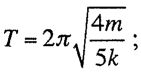
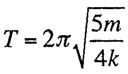
2. An elevator is accelerating upward with a constant acceleration of g/5 (g is the gravitational acceleration). An ideal spring with spring constant k is suspended vertically from the ceiling of the elevator and is attached by a block of mass m. What is the period T of this spring-block system for small vertical oscillations? (A) (B)(C)(D) (E)
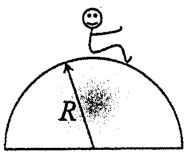
3. A boy is seated on the top of a hemispherical mound of ice (frictionless) of radius R as shown in the figure. He is given a very small push and starts sliding. What is the height of the point at which the boy leaves the ice?
(A) R/3 (B) R/2 (C) 2R/3 (D) 3R/4 (E) None of the above.
4. A pendulum is formed by pivoting a long thin rod of length L and mass M about a point on the rod. Apparently, the period (T) of this pendulum (for small oscillations) depends on the position of the pivot. Suppose the pivot is at a distance d from the center of the rod. What d would give a minimum T? (The moment of inertia of a thin rod about its center is ML²/12) (A) L/√6 (B) L/6 (C) L/√12 (D) L/12 (E) None of the above.
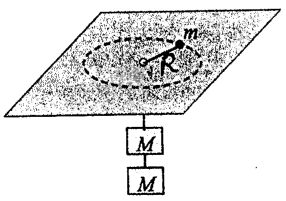
5. A particle of mass m travels in a horizontal circle of radius R on a frictionless table. The centripetal force is provided by a string passing through a hole in the table attached to two blocks of equal mass M, as shown in the figure. If one hanging block is removed, what will the radius of the particle motion become?
(A) ∛(2)R (B) ∛(2)R (C) √2 R (D) 2R (E) None of the above.
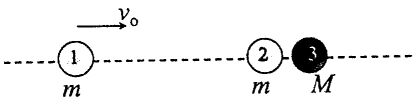
6. The two spheres (#2, #3) in the figure are slightly separated and initially at rest; the left sphere (#1) is incident with speed v₀. If M > m, what is the final velocity of sphere #2? We assume head-on elastic collisions.
(A) (B) (C) (D) (E) 0.
7. The transverse displacement of a standing wave on a string is given by
y(x,t) = 4 sin(0.5x) cos(30t), where x and y are in centimeters (cm).
What is the wave speed of component waves? (A) 10 cm/s (B) 15 cm/s (C) 30 cm/s (D) 60 cm/s (E) 120 cm/s.
8. For an ideal gas undergoing an adiabatic process, both its volume (V) and temperature (T) change. Which one of the following would remain constant? (γ = Cp/Cv) (A) (B) TVγ-1 (C) TγV (D) TγV-1 (E) None of the above.
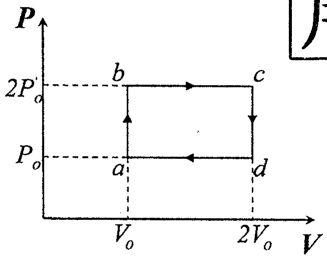
9. One mole of monatomic ideal gas is used as the working substance of an engine that operates the reversible cycle abcd shown in the figure. What is the efficiency of this engine?
(A) 1/2 (B) 1/4 (C) 2/11 (D) 2/13 (E) None of the above.
10. Continued from problem 9. Suppose there is a Carnot engine operating between the highest and the lowest temperature in the cycle abcd. What is the efficiency of this Carnot engine? (A) 1/4 (B) 1/2 (C) 5/8 (D) 3/4 (E) 4/5.
11. Two flat metal plates are a distance d apart, where d is small compared with the plate size. If the plates carry surface charge densities σ and -σ, what is the magnitude of the potential difference between them? (A) σd/ε₀ (B) σ/dε₀ (C) σd/2ε₀ (D) 2σd/ε₀ (E) σ/ε₀.
12. A conducting sphere is charged with a total charge Q (Q > 0) and in electrostatic equilibrium. Which of the following statement is true? (The electric potential at infinity is defined zero.) (A) The potential is the lowest, but not zero, at the center of the sphere. (B) The potential at the center of the sphere is zero. (C) The potential at the surface is higher than the potential at the center. (D) The potential at the center is the same as the potential at infinity. (E) The potential at the center of the sphere is the same as the potential at the surface.
13. A particle of mass m and charge q is circling on an orbit of radius R normal to an external magnetic field Bext. This moving charge would create a new magnetic field. What is this new magnetic field at the center of the orbit? (A) (B)(C)(D)(E) None of the above.
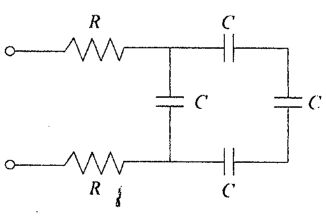
14. What is the time constant τ for the combination shown in the figure?
(A) 3RC/8 (B) 3RC/4 (C) 4RC/3 (D) 8RC/3 (E) None of the above.
15. A long conductive rod of radius R carries a nonuniform current density J(r) = J₀r/R, where J₀ is a constant and r is the radial distance form the rod axis. What is the expression for the magnetic field strength inside this rod? (A) μ₀J₀r (B) μ₀J₀r²/3R (C) μ₀J₀r²/R (D) μ₀J₀r²/5R (E) None of the above.
16. Suppose the magnetic field ( B ) in a plane electromagnetic (EM) wave is given by B = Byĵ, where By = 2×10⁻⁷sin(0.5×10³x + 1.5×10¹¹t) Tesla, ĵ is the unit vector along the y direction, and the SI unit is adopted. What is the expression for the electric field vector E(x,t) (in the SI unit) of this EM wave? (A) 60sin(0.5×10³x + 1.5×10¹¹t) î, where î is the unit vector along the x direction. (B) -60sin(0.5×10³x + 1.5×10¹¹t) î, where î is the unit vector along the x direction. (C) 60sin(0.5×10³x + 1.5×10¹¹t) k̂, where k̂ is the unit vector along the z direction. (D) -60sin(0.5×10³x + 1.5×10¹¹t) k̂, where k̂ is the unit vector along the z direction. (E) None of the above.
17. The reason why viruses can be seen using electron microscope is that the wavelength of electron can be smaller than the size of viruses. Assume an electron microscope has an accelerating voltage of 40 kV. What is the wavelength of the electron? (A) 0.006 nm (B) 0.003 nm (C) 0.06 nm (D) 0.03 nm (E) 0.6 nm.
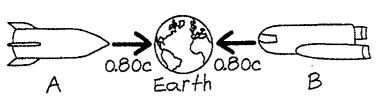
18. Two rockets A and B are approaching the Earth from opposite directions, each moving at 0.80c relative to the Earth, as shown in the figure. How fast do the spaceships move relative to each other?
(A) 0.48c (B) 0.80c (C) 0.98c (D) 1.3c (E) 1.6c.
19. Positronium consists of an election and a positron (a positive electron) orbiting about their common center of mass. According to the Bohr model, what is the expression of the energy level of a positronium? (A) En = -3.4 eV/n² (B) En = -6.8 eV/n (C) En = -6.8 eV/n² (D) En = -13.6 eV/n² (E) En = -13.6 eV/n
20. The fact that light can be polarized indicates which of the following? (A) Polarized light travels faster than non-polarized light. (B) Polarized light is monochromatic. (C) Light travels with a constant speed regardless of the reference frame. (D) Light is longitudinal wave. (E) Light is transverse wave.
 阿摩線上測驗
登入
 (B)
 (C)
 (D)
 (E)
 (B)
 (C)
 (D)
 (E)
 (A) R/3 (B) R/2 (C) 2R/3 (D) 3R/4 (E) None of the above.
 (A) ∛(2)R (B) ∛(2)R (C) √2 R (D) 2R (E) None of the above.
 (A)
 (B)
 (C)
 (D)
 (E) 0.
 (B) TVγ-1 (C) TγV (D) TγV-1 (E) None of the above.
 (A) 1/2 (B) 1/4 (C) 2/11 (D) 2/13 (E) None of the above.
 (B)
 (C)
 (D)
 (E) None of the above.
 (A) 3RC/8 (B) 3RC/4 (C) 4RC/3 (D) 8RC/3 (E) None of the above.
 (A) 0.48c (B) 0.80c (C) 0.98c (D) 1.3c (E) 1.6c.