所屬科目:研究所、轉學考(插大)◆普通物理學
1. A particle of mass m =100 g moves straight forward under an acceleration a(t) = 2 + t² (m/s²). If the particle starts at rest, what is the magnitudes of the momentum of the particle at t = 3 sec? (A) 0.2 kg-m/s (B) 0.5 kg-m/s (C) 1.1 kg-m/s (D) 1.5 kg-m/s (E) 2 kg-m/s
2. A circular object of mass m and of radius R rolls smoothly (without sliding) along a frictional incline, as shown in the right figure. In the following, which type of the object will roll with the highest acceleration?
(A) A ring (Rotational inertia about the center of mass Icm = mR²) (B) A solid sphere (Icm = 2mR²/5) (C) A spherical shell (Icm = 2mR²/3) (D) A disk (Icm = mR²/2) (E) The same.
3. Peter ties a stone to the end of a thin string (1-meter long), and swings it with a period 2-seconds. The central acceleration of the stone is approximately (m/s²): (A) 10 (B) 20 (C) 30 (D) 40 (E) 50
4. A sinusoidal wave is traveling on a string with velocity 0.4 m/s along the x direction. The displacement of the particles of the string is found to vary with time in the y direction according to the equation y(x,t) = 0.05 sin(kx − 2πt) m where k is the angular wave number of the wave. What is the wave length in meter of this wave? (A) 0.05 (B) 0.4 (C) 1 (D) 2π (E) 5π
5. Following the science fiction, earth is a hollow shell, and there is a cavity in the center of the earth as the inner world. According to gravitation theory, what is the gravity field in that inner world? (A) same as on the surface of the earth (B) linear function as the distance from the center (C) very small (D) proportional to 1/r² (E) proportional to 1/r
6. A disk rolls down a 30-degree slope without slipping. Given the inertial moment of a disk (mass M and radius R) I = MR²/2, please find the frictional force for the disk during rolling down: (A) 1 Mg (B) 1/2 Mg (C) 1/3 Mg (D) 1/6 Mg (E) 2/3 Mg
7. Connect three disks as shown in the following figure. Their centers form a regular triangle. Each disk of mass M, radius R has an inertial moment I = MR²/2 when rotating about the disk center. Calculate the total inertial moment of the three disks when rotating about the center of triangle (in unit of MR²).
(A) 1.5 (B) 2.5 (C) 3.5 (D) 4.5 (E) 5.5
8. The intensity from a sound source is I. If another identical but independent sound source is placed next to it, what will be the change of intensity level? (A) 2 dB (B) 3 dB (C) 4 dB (D) 5 dB (E) 6 dB
9. Which of the following is a consequence of (or is implied by) the second law of thermodynamics: (A) for all cyclic processes we have ΔQ/T < 0 (B) work cannot be completely converted to heat energy (C) heat energy cannot be completely converted to work (D) the reason all heat engine efficiencies are less than 100% is friction, which is unavoidable (E) in the Carnot engine, ΔS > 0 for each cycle
10. As shown in the following, two large insulating parallel plates carry positive charge of equal magnitude, one positive and the other negative, that is distributed uniformly over their inner surfaces. Rank the points 1 through 5 according to the magnitude of the electric field at the points, least to greatest.
(A) 1, 2, 3, 4, 5 (B) 5, 4, 3, 2, 1 (C) 1= 4 = 5, 2 = 3 (D) 2 = 3, 1 = 4 = 5 (E) 2 = 3, 1, 4 = 5
11. According to Hubble's Law the velocity of v of a galaxy moving away from Earth is proportional to its distance from Earth. Consider two galaxies one of which is twice as far away as the other from Earth at some instant of time. At subsequent times, the ratio of their distances to Earth will be: (A) 2 to 1. (B) greater than 2 to 1. (C) less than 2 to 1. (D) it depends on the specific time. (E) it depends on the positions of galaxies.
12. A person sits on a swing. When the person sits still, the swing oscillates back and forth at its natural frequency ω₀. If, instead, two people sit on the swing, the new natural frequency of the swing is (A) 4ω₀. (B) 3ω₀. (C) 2ω₀. (D) ω₀. (E) ω₀/2.
13. If the inertial mass and gravitational mass were not equal, which of the following principles would change? (A) Kepler's third law. (B) Principle of least action. (C) The inverse-square law of gravitation. (D) Newton's second law. (E) Nothing has changed.
14. An electron (mass m, charge −e) is accelerated from rest through a potential difference V and then deflected by a magnetic field B that is perpendicular to its velocity. The radius of the resulting electron trajectory is: (A) (B) (C) (D) (E) none of these
15. Eight identical spherical conducting raindrops are each at a potential V, relative to the potential far away. They coalesce to make one spherical raindrop whose potential is: (A) V/8 (B) V/2 (C) 2V (D) 4V (E) 8
16. An electron has velocity v = (32 i + 40 j) km/s as it enters a uniform magnetic field B = (60 i) μT. (A) The radius of the helical path taken by the electron is 0.38 m. (B) The pitch of that path is 1.9 m. (C) The period of the revolution is 60 μs. (D) To an observer looking into the magnetic field region from the entrance point of the electron, the electron spirals counterclockwise as it moves. (E) The magnetic force points in the +k direction.
17. Star S1 is moving away from us at a speed of 0.8c (c is the speed of light). Star S2 is moving away from us in the opposite direction at a speed of 0.5c. The speed of S1 as measured by an observer on S2 is: (A) 0.21c (B) 0.50c (C) 0.93c (D) 1.3c (E) 2.2c
18. An air wedge is formed from two glass plates which are in contact at their left edges. There are ten dark bands when viewed by reflection using monochromatic light. The left edge of the top plate is now slowly lifted until the plates are parallel. During this process: (A) the dark bands crowd toward the right edge (B) the dark bands remain stationary (C) the dark bands crowd toward the left edge (D) the dark bands spread out, disappearing off the right edge (E) the dark bands spread out, disappearing off the left edge
19. The uncertainty in position of an electron in a certain state is 5 × 10⁻¹⁰ m. The uncertainty in its momentum could be (A) 5.0 × 10⁻²⁴ kg·m/s (B) 4.0 × 10⁻²⁴ kg·m/s (C) 3.0 × 10⁻²⁴ kg·m/s (D) any of the above (E) none of the above
20. The figure shows the energy levels for an electron in a finite potential energy well. If an electron in the n = 2 state absorbs a photon of wavelength 2.0 nm, what happens to the electron?
(A) It makes a transition to the n = 3 state. (B) It makes a transition to the n = 4 state. (C) It escapes the well with a kinetic energy of 280 eV. (D) It escapes the well with a kinetic energy of 730 eV. (E) Nothing; this photon does not have an energy corresponding to an allowed transition so it is not absorbed.
1. As shown in the following figure, a spacecraft in the shape of a long cylinder has a length of 100 m and its mass with occupants is 1000 kg. It has strayed too close to a black hole having a mass 100 times that of the Sun. The nose of the spacecraft points toward the black hole, and the distance between the nose and the center of the black hole is 10.0 km. Which answers are correct in the followings?
(A) The total force on the spacecraft is 3.93×10¹⁷ N. (B) The total force on the spacecraft is 2.62×10¹⁷ N. (C) The total force on the spacecraft is 1.31×10¹⁷ N. (D) The difference in the gravitational fields acting on the occupants in the nose of the ship and on those in the rear of the ship, farthest from the black hole, is 2.62×10¹² N/kg. (E) The difference in the gravitational fields acting on the occupants in the nose of the ship and on those in the rear of the ship, farthest from the black hole, is 1.31×10¹² N/kg.
2. The wave function for a traveling wave on a string is y(x,t) = 2 sin(2x − t − 0.5), where both x and y are in centimeters, and time is in second. Choose the CORRECT statement(s): (A) The frequency is 1 second. (B) The wave length is 2 cm. (C) The wave speed is 0.5 cm/s. (D) The particle on the string velocity at x = 1.0 cm and t = 1.5 s is 2 cm/s. (E) The particle on the string has a maximum acceleration 2 cm/s².
3. One mole of ideal monatomic gas is taken around the reversible cycle as shown in the following figure. The isothermals are at 500 K and 300 K. (R is the gas constant)
(A) Q₁ = 500 Rln2 (B) Q₂ = −300 R (C) Q₃ = −300 Rln2 (D) the work done in one cycle is 300 Rln2 (E) the efficiency of the engine is 0.214.
4. In the figure below, the conducting rod has length L = 0.1 m and is being pulled along horizontal frictionless conducting rails at a constant velocity with v = 5 m/s. The rails are connected at one end with a metal strip. The rod has resistance of 0.4 Ω and the rails and connector have negligible resistance. A uniform magnetic field B = 1.2 T out of the page fills the region in which the rod moves. It is correct that
(A) the magnitude of the emf induced in the rod is 0.6 V (B) the induced current is 1.5 A (C) the induced current is clockwise (D) the leftward external force needed to keep the rod moving at constant velocity is 1.8 N (E) the power associated with the force is 3.0 W
 阿摩線上測驗
登入
 (A) A ring (Rotational inertia about the center of mass Icm = mR²) (B) A solid sphere (Icm = 2mR²/5) (C) A spherical shell (Icm = 2mR²/3) (D) A disk (Icm = mR²/2) (E) The same.
 (A) 1.5 (B) 2.5 (C) 3.5 (D) 4.5 (E) 5.5
 (A) 1, 2, 3, 4, 5 (B) 5, 4, 3, 2, 1 (C) 1= 4 = 5, 2 = 3 (D) 2 = 3, 1 = 4 = 5 (E) 2 = 3, 1, 4 = 5
 (B)
 (C)
 (D)
 (E) none of these
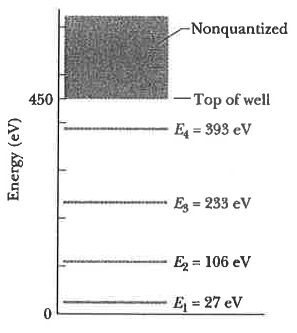 (A) It makes a transition to the n = 3 state. (B) It makes a transition to the n = 4 state. (C) It escapes the well with a kinetic energy of 280 eV. (D) It escapes the well with a kinetic energy of 730 eV. (E) Nothing; this photon does not have an energy corresponding to an allowed transition so it is not absorbed.
 (A) The total force on the spacecraft is 3.93×10¹⁷ N. (B) The total force on the spacecraft is 2.62×10¹⁷ N. (C) The total force on the spacecraft is 1.31×10¹⁷ N. (D) The difference in the gravitational fields acting on the occupants in the nose of the ship and on those in the rear of the ship, farthest from the black hole, is 2.62×10¹² N/kg. (E) The difference in the gravitational fields acting on the occupants in the nose of the ship and on those in the rear of the ship, farthest from the black hole, is 1.31×10¹² N/kg.
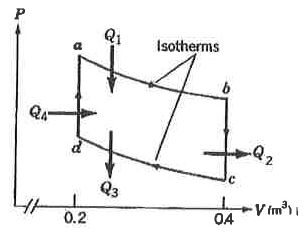 (A) Q₁ = 500 Rln2 (B) Q₂ = −300 R (C) Q₃ = −300 Rln2 (D) the work done in one cycle is 300 Rln2 (E) the efficiency of the engine is 0.214.
 (A) the magnitude of the emf induced in the rod is 0.6 V (B) the induced current is 1.5 A (C) the induced current is clockwise (D) the leftward external force needed to keep the rod moving at constant velocity is 1.8 N (E) the power associated with the force is 3.0 W