所屬科目:研究所、轉學考(插大)◆普通物理學
1. (10%) A satellite in low-Earth orbit is not truly traveling through a vacuum. Rather, it moves through very thin air. Does the resulting air friction cause the satellite to slow down? Explain.
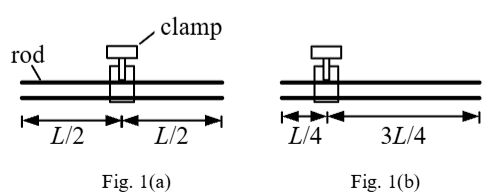
2. (10%) Fig. 1 shows a rod with two open ends. The air inside the rod forms a standing wave which has a maximum displacement at both ends of the rod. In Fig. 1(a), the rod is clamped at its center where a displacement node is forced by the clamp. The fundamental resonance frequency in Fig. 1(a) is 1 kHz. When the rod is clamped at L/4 from one end, as shown in Fig. 1(b), find the fundamental resonance frequency of the rod. (L is the length of the rod)
(a) Choose the statements which are characteristics of electric force.
(b) Choose the statements which are characteristics of magnetic force.
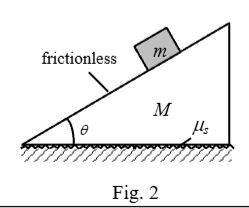
(15%) A small block of mass \( m \) is released from rest at the top of a frictionless, triangle-shaped wedge of mass \( M \), which sits on a horizontal surface as shown in Fig. 2. The coefficient of static friction between the wedge and horizontal surface is \( \mu_s \). The incline of the wedge makes an angle of \( \theta \) with the horizon. Find the minimum value of \( \mu_s \) so that the wedge does not move relative to the ground when the small block slides down.
(a) Find the electric energy stored at the charged capacitor.
(b) At time t = 0, the switch is turned on as shown in Fig. 3(b). Let V(t) be the voltage across the capacitor at any time t > 0. Find V(t).
(a) Does the particle carry positive charges or negative charges? Explain.
(b) FindΦ, the angle at which the particle leaves the magnetic field region.
(c) If the particle leaves the magnetic field region at a distance of d = 0.02 m, find the charge of the particle. (sin30° = 0.500, sin45° = 0.707, sin60° = 0.866)
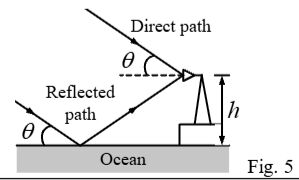
7. (15%) Radio waves of wavelength λfrom a galaxy reach a radio telescope by two separate paths as shown in Fig. 5. One is a direct path to the telescope, which is situated on the edge of a tall cliff by the ocean, and the second is by reflection off the ocean. As the galaxy rises in the east over the water, the first minimum of destructive interference occurs when the galaxy is θ above the horizon. Find the height h of the radio telescope above the ocean. Assume that the reflection by the ocean does not change the phase of the radio waves.
 阿摩線上測驗
登入