所屬科目:研究所、轉學考(插大)-基礎數學
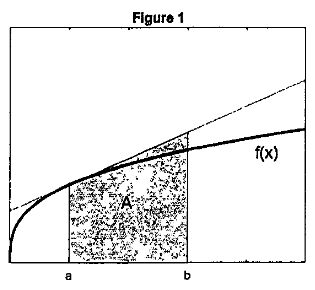
1. (10%) Let f(x) be a differentiable function as shown in Figure 1. It needs to compute the integral $\int_{a}^{b} f(x)dx$. For some reason, the integration is not possible. We decide to linearize f(x) at x = a$ and use the trapezoidal area $A$ to approximate the integral, i.e. \( \int_{a}^{b} f(x) dx \approx A \). Please find the area A.
(a) \( \lim_{x\to 1^{+}}f(x) = \infty ,\lim_{x\to 1^{-}}f(x) = -\infty ,\lim_{x\to -\infty}f(x) = 0 \)
(b) \( f(-2) = 3, f(5) = 1, f(0) = 0 \)
(c) \( f^{\prime}(5) = 0 \) \( f^{\prime}(-2) = 0 \)
(d) \( f'(x) > 0 \) if \( x < -2 \) or \( x > 5 \), \( f'(x) < 0 \) if \( -2 < x < 1 \) or \( 1 < x < 5 \).
(e) \( f''(x) > 0 \) if \( x < -3 \) or \( x > 1 \), \( f''(x) < 0 \) if \( -3 < x < 1 \).
3. (10%) Evaluate the integral $$E = \int_{0}^{L} \frac{\lambda c}{4\pi\delta(x^2 + c^2)^{3/2}} dx$$ Where $c, \lambda, \delta, L$ are constants.
4. (10%) Evaluate the double integral $$\int_{0}^{2} \int_{x^2}^{4} x e^{-y^2} dy dx$$
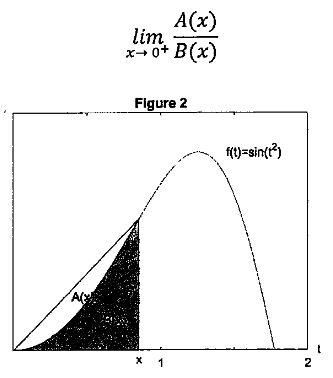
5. (10%) Let the function $f(t) = \sin(t^2)$ as shown in Figure 2. Consider two areas A(x) and B(x) for x < 1.5, where A(x) represents the triangular area, while B(x) designates the definite integral of f(t) from t = 0 to t = x. Find $$\lim_{x \to 0^+} \frac{A(x)}{B(x)}$$
(a) Write down the characteristic polynomial of \( A \) and use it to find the eigenvalues. (4%)
(b) Find the eigenspaces of \( A \). (5%)
(c) Orthogonally diagonalize the matrix \( A \). (You need to find out an orthogonal matrix \( P \) and a diagonal matrix \( D \) such that \( P^T AP = D \).) (10%)
(a) \( \operatorname{span}\{\vec{v}_1, \vec{v}_2, \dots, \vec{v}_k\} \) is a subspace of V. (10%)
(b) \( \operatorname{span}\{\vec{v}_1, \vec{v}_2, \dots, \vec{v}_k\} \) is the smallest subspace of \( V \) that contains \( \vec{v}_1, \vec{v}_2, \dots, \vec{v}_k \). (4%)
3. Let \( S = \{\vec{v}_1, \vec{v}_2, \dots, \vec{v}_k\} \) be an orthogonal set of nonzero vectors in a vector space \( V \). Please show that the vectors in \( S \) are linear independent. (10%)
4. Let \( T: P_2 \to P_2 \) be the linear transformation defined by $$T(p(x)) = p(2x - 1).$$ Please find the matrix of T with respect to the basis $\mathcal{E} = \{1, x + 1, x^2\}$. (7%)
 阿摩線上測驗
登入