所屬科目:研究所、轉學考(插大)◆財務管理
1. NUK Inc. operates as a partnership. Now the partners have decided to convert the business into a corporation. Which of the following statements is CORRECT? (A) The firm will find it more difficult to raise additional capital to support its growth. (B) The company will probably be subject to fewer regulations and required disclosures. (C) Assuming the firm is profitable, none of its income will be subject to federal income taxes. (D) The firm's investors will be exposed to less liability, but they will find it more difficult to transfer their ownership. (E) NUK's shareholders (the expartners) will now be exposed to less liability.
2. Which of the following mechanisms would be most likely to help _motivate_ managers to act in the best interests of shareholders? (A) Increase the proportion of executive compensation that comes from stock options and reduce the proportion that is paid as cash salaries. (B) Take actions that reduce the possibility of a hostile takeover. (C) Elect a board of directors that allows managers greater freedom of action. (D) Decrease the use of restrictive covenants in bond agreements.(E)Eliminate a requirement that members of the board of directors have a substantial investment in the firm's stock.
3. Stock A's beta is 2.0 and Stock B's beta is 0.9. Which of the following statements _must_ be true, assuming the CAPM is correct. (A) Stock A would be a more desirable addition to a portfolio then Stock B. (B) In equilibrium, the expected return on Stock B will be greater than that on Stock A. (C) In equilibrium, the expected return on Stock A will be greater than that on B. (D) When held in isolation, Stock A has more risk than Stock B. (E) Stock B would be a more desirable addition to a portfolio than A.
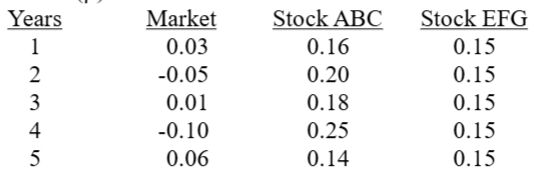
4. You have the following data on (1) the average annual returns of the market for the past 5 years and (2) similar information on Stocks ABC and EFG. Which of the possible answers best describes the historical betas ($\beta$) for ABC and EFG? (A) $\beta_{ABC} > 0; \beta_{EFG} = 1$. (B) $\beta_{ABC} < 0; \beta_{EFG} = 0$. (C) $\beta_{ABC} = 0; \beta_{EFG} = 1$. (D) $\beta_{ABC} > +1; \beta_{EFG} = 0$. (E)$\beta_{ABC} < 1; \beta_{EFG} = 1$.
5. If D₀ = $2.20, g (which is constant) = 5.0%, and P₀ = $50, what is the stock's expected dividend yield for the coming year? (A) 4.40% (B) 4.19% (C) 4.62% (D) 5.12% (E) 5.40%
6. Which of the following is _NOT_ a capital component when calculating the weighted average cost of capital (WACC) for use in capital budgeting? (A) Preferred stock. (B) Accounts receivables. (C) Retained earnings. (D) Common stock. (E) Longterm debt.
7. Which of the following would indicate an _improvement_ in a company's financial position, holding other things constant? (A) The inventory and total assets turnover ratios both decline. (B) The debt ratio increases. (C) The profit margin declines. (D) The timesinterestearned ratio increase. (E)The current and quick ratios both declines.
8. Which of the following statements concerning the effective annual rate are correct? I. When making financial decisions, you should compare effective annual rates rather than annual percentage rates II. The more frequently interest is compounded, the higher the effective annual rate. III. A quoted rate of 6% compounded continuously has a higher effective annual rate than if the rate were compounded daily. IV. When borrowing and choosing which loan to accept, you should select the offer with the highest effective annual rate. (A) I and II only (B) I and IV only (C) I, II, and III only (D) II, III, and IV only (E) I, II, III, and IV
9. You are scheduled to receive annual payments of $10,000 for each of the next 10 years. Your discount rate is 5 percent. What is the difference in the present value if you receive these payments at the beginning of each year rather than at the end of each year? (A) $3,699 (B) $3,861 (C) $4,706 (D) $5,000 (E) $5,850
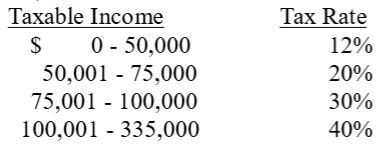
10. Given the tax rates as shown, what is the average tax rate for a firm with taxable income of $126,500? (A) 21.65% (B) 23.00% (C) 25.76% (D) 34.25% (E) 40.00%
11. NUK Co. generates 5 dollars of net income for every $100 in sales. Thus, NUK's has a _____ of 5%. (A) return on equity (B) return on assets (C) cash coverage ratio (D) total asset turnover (E)profit margin
12. A firm's market capitalization is equal to: (A) firm's stock price multiplied by number of shares outstanding. (B) par value of common equity. (C) total book value of assets less book value of debt. (D) firm's stock price multiplied by the number of shares authorized. (E) the maximum value an acquirer would pay for a firm in an acquisition.
13. NUK Co. has $6,400 in sales. The profit margin is 8%. There are 3,200 shares of stock outstanding. The market price per share is $1.20. What is the priceearnings ratio? (A) 7.5 (B) 10 (C) 15 (D) 30 (E) 50
14. A pro forma financial statement is one that: (A) is expressed as a percentage of the total assets of the firm. (B) is expressed as a percentage of the total sales of the firm. (C) is expressed relative to a chosen base year's financial statement. (D) projects future years' operations. (E) reflects the past and current operations of the firm.
15. Sunk costs include any cost that: (A) will change if a project is undertaken. (B) has previously been incurred and cannot be changed. (C) will be incurred if a project is accepted. (D) will occur if a project is accepted and once incurred, cannot be recouped. (E) is paid to a third party and cannot be refunded for any reason whatsoever.
16. Preemptive rights refer to the right of shareholders to: (A) share proportionately in dividends paid. (B) share proportionately in any new stock issues sold. (C) vote at annual shareholder meetings. (D) share proportionately in liquidated assets. (E)override the votes of other shareholders.
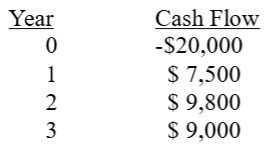
17. What is the profitability index for an investment with the following cash flows given a 10% required return? (A) 0.86 (B) 0.95 (C) 1.070 (D) 1.084 (E) 1.075
18. A project has an initial cost of $2,300. The cash inflows are $300, $500, $600, and $700 over the next four years, respectively. What is the payback period? (A) 2.71 years (B) 2.98 years (C) 3.11 years (D) 3.86 years (E)never
19. A bond that makes no coupon payments and is initially priced at a deep discount is called a _____ bond (A) Treasury (B) municipal (C) callable (D) zero coupon (E)convertible bond
20. NUK Inc. has a 5% coupon bond that matures in 20 years. The bond pays interest semiannually. What is the market price of a $1,000 face value bond if the yield to maturity is 5%? (A) $956.25 (B) $895.65 (C) $1000.00 (D) $1006.25 (E)$1102.65
1. NUK Corporation just paid a dividend of D₀ = $0.75 per share, and that dividend is expected to grow at a constant rate of 6.50% per year in the future. The company's beta is 1.25, the required return on the market is 10.50%, and the risk-free rate is 4.50%. What is the company's current stock price? (10 points)
2. Suppose the interest rate on a 1-year T-bond is 5.0% and that on a 2-year T-bond is 7.0%. Assuming the pure expectations theory (Unbiased Expectations Theory) is correct, what is the market's forecast for 1-year rates 1 year from now? (10 points)
3. NUK Co. has sales of $3,000, total assets of $2,500, and a profit margin of 10%. The firm has a total debt ratio of 40%. What is the return on equity? (10 points)
4. What is the internal rate of return (IRR)? List and briefly discuss the advantages and disadvantages of the internal rate of return (IRR) rule. (10 points)
 阿摩線上測驗
登入
 (A) $\beta_{ABC} > 0; \beta_{EFG} = 1$. (B) $\beta_{ABC} < 0; \beta_{EFG} = 0$. (C) $\beta_{ABC} = 0; \beta_{EFG} = 1$. (D) $\beta_{ABC} > +1; \beta_{EFG} = 0$. (E)$\beta_{ABC} < 1; \beta_{EFG} = 1$.
 (A) 21.65% (B) 23.00% (C) 25.76% (D) 34.25% (E) 40.00%
 (A) 0.86 (B) 0.95 (C) 1.070 (D) 1.084 (E) 1.075