所屬科目:研究所、轉學考(插大)◆普通物理學
2. Hook's law of spring states that if you stretch a spring from its equilibrium length by a displacement x, then the force F that the spring exerts on you is F = -c . Now a particle of mass m is executing oscillation obeying Hook's law. If the amplitude of oscillation is A, then its period is (A)proportional to (B) independent of A (C) proportional to 1/ (D) proportional to A2.
5. Two conducting plates have an area A and are separated by a distance d. The capacitance C of the parallel-plate capacitor is (A)(B)(C) (D) , where ε0, is the electric constant and μ0is the magnetic constant in a vacuum.
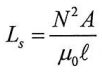
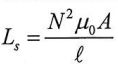
6.A very long ideal solenoid with a cross-section area A has N turns and a length l . Assume that each turn is circular. The self-inductance Ls of this ideal solenoid is NA (A) (B)(C) (D) , where ε0 is the electric constant and μ0 is the magnetic constant in a vacuum.
8. The unit of magnetic induction field B is denoted as [B]=[N]/[A.m] and the electric field is [E]=[V] /[m], where [N] is Newton, [A] Ampere [V] Volt, and [m] meter. The clectric field due to an infinite non-conducting plane with uniform surface charge densityσ is given by E=σ /2ε0, where ε0 is the electric constant. On the other hand, the magnetic induction inside an ideal solenoid with steady current I is given by B= μ0nl , where μ0 is the magnetic constant and n is the number of turns per unit length. By using these hints, the quantity has the dimension of (A)pressure (B) charge current (C) angular momentum (D) resistance.
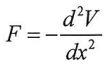
9. The total energy E= K +V of a particle traveling under the conservative force field is a constant of motion, where K is the kinetic energy and V is the potential energy. In a one-dimensional case, say the x-axis, the conservative force is related to potential energy by which equation? (A) (B) (C) (D)
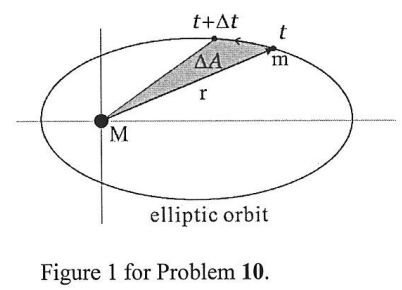
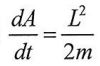
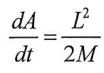
10. A planet of mass m orbits the sun of mass M in an elliptical path (see Figure 1), with the sun at a focal point. In accord with Kepler's laws, a line drawn from the sun to a planet sweeps out equal areas in cqual times, i.e., dAidt is a constant. Assume that the angular momentum of the planet relative to the sun is L, then dA/ dt is given by (A) (B) (C) (D)
11. Archimedes' principle states that a body wholly or partly submerged in a liquid is buoyed up by a force. This buoyant force is equal to the weight of the liquid displaced. Suppose that an iron block of volume V and mass densityρ floats in equilibrium in mercury of mass density ρ0, and V' is the volume of iron block submerged under the surface of the mercury. Then the ratio V'/V is equal to (A)(B)(C)(D)
12. A Copper wire of conductivity has a cross-sectional area of 4 mm2 and a length of 50 meters. Calculate its resistance. (A) 0.21Ω (B) 0.47Ω (C) 0.33Ω (D) 0.52Ω
13. Consider blue light of wavelength meter. Calculate its period. (Speed of light is 3.0x10⁸(m/s)) (A) (B) (C)(D)
14. Consider the following circuit (see Figure 2.) containing a battery with emf V=5.0 volt, an inductor L-0.2 Henry and two resistances R1=2.3Ωand R2=4.1Ω. At time t=0, switch S is closed. After a long time, a steady current is exhibited in this circuit. Calculate the current through resistance R1. (A) 2.2Ampere (B) 0.8 Ampere (C) 1.2 Ampere (D) zero Ampere.
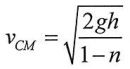
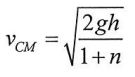
15. A rigid body (hollow/solid cylinder or sphere, with radius R and total mass M) rolls without slipping from rest at the top of an ineline with height h down an inclined rigid plane. Given the moment of inertia through the center of mass, where n is a number less or equal to 1. Find the speed of the center of mass vcy after reaching the bottom of the incline.(A) (B)(C) (D)
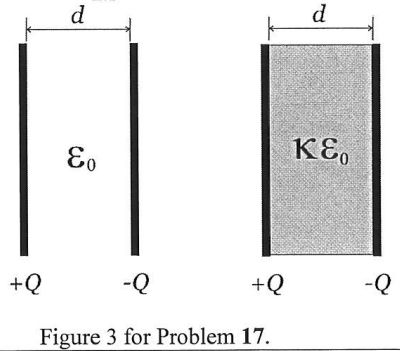
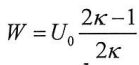
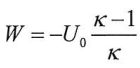
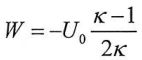
17. Capacitor and dielectric slab. Consider (see Figure 3.) a capacitor with a fixed charge Q but without a dielectric slab (vacuum permittivity is ε0). Its energy is denoted as U0 . A dielectric slab of dielectric constant K(i.e, permittivity becomesKε0) is now inserted into the plates. Find the work W required to insert the dielectric between the plates. (A)(B) W=U0(K+1) (C) (D)
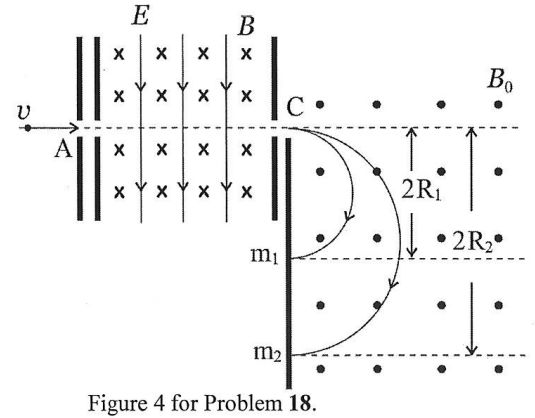
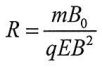
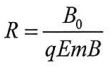
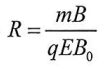
18. The mass spectrometer. In 1910, W. Aston proposed and constructed an experiment measuring the mass of a charged particle. The key elements of a mass spectrometer are shown in Figure 4. A collimated beam enters the velocity selector. Upon emerging from slit C, these particles of velocity u now enter a region with only a magnetic induction B0perpendicular to the plane of the diagram. These particles experiencing the Lorentz force traverse a semicircular path (with radius R) until they strike a screen. Find the resulting radius R . (A) (B) (C)(D)
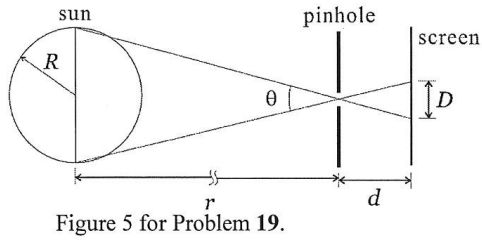
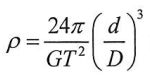
19. There is an interesting experiment that enables us to estimate the mass density of the sun. Consider (see Figure 5) an experimental setup that can get an image of the sun through a pinhole. The distance between the pinhole and the screen is d, and the diameter of the image is D. Because light propagates in a straight line (neglect geometrical distortions), you can obtain the angle θin terms of d and D. Therefore, the relationship between R and r can be exhibited, where R is the radius of the sun and r is the distance between the earth and the sun. It is known that the earth orbits the sun by the period days. Assume that the earth makes a circular orbit around the sun, and the sun is a perfect sphere. From these hints, the mass density of the sun p is given by (A) (B)(C) (D) , where G= is the gravitational constant.
20. Consider the following experimental arrangement, see Figure 6. A block of mass m is released at rest (point A) and is dragged along a table by a constant force F0 =5.0N, where the unit N means Newton. Assume that the surfaces of the table and the pulley are frictionless. Under the action of constant force F0, the mass m moves from point A (a=π/6) to point B(β=π/4) and has a horizontal displacement s = 2.0 meter. Find the work W carried out by the constant force F0 from A to (A) W =0(N.m) (B) W =10.0(N.m) (C) W=8.0(N.m) (D) W =1.6(N.m)
 阿摩線上測驗
登入
 (B) independent of A (C) proportional to 1/
 (B)
 (C)
 (D)
 , where ε0, is the electric constant and μ0is the magnetic constant in a vacuum.
 (B)
 (C)
 (D)
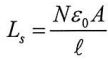 , where ε0 is the electric constant and μ0 is the magnetic constant in a vacuum.
 has the dimension of (A)pressure (B) charge current (C) angular momentum (D) resistance.
 (B)
 (C)
 (D)

 (A)
 (B)
 (C)
 (D)
 (B)
 (C)
 (D)

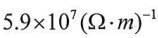 has a cross-sectional area of 4 mm2 and a length of 50 meters. Calculate its resistance. (A) 0.21Ω (B) 0.47Ω (C) 0.33Ω (D) 0.52Ω
 meter. Calculate its period. (Speed of light is 3.0x10⁸(m/s)) (A)
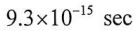 (B)
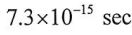 (C)
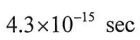 (D)
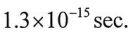
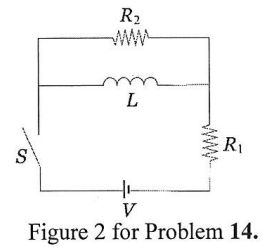 (A) 2.2Ampere (B) 0.8 Ampere (C) 1.2 Ampere (D) zero Ampere.
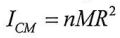 , where n is a number less or equal to 1. Find the speed of the center of mass vcy after reaching the bottom of the incline.(A)
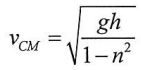 (B)
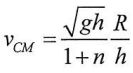 (C)
 (D)
 (A)
 (B) W=U0(K+1) (C)
 (D)
 (A)
 (B)
 (C)
 (D)

 days. Assume that the earth makes a circular orbit around the sun, and the sun is a perfect sphere. From these hints, the mass density of the sun p is given by
 (A)
 (B)
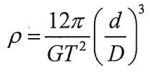 (C)
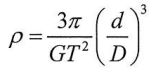 (D)
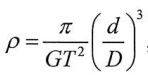 , where G=
 is the gravitational constant.
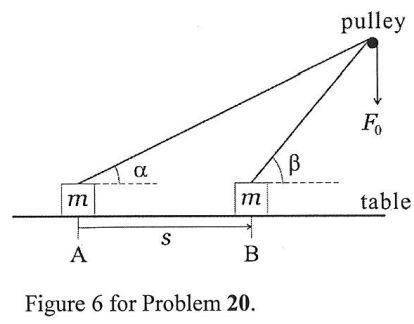 (A) W =0(N.m) (B) W =10.0(N.m) (C) W=8.0(N.m) (D) W =1.6(N.m)