所屬科目:研究所、轉學考(插大)◆普通物理學
(a). (8%) How long after closing the switch $S$ will the potential across each capacitor be reduced to 10.0 V.
(b). (8%) What will be the current at that time?
(a). (8%) Find the reading of meter A1, A2, A3 and A4 just after \( S \) is closed.
(b). (8%) What does meter A1, A2, A3 and A4 read long after S is closed.
(a). (5%) In case of balls falling in the vacuum (as shown in the left figure), which ball will arrive the ground firstly. Why? (steel ball, wooden ball or arrive at the same time)
(b). (8%) In case of balls falling in the atmosphere (as shown in the right figure), which ball will arrive the ground firstly. Why? (steel ball, wooden ball or arrive at the same time)
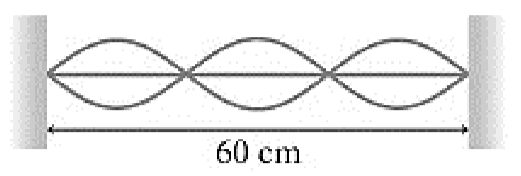
4. (10%) In the figure, a standing wave is oscillating at 690 Hz on a string. What is the speed of traveling waves on this string?
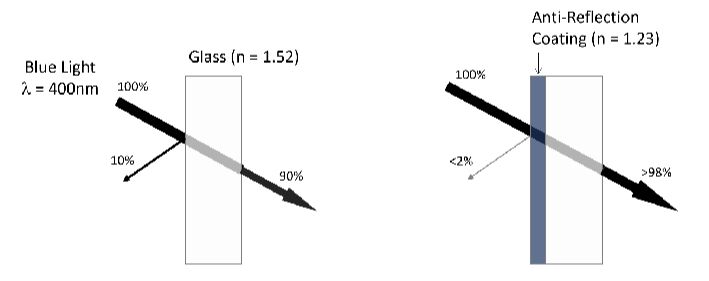
5. (15%) As indicated in the figure, a blue light in air (wavelength, $\lambda = 400$ nm) passing a glass (refractive index, n = 1.52) usually has a 10% reflection of light intensity. Assume a thin-film material (refractive index, n = 1.23) is coated on the surface of glass to reduce the reflectivity ($< 2\%$), what should be the minimum thickness of this anti-reflection coating? (Light speed, $c = 3.0 \times 10^8$ m/s)
(a). (7%) What is the final speed of block A?
(b). (8%) How much potential energy was stored in the compressed spring?
(a) (7%) In Case (A), a solid brass cylinder and a solid wood cylinder have the same radius and mass. When releasing these two cylinders together from rest to roll down an incline (no slip happened), which cylinder reaches the bottom firstly, or they arrive at the same time? Why?
(b) (8%) In Case (B), the wood cylinder is then shortened to match the length of the brass cylinder, and the brass cylinder is drilled out along its long (central) axis to match the mass of the wood cylinder. In this case, which cylinder will win the race? Why?
 阿摩線上測驗
登入