所屬科目:【阿摩】未分類題庫
1. (20%) Consider an RSA cryptographic system with the public key \( (n, e) = (649, 387) \). First, find prime numbers \( p \) and \( q \) such that \( n = pq \). Second, find the value of \( d \) in the private key \( (n, d) \). Third, decrypt the ciphertext 10 into plaintext. Fourth, encrypt the plaintext 351 into ciphertext. Finally, answer the question "Is it possible to find more than one values of \( d \) in the range \( 0 < d < (p - 1)(q - 1) \) that works in decryption?" If your answer is YES, find all possible values of \( d \); if your answer is NO, give a brief proof.
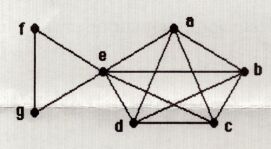
2. (20%) Answer the questions about the following graph. Is it a planar graph? Does it have a Euler circuit? Does it have a Euler path? Does it have a Hamilton circuit? Does it have a Hamilton path? Prove your answers.
3. (10%) Solve the recurrence relation \( na_n - (n+1)a_{n-1} = 1 \) with the initial condition \( a_0 = 1 \).
(a)(5%) The nonsingular matrix A can be reduced to row echelon form with a finite number of elementary row operations. Thus \( U = E_k E_{k-1} \cdots E_1 A \), where \( U \) denotes the upper triangular matrix, and \( E_n \) represents the elementary matrix, \( n = 1, \dots, k \). Then \( \det(U) = \det(E_k)\det(E_{k-1}) \cdots \det(E_1)\det(A) \). Use the above two equations, first find \( U \) and then compute \( \det(A) \) for the above linear system.
(b) (5%) (Triangular Factorization problem) Let \( A = LU \), where \( L \) and \( U \) denote the lower triangular matrix and upper triangular matrix, respectively. Find \( L \).
(c) (5%) Express the linear system in matrix representation \( A\vec{x} = \vec{b} \), then solve the linear system by computing \( A^{-1} \).
(d) \( (5\%) \) Solve the linear system using Cramer's Rule.
(a) \( (2\%) \) Is \( \{\vec{a}1,\vec{a}2,\vec{a}_4\} \) a spanning set for \( \mathbb{R}^3? \) Explain why or why not.
(b) \( (3\%) \) Are vectors \( \vec{a}1, \vec{a}2, \vec{a}3 \), and \( \vec{a}4 \) linearly independent? Explain why or why not.
(c) \( (5\%) \) Let matrix \( A = (\vec{a}1,\vec{a}2,\vec{a}_3) \). Find the eigenvalues of \( A \).
(d)(5%) Let \( \lambda_1, \lambda_2, \cdots, \lambda_n \) be the eigenvalues of matrix A. Prove that \( \det(A) = \lambda_1 \cdot \lambda_2 \cdot \cdots \lambda_n \).
6. (5%) Apply "Cauchy-Schwarz Inequality" and prove \( \| \vec{u} +\vec{v}\| \leq \| \vec{u}\| +\| \vec{v}\| \)
(a) (5%) If \( L \) is a linear transformation mapping from \( R^n \) into \( R^m \), there is an \( m \) by \( n \) matrix \( A \) such that \( L(\vec{x}) = A\vec{x} \) for each \( \vec{x} \in R^n \). This is the matrix representation for a linear transformation. Prove that the \( j \)th column vector \( \vec{a}j \) of \( A \) is given by \( \vec{a}j = L(\vec{e}_j) \), for \( j = 1, 2, \dots, n \).
(b) (5%) Let \( L(\vec{x}) = (2\vec{x}1 - \vec{x}2 - \vec{x}3, \vec{x}1 + 2\vec{x}2 - \vec{x}3)^{\mathrm{T}} \) be the transformation from \( R^3 \) to \( R^2 \). Determine the standard matrix representation \( A \) of the above transformation and find \( L(\vec{x}) \) for \( \vec{x} = (1, 2, 3)^{\mathrm{T}} \).
 阿摩線上測驗
登入