所屬科目:研究所、轉學考(插大)◆普通物理學
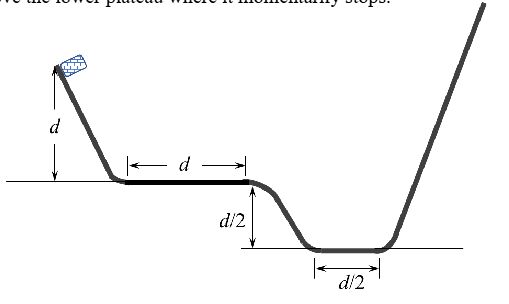
1. (12%) In the shown figure, a block is released from rest at height d = 50 cm and slides down a frictionless ramp and onto a first plateau, which has length d and where the coefficient of kinetic friction is 0.50. If the block is still moving, it then slides down a second frictionless ramp through height d/2 and onto a lower plateau, which has length d/2 and where the coefficient of kinetic friction is again 0.50. If the block is still moving, it then slides up a frictionless ramp until it (momentarily) stops. Where does the block stop? If its final stop is on a plateau, state which one and give the distance L from the left edge of that plateau. If the block reaches the ramp, give the height H above the lower plateau where it momentarily stops.
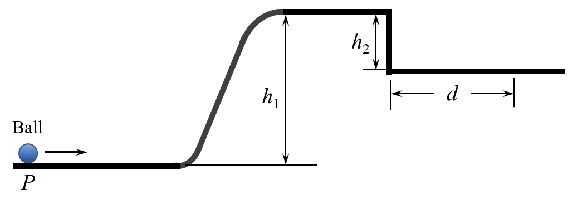
2. (12%) In the shown figure, a small, solid, uniform ball of mass M and radius R is to be shot from point P so that it rolls smoothly along a horizontal path, up along a ramp, and onto a plateau. Then, it leaves the plateau horizontally to land on a game board, at a horizontal distance d from the right edge of the plateau. The vertical heights are h1 = 5.00 cm and h2 = 1.60 cm. With what speed must the ball be shot at point P for it to land at d = 6.00 cm? (The moment of inertia of a solid sphere about central axis is (2/5)MR2.)
3. (5%) Explain why the surface of a perfect conductor is an equipotential surface under electrostatic condition.
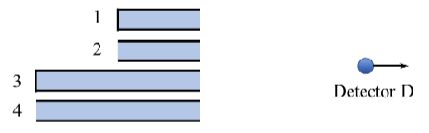
(12%) The figure shows four tubes with lengths 1.0 m or 2.0 m, with one or two open ends as drawn. The third harmonic is set up in each tube, and some of the sound that escapes from them is detected by detector \( D \), which moves directly away from the tubes. <u>In terms of the speed of sound \( v \), what speed must the detector have such that the detected frequency of the sound from (a) tube 1, (b) tube 2, (c) tube 3, and (d) tube 4 is equal to the tube’s fundamental frequency?</u>
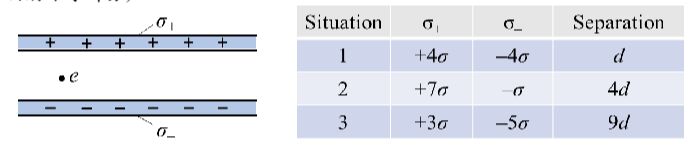
5. (10%) In the shown figure an electron is released between two infinite nonconducting sheets that are horizontal and have uniform surface charge density σ+ and σ–, as indicated. The electron is subjected to the following three situations involving surface charge densities and sheet separations. Rank the magnitudes of the electron’s acceleration and Explain your answer. (無說 明理由將不予計分)
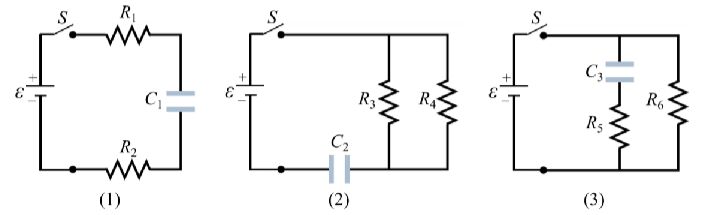
(15%) Consider three circuits as shown and assume the batteries have no internal resistance. All capacitors (\( C_1 \), \( C_2 \), and \( C_3 \)) are initially uncharged. The resistors and capacitors are all identical with resistance \( R \) and capacitance \( C \), respectively. (a) All switches \( S \) are closed at \( t = 0 \), find the currents in the resistors \( R_2 \), \( R_4 \), and \( R_6 \) at \( t = 0 \)? After the switches are closed for a very long time (\( t \to \infty \)), (b) determine the currents in the resistors \( R_2 \), \( R_4 \), and \( R_6 \) and (c) the stored energies in the capacitors \( C_1 \), \( C_2 \), and \( C_3 \). (d) <u>Rank</u> the time required for the capacitor to reach 50% of its final charge and <u>Explain your answer</u>. (無說明理由將不予計分)
(11%) An electron moves in a circle of radius \( r = 5.29 \times 10^{-11} \, \text{m} \) with speed \( 2.19 \times 10^6 \, \text{m/s} \). Treat the circular path as a current loop with a constant current equal to the ratio of the electron's charge magnitude to the period of the motion. If the circle lies in a uniform magnetic field of magnitude \( B = 7.10 \, \text{mT} \), what is the maximum possible magnitude of the torque produced on the loop by the field?
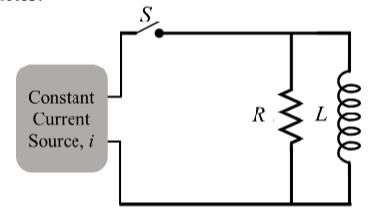
8. (12%) In the shown figure, after switch S is closed at time t = 0, the emf of the source is automatically adjusted to maintain a constant current i through S. (a) Find the current through the inductor as a function of time. (b) At what time is the current through the resistor equal to the current through the inductor?
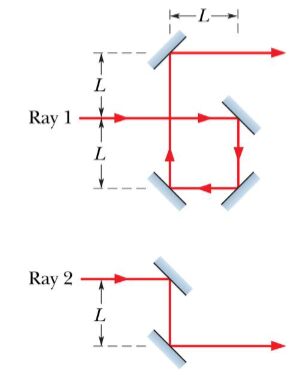
9. (11%) Two light rays go through different paths by reflecting from the various flat surfaces as shown. The light waves have a wavelength of 420.0 nm and are initially in phase. What are the (a) smallest and (b) second smallest value of distance L that will put the waves exactly out of phase as they emerge from the region?
 阿摩線上測驗
登入
 </u>