所屬科目:研究所、轉學考(插大)◆生物化學
1. Protein X becomes more active in an acidic environment. When the surrounding pH decreases, protein X undergoes a conformational change, leading to its activation. Which of the following amino acid residues is most likely responsible for this pH-dependent regulation?(A) Alanine(B) Leucine(C) Histidine(D) Valine(E) Phenylalanine
2. A research team is studying a mutation in protein Y associated with a genetic disorder. They discover that a single amino acid substitution causes a loss of a-helical structure in a critical domain of protein Y, leading to the protein misfolding and loss of function. Which of the following amino acid substitutions is most likely responsible for disrupting the a-helix in this protein?(A) Alanine → Leucine(B) Leucine → Valine(C) Alanine → Glutamic acid(D) Leucine → Proline(E) Valine → Isoleucine
3. A systems biologist examines how biological processes operate over vastly different time scales, from molecular events to cellular functions. Which of the following processes occurs on the "shortest" time scale?(A) Cell division during tissue renewal(B) Protein synthesis from mRNA(C) Folding of a newly synthesized protein(D) Chromatin remodeling during gene regulation(E) Enzyme-catalyzed bond formation at the active site
4. A 0.02 M solution of monoprotic acid HA has a pH of 4.0. What are the values of the acid dissociation constant \(K_a\) and \(pK_a\)? (A) \(K_a = 5.0 \times 10^{-7}\), \(pK_a = 6.30\) (B) \(K_a = 5.0 \times 10^{-9}\), \(pK_a = 8.30\)(C)\(K_a = 1.0 \times 10^{-4}\), \(pK_a = 4.00\) (D)\(K_a = 2.0 \times 10^{-6}\), \(pK_a = 5.70\) (E) \(K_a = 1.0 \times 10^{-5}\), \(pK_a = 5.00\)
5. Which statement about the functions of O-linked and N-linked glycosylation is CORRECT?(A) N-linked glycosylation mainly controls the cytoskeleton, while O-linked glycosylation controls protein folding in the ER.(B) O-linked glycosylation promotes protein folding in the ER, while N-linked glycosylation is not needed for quality control.(C) N-linked glycosylation is essential for protein folding, ER quality control, and secretion, while O-linked glycosylation affects protein stability and cell interactions.(D) Both mainly serve as energy storage with little effect on protein function.(E) O-linked glycosylation sends misfolded proteins to the proteasome, while N-linked glycosylation mainly presents antigens.
6. Which of the following statements about lipids in biological membranes is correct?(A) The hydrophobic tails of phospholipids are primarily composed of fatty acid chains.(B) Saturated fatty acids contain double bonds and increase membrane fluidity.(C) Cholesterol increases membrane fluidity at all temperatures.(D) Lipids in biological membranes cannot be modified by sugars and therefore do not participate in cell recognition.(E) Natural unsaturated fatty acids commonly contain trans double bonds.
7. Which statement about primary active transporters is correct?(A) They use the electrochemical gradient of another ion to drive solute transport.(B) They directly hydrolyze ATP to move substrates against their concentration gradients.(C) They transport substrates only down their concentration gradients.(D) They function exclusively as symporters in biological membranes.(E) They do not require energy input for substrate transport.
8. Lipids, sugars, and amino acids can be chiral. Which statement about their stereochemical properties in nature is correct?(A) All naturally occurring amino acids in proteins are chiral and have the L-configuration.(B) Fatty acids in biological membranes are predominantly chiral and exist mainly as L-enantiomers.(C) Naturally occurring sugars and amino acids both predominantly adopt the L-configuration.(D) Most monosaccharides in biological systems have the D-configuration, and glycerol-based membrane lipids are synthesized from sn-glycerol-3-phosphate with defined stereochemistry.(E) Biological systems contain racemic mixtures of sugars, amino acids, and lipids due to spontaneous chemical reactions.
9. Which statement correctly describes the effects of competitive, noncompetitive, and uncompetitive enzyme inhibitors on kinetic parameters?(A) Competitive inhibitors decrease Vmax but do not affect Km.(B) Noncompetitive inhibitors increase Km but do not change Vmax.(C) Uncompetitive inhibitors decrease both Vmax and Km.(D) Competitive inhibitors decrease both Vmax and Km.(E) Uncompetitive inhibitors increase Vmax by stabilizing the enzyme-substrate complex.
10. In transmembrane proteins, which amino acid is most commonly enriched at the water-lipid interface of the membrane?(A) S(B) P(C) A(D) F(E) W
11. Which of the TCA cycle intermediates is not a four-carbon molecule?(A) Succinate(B) Fumarate(C) Malate(D) Citrate(E) Oxaloacetate
12. Which of the following enzyme complexes links glycolysis to the TCA cycle?(A) Pyruvate dehydrogenase complex(B) a-ketoglutarate dehydrogenase complex(C) Glyceraldehyde-3-phosphate dehydrogenase(D) Pyruvate kinase complex(E) Phosphoglycerate kinase complex
13. Which of the following molecules cannot stimulate glycolytic flux?(A) AMP(B) ADP(C) Fructose-2,6-bisphosphate(D) Insulin(E) Citrate
14. Which of the following enzyme complexes links the TCA cycle to the electron transport chain in the inner mitochondrial membrane?(A) NADH ubiquinone oxidoreductase complex(B) Ubiquinol-cytochrome c reductase complex(C) Succinate dehydrogenase complex(D) Pyruvate dehydrogenase complex(E) Phosphoglycerate kinase complex
15. The linear photosynthesis electron chain does not involve the transport of electrons to:(A) Photosystem I(B) Photosystem III(C) Cytochrome b6f complex(D) Plastoquinone(E) Ferredoxin
16. Which of the following biomolecule is a crossroad between glycolytic pathway and pentose phosphate pathway?(A) Glucose 6-phosphate(B) Glyceraldehyde 3-phosphate(C) Pyruvate(D) Acetyl-CoA(E) Fructose 1,6-bisphosphate
17. Which of the following reaction would favor cellular gluconeogenesis in the fasted state?(A) AMP activates phosphfructokinase 1(B) Fructose 2,6-bisphosphateactivates pyruvate kinase(C) Acetyl-CoA activates pyruvate carboxylase(D) NAD+ activates glyceraldehyde 3-phosphate dehydrogenase(E) None of the above.
18. Which of the following urine component can be used as a biomarker to monitor DNA turnover?(A) beta-aminoisobutyrate(B) ammonium ion(C) beta-alanine(D) cytidine(E) AMP
19. Which of the following amino acid is a pure ketogenic amino acid means its carbon skeleton can be used for the synthesis of ketone bodies but not glucose?(A) Lysine(B) Glycine(C) Proline(D) Methionine(E) Tryptophan
20. Carnitine transport of fatty acids from the cytosol to the mitochondria is important for fatty acid catabolism. Which of the following statement is not true?(A) the reaction is energy required(B) free carnitine and acyl-carnitine can be exchanged across mitochondrial inner membrane(C) release of CoASH from fatty acyl CoA in the cytosol side(D) carnitine:acylcarnitine translocase plays essential role in this reaction(E) carnitine palmitoyl transferase 1 and 2 located on outer- and inner-mitochondrial membrane, respectively.
21. G-proteins are associated with which receptor superfamily?(A) oligomeric ligand-gated ion channels(B) 7-transmembrane segment (7-TMS) receptors(C) cell adhesion protein receptors(D) single-transmembrane segment catalytic receptors(E) none of the above
22. The second messenger produced from the hydrolysis of PIP$_{2}$ that activates the increase of Ca$^{++}$ concentrations in the cytoplasm is:(A) diacylglycerol (DAG).(B) phosphatidylinositol (PI).(C) phosphatidylinositol-4,5-bisphosphate (PIP$_{2}$).(D) inositol-1,4,5-trisphosphate (IP$_{3}$).(E) inositol-1,4-bisphosphate (IP2).
23. Which of the following is NOT a second messenger?(A) cGMP(B) norepinephrine(C) nitric oxide(D) diacylglycerol(E) Ca$^{2+}$
24. A highly conserved protein that is involved in protein degradation is:(A) ricin(B) met-aminopeptidase(C) ubiquitin(D) degradase(E) peptidyl transferase
25. Mitochondrial and chloroplastic ribosomes resemble __ ribosomes.(A) prokaryotic(B) lower eukaryotic(C) higher eukaryotic(D) no other(E) none are true
1. In a cell at 37°C (310 K), ATP hydrolysis is:ATP + H₂O → ADP + PᵢGiven:ΔG°' = -30.5 kJ/mole[ATP] = 5.0 mM[ADP] = 0.50 mM[Pᵢ] = 1.0 mMand assume activity of water ≈ 1.(a) Calculate the reaction quotient Q. (5%)(b) Compared with standard biochemical conditions, is ATP hydrolysis more favorable, less favorable, or equally favorable in this cell? Briefly justify. (5%)
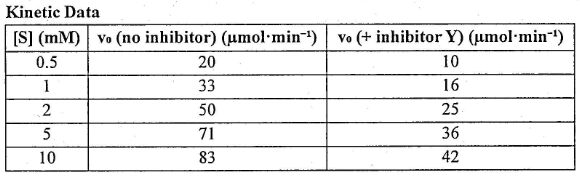
2. The initial velocity of an enzyme-catalyzed reaction was measured at various substrate concentrations in the absence and in the presence of inhibitor Y at a fixed concentration. The results are shown below.(a) Based on the data, how does inhibitor Y affect Vmax and Km? (4%)??(b) What type of inhibition does inhibitor Y most likely exhibit? Explain briefly using the kinetic data. (4%)??(c) If the substrate concentration were increased to a very high level, would the inhibition by Y be overcome? Why or why not? (2%)??
 阿摩線上測驗
登入