2. The initial velocity of an enzyme-catalyzed reaction was measured at various substrate concentrations in the absence and in the presence of inhibitor Y at a fixed concentration. The results are shown below.
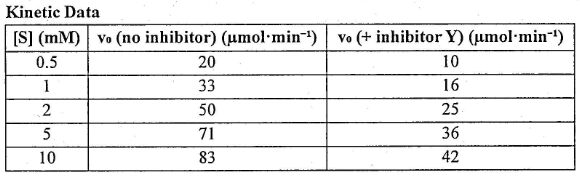
Kinetic Data

| [S] (mM) | vo (no inhibitor) (µmol·min⁻¹) | vo (+ inhibitor Y) (µmol·min⁻¹) |
| :------- | :----------------------------- | :----------------------------- |
| 0.5 | 20 | 10 |
| 1 | 33 | 16 |
| 2 | 50 | 25 |
| 5 | 71 | 36 |
| 10 | 83 | 42 |

(a) Based on the data, how does inhibitor Y affect Vmax and Km? (4%)??
(b) What type of inhibition does inhibitor Y most likely exhibit? Explain briefly using the kinetic data. (4%)??
(c) If the substrate concentration were increased to a very high level, would the inhibition by Y be overcome? Why or why not? (2%)??

3. Please explain the definition (2%), process (4%), and mechanism (4%) of photorespiration.??

4.
(a) What is the salvage pathway of purine???
(b) What reactions (substrates & products) are involved???
(c) What is the key enzyme in response to this process???
(d) What disease is caused by the deficient of this key enzyme???
(e) What is the outcome of the disease?

??


5. The folding cycle of the GroES-GroEL complex in E. coli involves the following steps: Please consider these steps and arrange them in the correct order for the folding cycle.

選項:
A. ATP binding to GroEL
B. GroES dissociates from the complex
C. Partially folded protein hydrophobic residues bind GroEL
D. GroES is recruited to GroEL
E. GroES promotes ATP hydrolysis and α-subunits undergo a conformational change that buries the hydrophobic patches