所屬科目:研究所、轉學考(插大)◆普通物理學
1. Given the velocity of a car in two dimensions: = (t²-1, 3). The car starts out at position (x, y) = (2, 4) at t = 0. What is the car at t = 3? (A) (6,9) (B) (8,3) (C) (10,7) (D) (8,13) (E) none of the above.
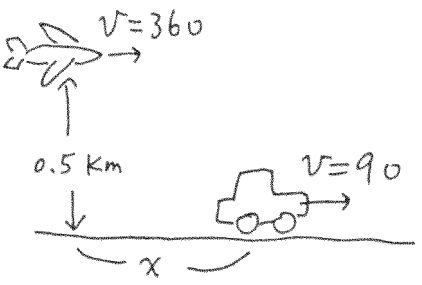
2. An airplane flies at an altitude of 0.5 km and a speed of 360 km/h. At what horizontal distance x should it release a bomb to hit a target that is moving with constant velocity 90 km/h? (Approximate the gravitational acceleration g by 10 m/s² throughout this test)
(A) 500 (B) 750 (C) 250 (D) 1000 (E) none of the above.
3. A boy wishes to row across a river in the shortest possible time. He can row at 2 m/s in still water and the river is flowing at 1 m/s. At what angle with respect to the water velocity should he point the bow (the front of the boat)? (A) 30° (B) 45° (C) 60° (D) 90° (E) none of the above.
4. Two blocks of mass 25 kg and 75 kg are connected by a light rope across a fixed pulley of radius 50 cm and moment of inertia I = 10 kg·m². Assume that the rope never slips. What is the magnitude of the acceleration of the 75 kg block? (A) 0.54 m/s² (B) 0.1 m/s² (C) 0.049 m/s² (D) 0.8 m/s² (E) none of the above.
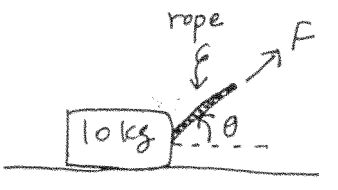
5. A rope is used to pull a 10 kg box with constant velocity across the floor with coefficient of kinetic friction μk = 1/√3. At what angle (in degrees) is the force F least?
(A) 30 (B) 45 (C) 60 (D) 0 (E) none of the above.
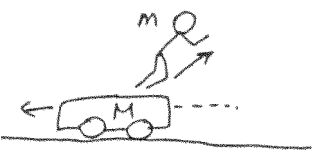
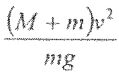
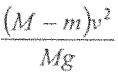
6. My weight is mg and the maximum speed my jump is v₀. If I jump off a cart of mass M that can move without friction, what is my maximum horizontal displacement via adjusting the angle of my jump? Note that v₀ is now measured relative to the car.
(A) (B) (C) (D) (E) none of the above.
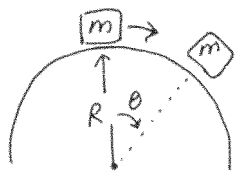
7. An object of mass m that is initially at rest slides down from the top of a smooth sphere (of radius R). If the size of the object is negligible, at what angle θ will it detach from the sphere?
(A) cosθ = 1/2 (B) sinθ = 1/2 (C) sinθ = 2/3 (D) cosθ = 2/3 (E) none of the above.
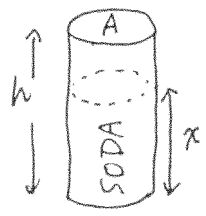
8. A uniform soda can of base area A = 12 cm², mass m = 10 g and height h = 20 cm is filled with soda of density ρ = 1 g/cm³. Use x to denote the height of the remaining soda; find the x that makes the center of mass of the whole system the lowest. It occurs when the soda is
(A) half-filled (B) less than half, but more than a quarter filled (C) less than a quarter filled (D) completely empty (E) none of the above.
9. A 10 kg monkey climbs up a light rope that runs over a frictionless tree limb and back down to a 20 kg package on the ground. What is the least acceleration the monkey must have if it is to lift the package off the ground? (A) g/4 (B) g/2 (C) g (D) 2g (E) none of the above.
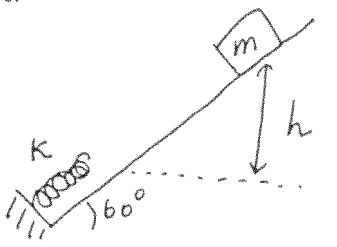
10. A block of mass m = 10 kg slides from vertical height h = 1 m down a slope of angle θ = π/3 and kinetic friction coefficient μk = 0.5. At the foot of the slope lies a spring of constant K = 200 nt/m. What is the maximum compression of the spring?
(A) 1 (B) 1.5 (C) 2 (D) 2.5 (E) none of the above.
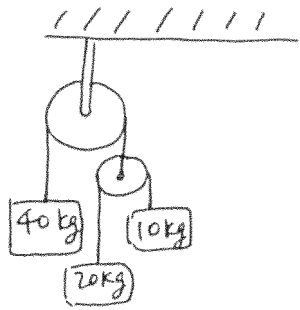
11. Three masses are connected by two massless pulleys as shown in the figure. Find the acceleration of the 10 kg mass?
(A) 6 (B) 4 (C) 2 (D) 1 (E) none of the above.
12. How much gravitational potential energy is stored in a uniform solid sphere of mass M and radius R? (Use G to denote the gravitational constant). (A) GM/R (B) GM²/R (C) 2GM²/R (D) 2GM²/5R (E) none of the above.
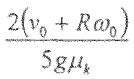
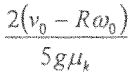
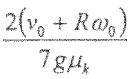
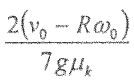
13. A bowler throws a bowling ball of radius R and mass M (and moment of inertia I = 2MR²/5) along a lane. The ball slides on the lane with initial speed v₀ and initial angular speed ω₀. The coefficient of kinetic friction between the ball and the lane is μk. How long does it take before the ball rolls without slipping? (A)(B)(C)(D)(E) none of the above.
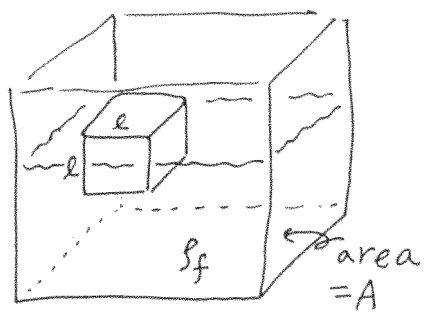
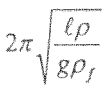
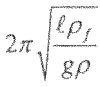
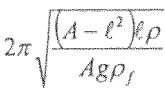
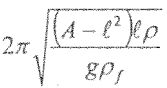
14. A cubic block of size ℓ and density ρ floats in a container of base area A which is filled with fluid of density ρf. If I tap the block on the top surface, it will oscillate up and down. What will be the period of this simple harmonic motion?
(A)(B)(C) (D) (E) none of the above.
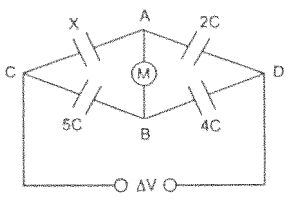
15. Four capacitors are arranged as shown in the right figure. A potential difference ΔV is applied between the terminal C and D. A voltmeter M is connected between A and B. What is the capacitance of capacitor X such that the meter reads zero?
(A) 5C/2 (B) 8C/5 (C) 20C/11 (D) 1C (E) 20C.
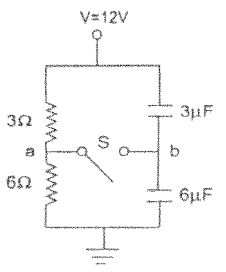
16. What is the potential of point a with respect to point b in the right figure when switch S is open?
(A) -4V (B) 4V (C) 8V (D) 0V (E) 2V.
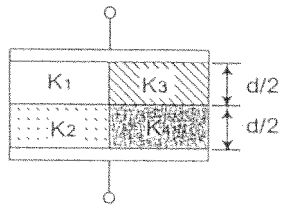
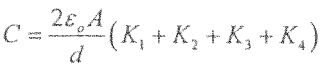
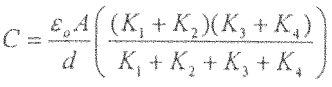
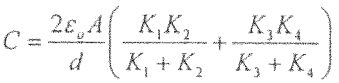
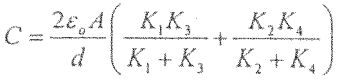
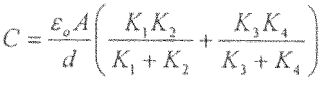
17. A parallel-plate capacitor has space between the plates filled with four slabs of dielectric. The dielectric constant of each slab is indicated in the figure below on the next page. Each slab has thickness d/2, where d is the plate separation. What is the capacitance of the parallel-plate capacitor?
(A)(B) (C)(D)(E)
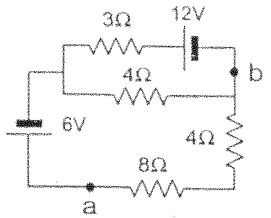
18. For the circuit shown on the right, what is the potential difference between points a and b?
(A) 11.25V (B) 6V (C) 0.75V (D) 5.25V (E) 18V
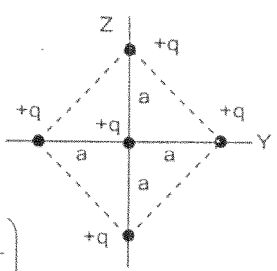
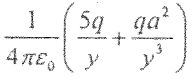
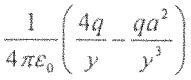
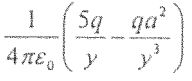
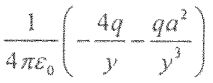
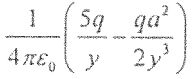
19. Five equal positive point charges q are fixed at coordinate (0,0), (0,+a), (0,-a), (+a,0) and (-a,0) on the Z,Y coordinate system as shown. What is the electric potential at point along the Y-axis if y is very large compared with a?
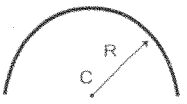
20. A thin plastic rod has uniform linear positive charge density λ distributed along a semicircular arc of radius R. What is the magnitude of the electric field at the center of the arc?
(A)(B)(C)(D)(E)
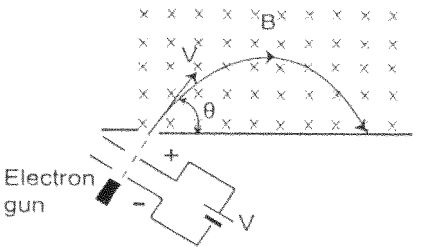
21. A particle with mass m and charge q emerging from the gun with a velocity V makes an angle θ with the axis as shown. There is a uniform magnetic field B parallel to the axis, so the trajectory of the particle will be a helix. What is the time for the particle to touch the axis again?
(A) (B)(C)(D)(E)
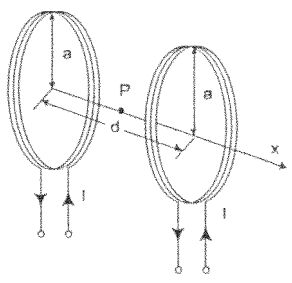
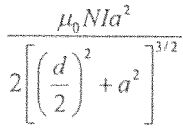
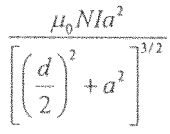
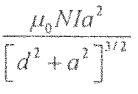
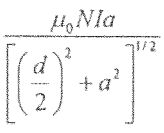
22. Two circular coils with radius a, each of N turns, are separated by a distance d. Each coil carriers a current I circulating in the same direction. What is the magnetic field in the midway point on the axis between the coils?
(A)(B)(C) 0 (D)(E)
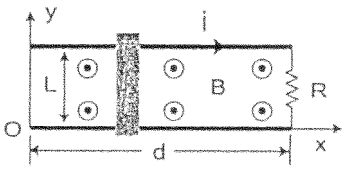
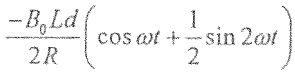
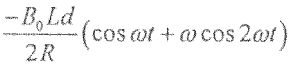
23. Two parallel conducting rails with width L and length d and a conducting sliding bar in a sinusoidal varying magnetic field = B₀cosωt ẑ. The position of the sliding bar is given by x = (1-sinωt). What is the current through R?
(A)(B) (C)(D) (E)
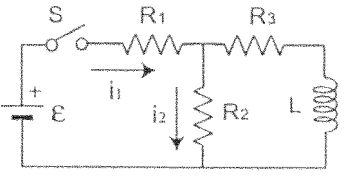
24. Consider the circuit shown on the right. The circuit elements have following values: ε=10V, R₁=10Ω, R₂=20Ω, R₃=30Ω, L=8H. Switch S is closed at time t=0. What are the initial currents i₁ and i₂?
(A) i₁ = 0.45 A, i₂ = 0.27 A (B) i₁ = 0.45 A, i₂ = 0.18A (C) i₁ = 0.33 A, i₂ = 0.19 A (D) i₁ = 0.45 A, i₂ = 0.45 A (E) i₁ = 0.33A, i₂ = 0.33A.
25. For a monochromatic electromagnetic plane wave of amplitude E₀, frequency ω, and phase angle θ that is traveling in the positive x-direction and polarized in the y-direction, what is the electric and magnetic field of the wave?
(A)
(B)
(C)
(D)
(E)
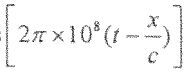
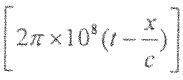
26. The electric field of a plane electromagnetic wave in vacuum is represented by
Ex = Ez = 0, Ey = 0.5cos NC⁻¹.
Which of the following statement is incorrect? (A) The wavelength is 3m. (B) It is a linear polarized wave. (C) The wave travels out +x axis. (D) By = ẑcos (E) The average intensity is 5.3×10⁻⁴ Wm⁻². (vacuum permittivity ε₀ = 8.85×10⁻¹² Wm⁻²)
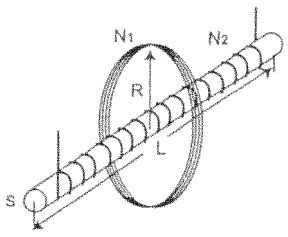
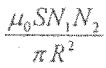
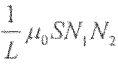
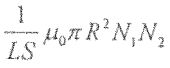
27. A coil with N₁ turns and radius R is placed around a very long solenoid with cross section S and N₂ turns. The windings of the solenoid have length L. What is the mutual inductance of the system?
(A) (B) (C)(D) μ₀SN₁N₂ (E)
28. A cylindrical container of an incompressible liquid with density ρ rotates with constant angular speed ω about its axis of symmetry, which we take to be the y-axis. The gravitational acceleration is g. The surface height h of the liquid is given by:
(A) ω²r²/2g (B) ω²r²/g (C) ω²r²/2gρ (D) ω²r²/gρ (E) none of the above.
29. After going through a free expansion, the temperature of a real gas whose intermolecular interaction is an attractive force would (A) remain the same (B) increase (C) decrease (D) not be definable (E) be arbitrary.
30. For an infinitesimal reversible process of a thermodynamic system, which of the following statement is not true?
(A) dU = CvdT - pdV (B) dU = TdS - pdV (C) dS > 0 (D) There can not be any frictional force. (E) there is no heat exchange between the system and an thermal bath with a finite temperature difference.
31. For an ideal gas in thermal equilibrium, which of the following statement is true?
(We define vav, vmp, and vrms to be the average, the most probable, and the root-mean-square speeds of the gas respectively.) (A) vav < vmp < vrms (B) vmp < vav < vrms (C) vrms < vav < vmp (D) vrms < vmp < vav (E) None of the above.
32. A volume of air (assumed to be an ideal gas) undergoes the thermodynamic process, as shown by the path abc in the figure. What is the ratio of Tc to Ta? How much heat does the air exchange with its surroundings during the process abc? The answers to these two questions are:
(A) 1.0 and 8.0 kJ (B) 1.0 and 4.0 kJ (C) 3.0 and 8.0 kJ (D) 3.0 and 4.0 kJ (E) none of the above.
33. A thermally insulated chamber has two equal-volume compartments with a movable insulated partition in between. Initially one compartment contains two moles of helium gas at T = 100 K, and the other compartment contains one mole of argon gas at T = 400 K. Assume that both gases can be considered ideal gas. What is the total change of entropy of the system after the compartment has been removed and the gases have reached a new equilibrium? (A) 1.5Rln2 (B) 3Rln2 (C) 4.5Rln2 (D) 6Rln2 (E) none of the above.
34. The speed of sound in a stationary air is 340 m/s. A police car with its 300-Hz siren turned on is moving toward a wall at 180 km/hour. The frequency of the reflected wave that the driver of the car hear is: (A) 403 Hz (B) 223 Hz (C) 344 Hz (D) 351 Hz (E) none of the above.
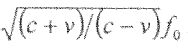
35. A police uses a radar gun of frequency f₀ to measure an approaching car moving at a speed of v. The frequency of the reflected beam measured by the police is: (A) (B) (C) f₀(c-v)/(c+v) (D) f₀(c+v)/(c-v) (E) none of the above.
36. A plane wave of monochromatic light is incident on an opaque metal sheet with four equally-spaced narrow slits. If the incident angle is slanted so that φ = nπ/2 is the phase difference between adjacent slits, and n is an integer. The center line at a far away screen parallel to the sheet is: (A) a bright line (B) a dark line (C) half way between a bright line and a dark line (D) a major bright line if n is a multiple of 4 and a minor bright line otherwise (E) a bright line if n is a multiple of 4 and a dark line otherwise.
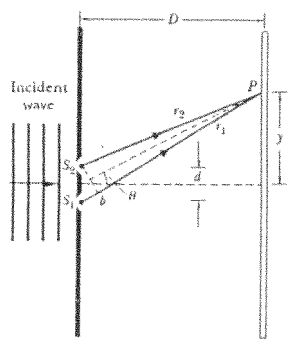
37. Slits of unequal widths are used in a double-slit arrangement to produce an interference pattern on a distant screen. If only the narrower slit S₁ is illuminated with monochromatic light of wavelength λ, the center of the pattern on the screen has amplitude E₀ and intensity I₀. If only the wider slit S₂ is illuminated, the amplitude of the light at the center of the pattern is 2E₀. In the figure on the right, d << D. The widths of the slits are much less than λ such that it is no need to consider the single-slit diffraction envelope. When both slits are illuminated, the normalized intensity pattern I(θ)/I₀ as a function of θ on a far away screen is:
(A) (5 + 4cos(2πd sinθ/λ)) (B) (4 + 5cos(2πd sinθ/λ)) (C) (3 + 2cos(2πd sinθ/λ)) (D) (2 + 3cos(2πd sinθ/λ)) (E) none of the above.
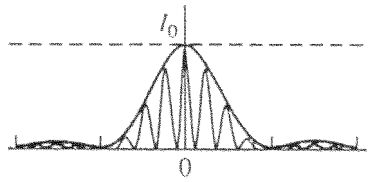
38. An Ar-laser of λ = 540 nm is used to illuminate two slits of finite width a. The center-to-center distance between the slits is d. A diffraction pattern, shown in the figure, is observed on a screen 6.0 m away. The distance between two adjacent interference maxima is 3.0 mm. The values of d and a in units of mm are:
(A) 0.27 and 0.14 (B) 0.54 and 0.14 (C) 1.08 and 0.54 (D) 1.08 and 0.27 (E) none of the above.
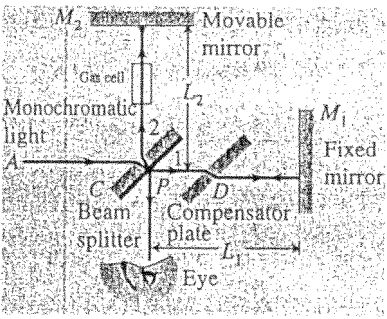
39. Linda uses a Michelson interferometer with the 606-nm light from a krypton-86 lamp and she places a gas cell of length 10.0 cm in the arm of movable mirror (as shown in the figure). Assuming the cell is filled with air at 1 atm which has an index of refraction n = 1.00025. Find the number of fringes moving across a line in her field of view if Linda slowly pumps out the air in the cell.
(A) 413 (B) 41.3 (C) 165 (D) 16.5 (E) none of the above.
40. Which of the following functions represents traveling waves moving in the positive x direction? (A) Acos((kx + ωt)²) (B) Acos((kx)² - (ωt)²) (C) Asin(ωt)cos(kx) (D) Aexp(-(x - vt)²) (E) none of the above.
 阿摩線上測驗
登入
 = (t²-1, 3). The car starts out at position (x, y) = (2, 4) at t = 0. What is the car at t = 3? (A) (6,9) (B) (8,3) (C) (10,7) (D) (8,13) (E) none of the above.
 (A) 500 (B) 750 (C) 250 (D) 1000 (E) none of the above.
 (A) 30 (B) 45 (C) 60 (D) 0 (E) none of the above.
 (A)
 (B)
 (C)
 (D)
 (E) none of the above.
 (A) cosθ = 1/2 (B) sinθ = 1/2 (C) sinθ = 2/3 (D) cosθ = 2/3 (E) none of the above.
 (A) half-filled (B) less than half, but more than a quarter filled (C) less than a quarter filled (D) completely empty (E) none of the above.
 (A) 1 (B) 1.5 (C) 2 (D) 2.5 (E) none of the above.
 (B)
 (C)
 (D)
 (E) none of the above.
 (A)
 (B)
 (C)
 (D)
 (E) none of the above.
 (A) 5C/2 (B) 8C/5 (C) 20C/11 (D) 1C (E) 20C.
 (A) -4V (B) 4V (C) 8V (D) 0V (E) 2V.
 (A)
 (B)
 (C)
 (D)
 (E)
 (A) 11.25V (B) 6V (C) 0.75V (D) 5.25V (E) 18V
 (A)
 (B)
 (C)
 (D)
 (E)
 (A)
 (B)
 (C)
 (D)
 (E)

 (A)
 (B)
 (C)
 (D)
 (E)

 (A)
 (B)
 (C) 0 (D)
 (E)
 = B₀cosωt ẑ. The position of the sliding bar is given by x =
 (1-sinωt). What is the current through R?
 (A)
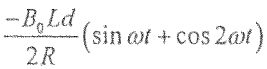 (B)
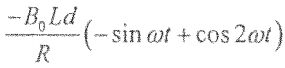 (C)
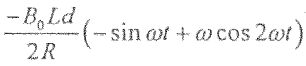 (D)
 (E)
 (A) i₁ = 0.45 A, i₂ = 0.27 A (B) i₁ = 0.45 A, i₂ = 0.18A (C) i₁ = 0.33 A, i₂ = 0.19 A (D) i₁ = 0.45 A, i₂ = 0.45 A (E) i₁ = 0.33A, i₂ = 0.33A.





 NC⁻¹.
 cos
 (E) The average intensity is 5.3×10⁻⁴ Wm⁻². (vacuum permittivity ε₀ = 8.85×10⁻¹² Wm⁻²)
 (A)
 (B)
 (C)
 (D) μ₀SN₁N₂ (E)
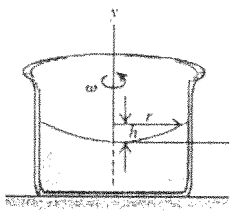 (A) ω²r²/2g (B) ω²r²/g (C) ω²r²/2gρ (D) ω²r²/gρ (E) none of the above.
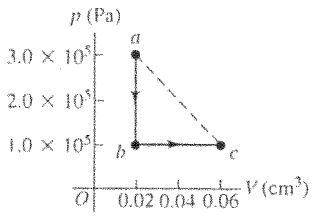 (A) 1.0 and 8.0 kJ (B) 1.0 and 4.0 kJ (C) 3.0 and 8.0 kJ (D) 3.0 and 4.0 kJ (E) none of the above.
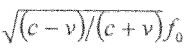 (B)
 (C) f₀(c-v)/(c+v) (D) f₀(c+v)/(c-v) (E) none of the above.
 (A) (5 + 4cos(2πd sinθ/λ)) (B) (4 + 5cos(2πd sinθ/λ)) (C) (3 + 2cos(2πd sinθ/λ)) (D) (2 + 3cos(2πd sinθ/λ)) (E) none of the above.
 (A) 0.27 and 0.14 (B) 0.54 and 0.14 (C) 1.08 and 0.54 (D) 1.08 and 0.27 (E) none of the above.
 (A) 413 (B) 41.3 (C) 165 (D) 16.5 (E) none of the above.