 阿摩線上測驗
1. Figure 1 demonstrates that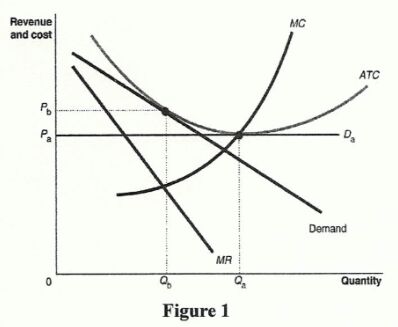
(A) In the short run, the monopolistic competitor produces an output \( Q_{b} \) but in the long run after it adjusts its capacity, it will produce the allocatively efficient output, \( Q_{a} \).
(B) It is not possible for a monopolistic competitor to produce the productively efficient output level, \( Q_{a} \), because of product differentiation.
(C) It is possible for a monopolistic competitor to produce the productively efficient output level, \( Q_{a} \), if it is willing to lower its price from \( P_{b} \) to \( P_{a} \).
(D) In the long run, the monopolistic competitor produces the minimum-cost output level, \( Q_{a} \), but in the short run its output of \( Q_{b} \) is not cost minimizing. Figure 2 In 2025, New Taipei City's Franchise and Concession Review Committee granted permission to firm A to enter the market for cable TV, ending the monopolies of firms B and C. Figure 2 shows the cable television market in New Taipei City.
統計: 尚無統計資料