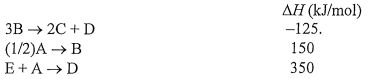
所屬科目:研究所、轉學考(插大)◆普通化學
1. Avogadro's hypothesis states that: (A) Each atom of oxygen is 16 times more massive than an atom of hydrogen. (B) A given compound always contains exactly the same proportion of elements by mass. (C) When two elements form a series of compounds, the ratios of masses that combine with 1 gram of the first element can always be reduced to small whole numbers. (D) At the same temperature and pressure, equal volumes of different gases contain an equal number of particles. (E) Mass is neither created nor destroyed in a chemical reaction.
2. Consider an atom traveling at 1% of the speed of light. The de Broglie wavelength is found to be 4.15 x 10⁻³ pm. Which element is this? (h=6.626 x 10⁻³⁴ J-s) (A) He (B) S (C) F (D) Cu (E) P
3. The electron configuration for the carbon atom is: (A)\(1s^2 2s^2 2p^2\) (B) [He] \(2s^4\) (C) [Ne] \(2s^2 2p^2\) (D) \(1s^2 2p^4\) (E) none of these
4. In the gaseous phase, which of the following diatomic molecules would be the most polar? (A) CsF (B) CsCl (C) NaCl (D) NaF (E) LiF
5. All of the following are in aqueous solution. Which is incorrectly named? (A) H2SO4 sulfuric acid (B) H2CO3, carbonic acid (C) H3PO4 phosphoric acid (D) HCN, cyanic acid (E) HCl, hydrochloric acid
6. The molecular structure of NO3- is (A) linear (B) trigonal planar (C) tetrahedral (D) bent (E) none of these
7. The fact that O2 is paramagnetic can be explained by (A) the Lewis structure of O2 (B) resonance (C) a violation of the octet rule (D) the molecular orbital diagram for O2 (E) hybridization of atomic orbitals in O2
8. According to the first law of thermodynamics, the energy of the universe is constant. Does this mean that ΔE is always equal to zero? (A) Yes, ΔE = 0 at all times, which is why q = -w. (B) No, ΔE does not always equal zero, but this is only due to factors like friction and heat. (C) No, ΔE does not always equal zero because it refers to the system's internal energy, which is affected by heat and work. (D) No, ΔE never equals zero because work is always being done on the system or by the system. (E) No, ΔE never equals zero because energy is always flowing between the system and surroundings.
10. Consider a sample of gas in a container on a comfortable spring day. The Celsius temperature suddenly doubles, and you transfer the gas to a container with twice the volume of the first container. If the original pressure was 12 atm, what is a good estimate for the new pressure? (A) 3 atm (B) 5.5 atm (C) 6.4 atm (D) 12 atm (E) 15 atm
11. A sample of N2 gas is contaminated with a gas ( A ) of unknown molar mass. The partial pressure of each gas is known to be 200. torr at 25°C. The gases are allowed to effuse through a pinhole, and it is found that gas A escapes at 2 times the rate of N2. The molar mass of gas A is: (A) 7.00 g/mol (B) 56 g/mol (C) 14.01 g/mol (D) 112 g/mol (E) none of these
12. Chromium metal (52g/mol) crystallizes as a body-centered cubic lattice. If the atomic radius of Cr is 1.25 angstroms, what is the density of Cr metal in g/cm3? (Cr=52 g/mol) (A) 5.52 (B) 7.18 (C) 14.4 (D) 2.76 (E) 3.59
13. When one mole of benzene is vaporized at a constant pressure of 1.00 atm and at its boiling point of 353.0 K, 30.33 kJ of energy (heat) is absorbed and the volume change is +28.90 L. What is ΔH for this process? (1 L·atm = 101.3 J) (A) 27.40 kJ (B) 33.26 kJ (C) 1.43 kJ (D) 30.33 kJ (E) 59.23 kJ
14. A benzene-toluene solution is allowed to come to equilibrium with its vapor. The vapor is then condensed and found to contain 50.0 mole percent of each component. Calculate the composition (mole percent) of the original solution. The vapor pressures of pure benzene and toluene at this temperature are: 750. torr and 300. torr, respectively. (A) 50.2% benzene (B) 28.6% benzene (C) 71.0% benzene (D) 40.0% benzene (E) none of these
15. A 5.86-gram sample of a compound is dissolved in 250. grams of benzene. The freezing point of this solution is 1.02°C below that of pure benzene. What is the molar mass of this compound? (Note: Kf for benzene = 5.12°C/m.) Ignore significant figures for this problem. (A) 29.4 g/mol (B) 118 g/mol (C) 235 g/mol (D) 4.67 g/mol (E) 58.8 g/mol
16. A first-order reaction is 40.0% complete at the end of 28.7 minutes. What is the value of the rate constant (in min-1)? (A) 3.19 x 10⁻² (B) 1.78 x 10⁻²(C) 56.2 (D) 31.3 (E) none of these
18. Consider the following equilibrium: 2NOCl(g) ⇌ 2NO(g) + Cl2(g) with K = 1.6 x 10⁻⁵. 1.00 mole of pure NOCl and 0.967 mole of pure Cl2 are placed in a 1.00-L container. Calculate the equilibrium concentration of Cl2(g). (A) 1.6 x 10⁻⁵ M (B) 0.969 M (C) 0.485 M (D) 2.03 x 10⁻³ M (E) 4.07 x 10⁻³ M
19. Substance X has a heat of vaporization of 52.1 kJ/mol at its normal boiling point (423°C). For the process X(l) → X(g) at 1 atm and 423°C calculate the value of ΔS. (A) 0 (B) 74.9 J/K mol (C) 123 J/K mol (D) -74.9 J/K mol (E) -123 J/K mol
20. The following reaction has a ΔG° value of 48.71 kJ/mol at 25°C. HB(aq) + H2O(l) ⇌ H3O+(aq) + B-(aq) Calculate the Ka for the acid HB. (A) 0.981 (B) -19.7 (C) 2.89 x 10⁻⁹ (D) 4.87 x 10⁻⁵ (E) -234
 阿摩線上測驗
登入