所屬科目:研究所、轉學考(插大)◆普通化學
1. Which of the following statements is (are) true?I. O and F have the same number of neutrons.II. C and N are isotopes of each other because their mass numbers are the same.III. O2– has the same number of electrons as Ne.(A) I only (B) II only (C) III only (D) I and II only (E) I and III only
2. How many of the following elements have one unpaired electron in their ground state?Li, Be, B, C, N, O, F, Si, P, S, Cl(A) 8 (B) 6 (C) 5 (D) 4 (E) 3
3. Which of the following is not determined by the principal quantum number, n, of the electronin a hydrogen atom?(A) the minimum wavelength of the light needed to remove the electron from the atom.(B) the energy of the electron(C) the shape of the corresponding atomic orbital(s)(D) the size of the corresponding atomic orbital(s)(E) All of the above are determined by n.
4. How many of the following orbital labels are incorrect? 1s, 1p, 7d, 9s, 3f, 4f, 2d(A) 2 (B) 3 (C) 4 (D) 5 (E) 6
5. Which element has the greatest second ionization energy?(A) Mg (B) Ca (C) K (D) Al (E) Na
6. The configuration (σ2s)²(σ2s*)²(π2py)¹(π2px)¹ is the molecular orbital description for the groundstate of which of the following species?(A) Be₂ (B) Li₂⁺ (C) B₂²⁻ (D) B₂ (E) C₂
7. What is the formal charge of carbon ( C ) in carbon monoxide (CO)?(A) −2 (B) −1 (C) 0 (D) +1 (E) +2
8. How many of the following molecules have no dipole moment? XeCl2, ICl3, TeF4, PCl5, PCl3(A) 1 (B) 2 (C) 3 (D) 4 (E) 0
9. How many electrons are involved in π (pi) bonding in benzene (C₆H₆)?(A) 18 (B) 6 (C) 30 (D) 3 (E) 12
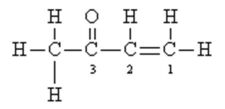
10. Consider the following Lewis structure. (Lone pairs are not drawn in.)Which statement about the molecule is false?(A) This molecule contains 28 valence electrons.(B) C-2 is sp² hybridized with bond angles of 120°.(C) Oxygen is sp³ hybridized.(D) There are 10 σ (sigma) and 2 π (pi) bonds.(E) There are some H–C–H bond angles of about 109° in the molecule.
11. The mass percent of iron in an iron oxide is 77.7%. Find the empirical formula.(A) Fe3O2 (B) Fe3O4 (C) Fe2O3 (D) FeO (E) none of these
13. Which of below does not have the same units as energy or energy per mole?(A) PV (B) RT (C) TS (D) nFE (E) I2R
14. Consider the following numbered processes:1. A → 2B2. B → C + D3. E → 2DΔH for the process A → 2C + E is(A) ΔH1 + ΔH2 (B) ΔH1 + 2ΔH2 – ΔH3 (C) ΔH1 + ΔH2 + ΔH3 (D) ΔH1 + 2ΔH2 + ΔH3(E) ΔH1 + ΔH2 – ΔH3
15. Which is wrong?(A) bomb calorimeter measures ΔH directly. (B) In an adiabatic process, q = 0 and ΔS = 0.(C) In a process of free expansion, w = 0. (D) In an isothermal process, ΔH = 0.(E) Breaking a chemical bonding is usually an endothermic reaction.
16. The following reaction is investigated (assume an ideal gas mixture).2N2O(g) + N2H4(g) ⇌3N2(g) + 2H2O(g)Initially there are 0.08 mol of N2O and 0.38 mol of N2H4, in a 30.0-L container. If there is 0.050mol of N2O at equilibrium, how many moles of N2 are present at equilibrium?(A) 0.053 (B) 0.045 (C) 0.12 (D) 0.030 (E) 0.15
17. When doubling the volume of a buffer solution containing a weak acid and its conjugate base,which is correct?(A) pH will shift toward the pKa of the acid.(B) pH will significantly increase.(C) The buffer capacity will decrease.(D) Its titration curve remains the same.(E) pH will decrease when using a base and it conjugated acid as the buffer solution.
18. Calculate the concentration of chromate ion, CrO42–, in a saturated solution of CaCrO4 (Ksp= 7.1 × 10⁻⁴).(A) 2.7 × 10⁻² M (B) 3.5 × 10⁻² M (C) 7.1 × 10⁻⁴ M (D) 3.5 × 10⁻⁴ M(E) 5.0 × 10⁻⁷ M
19. How many moles of HCl(g) must be added to 1.0 L of 2.0 M NaOH to achieve a pH of 0.00?(Neglect any volume change.)(A) 3.0 mol (B) 10. mol (C) 1.0 mol (D) 2.0 mol (E) none of these
20. For a titration reaction of a weak acid, which is correct?(A) The pH of the equivalence point is dependent of the original concentrations or volumes.(B) At the equivalence point, the pH can be found by the pKa of the acid and pKb of the base.(C) The pH of the end point is depended on the pKa of the acid and pKb of the base.(D) The initial pH is not affected by the concentration.(E) The end point is always at the center of the steepest section of the titration curve no matter ofthe stoichiometry of reactions or the choice of indicator.
21. How many electrons are transferred in the following reaction?SO32–(aq) + MnO4–(aq) → SO42–(aq) + Mn2+(aq)(A) 4 (B) 10 (C) 3 (D) 2 (E) 6
22. When increasing the anode solution concentration of Cu|Cu2+, which of the following wouldbe true about the cell potential?(A) It would remain constant. (B) It would increase. (C) It would decrease.(D) This cannot be determined. (E) All are possible.
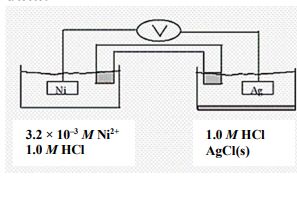
23. Calculate E at 25°C for this cell, given the following data:Ag++ e–→ Ag(s) E° = 0.80 VNi2+ + 2e–→ Ni(s) E° = –0.23 VKsp for AgCl = 1.6 × 10⁻¹⁰(A) 0.54 V(B) 2.98 V(C) 0.83 V(D) 1.01 V(E) This cannot be determined from the data given
24. The rate expression for a particular reaction is Rate = k[A][B]3. If the initial concentration of B is increased from 0.2 M to 0.6 M, the initial rate will increase by which of the following factors?(A) 6 (B) 3 (C) 27 (D) 4 (E) 12
25. Which of the following is the correct order of boiling points for NaNO3, CH3OH, C3H8, andHe?(A) He < C3H8 < NaNO3 < CH3OH (B) He < C3H8 < CH3OH < NaNO3(C) He < CH3OH < C3H8 < NaNO3 (D) NaNO3 < CH3OH < C3H8 < He(E) C3H8 < He < CH3OH < NaNO3
 阿摩線上測驗
登入
阿摩線上測驗
登入