所屬科目:研究所、轉學考(插大)◆普通化學
1. Which of the following is not the correct name for the formula given? (A) PCl5 phosphorus pentachloride (B) Fe2O3 iron(III) oxide (C) HClO hypochlorous acid (D) CoO cobalt(II) oxide (E) BaSO3 barium sulfate
2. Which molecule has the carbon with the biggest oxidation state? (A) CO (B) CO2 (C) HCO2H (D) H2CO (E) CH3OH
3. How many electrons can have the quantum numbers n = 4, l = 3, and mₗ = 0? (A) 2 (B) 6 (C) 10 (D) 14 (E) 0
4. Which element has the greatest second ionization energy? (A) Mg (B) Ca (C) K (D) Na (E) Al
5. Rank the following bonds in order of increasing ionic character: N–O, Ca–O, C–F, Br–Br, K– F. (A) N–O < Br–Br < C–F < K–F < Ca–O (B) Br–Br < C–F < N–O < Ca–O < K–F (C) Br–Br < N–O < Ca–O < C–F < K–F (D) N–O < C–F < Br–Br < Ca–O < K–F (E) Br–Br < N–O < C–F < Ca–O < K–F
6. Which of the following statement is true? (A) It is impossible to satisfy the octet rule in XeF2. (B) Because SF4 exists, OF4 should also exist because O and S are in the same family. (C) In O3, one O-O bond is stronger than the other. (D) All elements with n = 2 must obey octet rule. (E) CO3 2- keep switching among three resonance structures.
7. Order the following from shortest to longest bond: C2, B2, H2, N2 (A) H2, N2, C2, B2 (B) C2, N2, H2, B2 (C) N2, C2, B2, H2 (D) C2, B2, H2, N2 (E) none of these
8. Which orbitals below form bonding molecular orbitals? (A) I and III (B) I, III, and V (C) I, IV, and V (D) I, IV, V, and VI (E) I, III, V, and VI
9. How many of the following are predicted to be stable diatomic species according to the molecular orbital (MO) model? H2 +, H2, H2 - , H2 2- , N2 2- , O2 2- , F2 2- (A) 2 (B) 3 (C) 4 (D) 5 (E) 6
10. Which of the following observation is explained by molecular orbital (MO) theory? (A) H2 is stable but He2 is not. (B) NO+ is more stable than NO- . (C) N2 has a very high bond energy. (D) B2 and O2 are paramagnetic but C2, N2, and F2 are diamagnetic. (E) All of above.
11. An aqueous solution of silver nitrate is added to an aqueous solution of potassium chromate, and this reaction produces a solid. What is the formula for the solid? (A) AgCrO4 (B) KNO3 (C) K2NO3 (D) AgK (E) Ag2CrO4
12. When the following reaction is balanced in acidic solution, what is the coefficient of water?Zn(s) + NO3 –(aq) → Zn2+(aq) + NH4 +(aq) (A) 1 (B) 2 (C) 3 (D) 4 (E) none of these
13. Which of the following statements is(are) true? (A) In exothermic reactions, the reactants are lower in potential energy than the products. (B) The heat of reaction and change in enthalpy can always be used interchangeably. (C) Enthalpy is a state function. (D) A chemist takes the point of view of the surroundings when determining the sign for work or heat. (E) At least two of these statements are true.
14. When increase pure water temperature, which is wrong? (A) pH remains 7. (B) [H+] increases. (C) [H+] = [OH- ] (D) The solubility of NaCl increases. (E) The conductivity increases.
15. Which statement is true of a process in which 1 mol of a gas is expanded from state A to state B? (A) The final volume of the gas will depend on the path taken. (B) The amount of work done in the process must be the same, regardless of the path. (C) When the gas expands from state A to state B, the surroundings are doing work on the system. (D) The amount of heat released in the process will depend on the path taken. (E) It is not possible to have more than one path for a change of state.
16. Which is correct? (A) The pH of a strong acid solution is always lower than the pH of a weak acid solution. (B) The equilibrium constants must be the same at different conditions, including different volumes, pressures, and temperatures. (C) HF is dangerous because it is a strong acid. (D) HCN is safe because it is a weak acid. (E) 10-6 M hydrochloric acid is still considered as a strong acid.
17. Which is correct? (A) When the concentrations of the reactants and products of a given chemical reaction remain unchanged, the system is at chemical equilibrium. (B) There are infinite equilibrium positions at equilibrium. (C) For an endothermic reaction, the reaction will shift to right when decreasing temperature. (D) In exothermic reactions, the reactants have lower potential energy than the products. (E) An exothermic reaction usually occurs more quickly than an endothermic reaction.
18. For a reaction in a voltaic cell, both ΔH° and ΔS° are positive. Which of the following statements is true? (A) E°cell will increase with an increase in temperature. (B) E°cell will decrease with an increase in temperature. (C) E°cell will not change when the temperature increases. (D) ΔG° > 0 for all temperatures. (E) None of the above statements is true.
19. Which of the following is the best reducing agent? (A) Cl- (B) Cl2 (C) H2 (D) Mg (E) Mg2+
20. Which substance can be described as cations bonded together by mobile electrons? (A) S8(s) (B) Ag(s) (C) Kr(l) (D) HCl(l) (E) KCl(s)
21. Rate constants are dependent upon (A) the temperature (B) the orientation of the collision (C) the frequency of collisions (D) the activation energy (E) all of the above
22. The reaction A → B + C is known to be zero order in A with a rate constant of 5.2 × 10⁻² mol/L • s at 25° C. An experiment was run at 25°C where [A]0 = 3.2 × 10⁻³ M. What is the half-life for the reaction? (A) 1.3× 101 s (B) 2.6× 10⁻² s (C) 8.3× 10⁻² s (D) 6.0× 10⁴ s (E) 3.1× 10⁻² s
23. An electron is trapped in a one-dimensional box. Which box has the lowest ground-state energy? (A) The length of the box is 1 μm. (B) The length of the box is 100 nm. (C) The length of the box is 10-9 m. (D) All have the same ground-state energy. (E) The information is insufficient to decide.
24. A certain substance has the phase diagram shown below. At which of the following values of T and P is the substance a pure liquid? (A) T = 70°C, P = 1.2 atm (B) T = 10°C, P = 1 atm (C) T = 8°C, P = 1 atm (D) T = 10°C, P = 0.5 atm (E) T = 80°C, P = 1 atm
25. Place the following atoms and ions in order of decreasing size: Sc³⁺, Ca²⁺, K⁺, Cl⁻, S²⁻. (A) S²⁻ > Cl⁻ > K⁺ > Ca²⁺ > Sc³⁺ (B) Cl⁻ > S²⁻ > K⁺ > Ca²⁺ > Sc³⁺ (C) K⁺ > Ca²⁺ > Sc³⁺ > Cl⁻ > S²⁻ (D) S²⁻ > K⁺ > Cl⁻ > Ca²⁺ > Sc³⁺ (E) Cl⁻ > K⁺ > S²⁻ > Ca²⁺ > Sc³⁺
 阿摩線上測驗
登入
阿摩線上測驗
登入
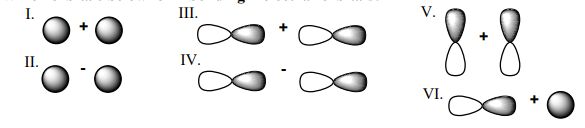 (A) I and III (B) I, III, and V (C) I, IV, and V (D) I, IV, V, and VI (E) I, III, V, and VI
 (A) Cl- (B) Cl2 (C) H2 (D) Mg (E) Mg2+
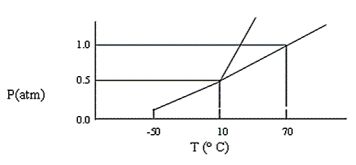 (A) T = 70°C, P = 1.2 atm (B) T = 10°C, P = 1 atm (C) T = 8°C, P = 1 atm (D) T = 10°C, P = 0.5 atm (E) T = 80°C, P = 1 atm