所屬科目:研究所、轉學考(插大)◆普通化學
1. What is the bond order of the N-O bond in the ion NO+ ? (A) 2 (B) 2½ (C) 3 (D) 1 ½
2. When a weak acid is titrated with a strong base, the pH at the equivalence point (A) is greater than 7.0. (B) is equal to 7.0. (C) is less than 7.0. (D) is equal to the pKa of the acid. (E) is equal to 14.0 – pKb , where pKb is that of the base.
3. Based on the molecular orbital description of the O2 molecule, which of the following statements is NOT true? (A) There are two unpaired electrons. (B) There are eight electrons in antibonding orbitals. (C) The molecule has a bond order of 2. (D) The unpaired electrons are in π* orbitals.
4. When two atoms, with their p orbitals, are brought together, what happens to the p orbitals perpendicular to the axis between the atoms? (A) These orbitals interact in a side-to-side manner to give two π orbitals and two π* orbitals. (B) The electrons in these orbitals repel each other to reduce the overall stability of the molecule. (C) These orbitals do not interact because they do not have any electron density in the region between the two atoms. (D) The orbitals interact to form a second set of σ and σ* orbitals, which allows for the formation of a double bond.
5. Regarding C2’s MO diagram (the molecule lies in the x-axis), which statement is true? (A) Two unpaired electrons are in π-2py and π-2pz orbitals (B) Two unpaired electrons are in π*-2px and π*-2pz orbitals (C) There is no unpaired electron in C2’s molecular orbitals (D) Two paired electrons occupy σ*-2py orbital
6. Regarding Li2 + ion in gas phase (lying in the x-axis), which statement about its MO is correct? (A) σ-2p is half-filled (B) σ*-2s is half-filled (C) σ*-2p is half-filled (D) σ-2s is half-filled
7. Carbon uses ______ hybrid orbitals in ClCN. (A) sp (B) sp2 (C) sp3 (D) sp3d (E) sp3d2
8. If a sample of gas occupies 487 ml at 896 torr, what volume will it occupy at 723 torr? (A) 393 ml (B) 1330 ml (C) 604 ml (D) 315 ml
9. A small container of gas was allowed to expand into a much larger one. If the small container had a volume of 325 ml at 3.6 atmospheres pressure and 25°C and the large container had a volume of 6830 ml and a final pressure of 0.180 atmospheres, what was the final temperature of the gas? (A) 26.3°C (B) 40.1°C (C) 11.6°C (D) 313°C
10. Which, if any, of the following aqueous mixtures would be a buffer system? (A) CH3COOH, NaH2PO4 (B) H2CO3, HCO3 – (C) H2PO4 – , HCO3 – (D) HSO4 – , HSO3 – (E) None of the above will be a buffer solution.
11. Boyle's law states that (A) pressure is proportional to volume. (B) pressure is proportional to temperature. (C) the product of pressure and volume is a constant. (D) volume is proportional to temperature.
12. Why does water have a very high surface tension? (A) because of its low molecular weight. (B) because of the strong intermolecular forces present in water. (C) because water molecules do not like to interact with other water molecules. (D) because of its high freezing point.
13. Which one of the following statements about orbital hybridization is incorrect? (A) The carbon atom in CH4 is sp3 hybridized. (B) The carbon atom in CO2 is sp hybridized. (C) The nitrogen atom in NH3 is sp2 hybridized. (D) sp hybrid orbitals lie at 180° to each other. (E) sp2 hybrid orbitals are coplanar, and at 120° to each other.
14. Which of the following are NOT intermolecular forces? (A) Covalent bonds (B) Dipole-dipole interactions (C) London dispersion forces (D) Hydrogen bonds
15. What is sublimation? (A) A solid melts and then quickly vaporizes. (B) A liquid is converted to a solid at low pressures. (C) A gas is directly converted to a solid. (D) A solid substance goes directly into the gas phase.
16. The reaction system POCl3(g) ↔POCl(g) + Cl2(g) is at equilibrium. Which of the following statements describes the behavior of the system if POCl is added to the container? (A) The forward reaction will proceed to establish equilibrium. (B) The reverse reaction will proceed to establish equilibrium. (C) The partial pressures of POCl3 and POCl will remain steady while the partial pressure of Cl2 increases. (D) The partial pressure of chlorine remains steady while the partial pressures of POCl3 and POCl increase. E) The partial pressure of chlorine will increase while the partial pressure of POCl decreases.
17. The equilibrium constant, Kp , for the reaction CO(g) + H2O(g) ↔CO2(g) + H2(g) at 986°C is 0.63. A rigid cylinder at that temperature contains 1.2 atm of carbon monoxide, 0.20 atm of water vapor, 0.30 atm of carbon dioxide, and 0.27 atm of hydrogen. Is the system at equilibrium? (A) Yes. (B) No, the forward reaction must proceed to establish equilibrium. (C) No, the reverse reaction must proceed to establish equilibrium. (D) Need to know the volume of the container before deciding. E) Need to know the starting concentrations of all substances before deciding.
18. What is the correct formula for the compound formed from the sodium ion and the bicarbonate ion? (A) Na2CO3 (B) Na4C (C) Na2(CO3)2 (D) NaHCO3
19. Copper can be prepared by the roasting of copper(II) sulfide by the reaction CuS + O2 → Cu + SO2. If 8.47 g of copper is obtained by roasting 18.65 g of CuS in excess oxygen, what is the percent yield? _Atomic mass: Cu 63.5, S 32._ (A) 22.5% (B) 31.7% (C) 45.4% (D) 68.3%
20. Which of the following is the strongest acid? (A) CH3COOH (B) HF (C) H3PO4 (D) H2SO3 (E) H2SO4
21. When a chemical system is at equilibrium, (A) the concentrations of the reactants are equal to the concentrations of the products. (B) the concentrations of the reactants and products have reached constant values. (C) the forward and reverse reactions have stopped. (D) the reaction quotient, Q, has reached a maximum. (E) the reaction quotient, Q, has reached a minimum.
22. Which of the following has an effect on the magnitude of the equilibrium constant? (A) removing products as they are formed (B) adding more of a reactant (C) adding a catalyst (D) increasing the pressure, in a gas-phase reaction (E) change in temperature
23. Which of the following is true for a system at equilibrium? (A) ΔS°sys= ΔS°surr (B) ΔS°sys = –ΔS°surr (C) ΔS°sys = ΔS°surr= 0 (D) ΔS°univ > 0
24. Which statement best describes ΔSsys° for the following reaction? Pb(s) + Cl2(g) Æ PbCl2(s) (A) ΔSsys° » 0 (B) ΔSsys° < 0 (C) ΔSsys° > 0 (D) ΔSsys° = ΔH°/T
25. For a process with ΔSsys < 0, which one of the following statements is correct? (A) The process will definitely be spontaneous if ΔH < 0. (B) The process will be definitely be spontaneous if ΔH < TΔSsys. (C) The process can never be spontaneous. (D) The process will definitely be spontaneous, regardless of ΔH. E) The process will definitely be spontaneous if ΔSsurr > 0.
26. Calculate the lattice energy of magnesium sulfide from the data given below. Mg(s) → Mg(g) ΔH° = 148 kJ/molMg(g) → Mg2+(g) + 2e– ΔH° = 2186 kJ/molS8(s) → 8S(g) ΔH° = 2232 kJ/molS(g) + 2e− → S2−(g) ΔH° = 450 kJ/mol8Mg(s) + S8(s) → 8MgS(s) ΔH° = –2744 kJ/molMg2+(g) + S2−(g) → MgS(s) ΔH°lattice = ?(A) –3406 kJ/mol (B) –2720. kJ/mol (C) 2720. kJ/mol (D) 3406 kJ/mol
27. Which of the following types of radioactive decay does not produce new element? (A) gamma emission (B) electron capture (C) beta emission (D) alpha emission
28. The strongest intermolecular interactions between pentane (C5H12) molecules arise from (A) dipole-dipole forces. (B) London dispersion forces. (C) hydrogen bonding. (D) ion-dipole interactions. (E) carbon-carbon bonds.
29. Select the correct name for the compound on the right. (A) 1,1,3-triethyl-2-methylbutane (B) 1,1-diethyl-2,3-dimethylpentane (C) 2,4-diethyl-3-methylhexane (D) 3-ethyl-4,5-dimethylheptane
30. Testosterone is a male hormone. Identify the functional group circled. (A) aldehyde (B) ketone (C) alcohol (D) ester E) carboxyl
簡答題 5 題,一題 2 分。(a)What is the systematic name for Fe3(PO4)2?
(d) What is the IUPAC name for N2O5?
(e) Draw the correct Lewis structure of hydrazine, N2H4.
 阿摩線上測驗
登入
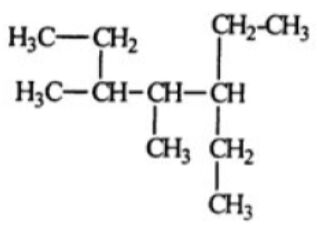 (A) 1,1,3-triethyl-2-methylbutane (B) 1,1-diethyl-2,3-dimethylpentane (C) 2,4-diethyl-3-methylhexane (D) 3-ethyl-4,5-dimethylheptane
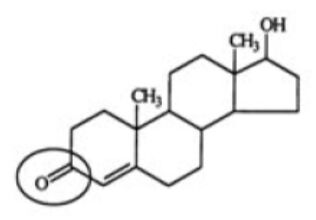 (A) aldehyde (B) ketone (C) alcohol (D) ester E) carboxyl