所屬科目:研究所、轉學考(插大)◆普通化學
1. Based on the following cell diagram: Pt|Fe2+,Fe3+||Cu2+|Cu, what reaction occurs at the anode? (A) Fe2+ → Fe3+ (B) Fe3+ → Fe2+ (C) Cu → Cu2+ (D) Cu2+ → Cu
2. Based on the following cell diagram: Pt|MnO4-, Mn2+, H+ ||Sn2+, Sn4+|Pt, what is the balanced redox reaction? (A) Mn2+(aq) + Sn4+(aq) → MnO4-(aq) + Sn2+(aq) + H+(aq) (B) 2Mn2+(aq) + 5Sn4+(aq) + 8H2O → 2MnO4-(aq) + 5Sn2+(aq) + 16H+(aq) (C) 2MnO4-(aq) + 5Sn2+(aq) + 16H+(aq) → 2Mn2+(aq) + 5Sn4+(aq) + 8H2O (D) 2Mn2+(aq) + 5Sn4+(aq) → 2MnO4-(aq) + 5Sn2+(aq) + 16H+(aq)
3. The redox reaction \( 3\text{Cu}_{(s)} + 2\text{Al}^{3+}_{(aq)} \rightarrow 2\text{Al}_{(s)} + 3\text{Cu}^{2+}_{(aq)} \) has a potential of -1.85 V under some nonstandard conditions. What is the free energy change for the reaction? (A) 1070 kJ/mol (B) 536 kJ/mol (C) -1070 kJ/mol (D) -563 kJ/mol
4. In the elemental notation \( _{Z}^{A}X \), what does the \( A \) represent? (A) The number of protons in the nucleus (B) The number of electrons in the atom (C) The number of neutrons in the nucleus (D) The number of protons and neutrons in the atom
5. Select the nuclide that completes the following nuclear reaction: \( _{62}^{147}Sm \rightarrow _{2}^{4}He + ? \) (A) \( _{64}^{151}Gd \) (B) \( _{64}^{149}Gd \) (C) \( _{60}^{145}Nd \) (D) \( _{60}^{151}Nd \) (E) \( _{60}^{143}Nd \)
6. Consider the reaction \( \text{CuO}_{(s)} + \text{H}_{2(g)} \rightarrow \text{Cu}_{(s)} + \text{H}_2\text{O}_{(l)} \) In this reaction, which substances are the oxidant and reductant, respectively? (A) \( \text{CuO} \) and \( \text{H}_2 \) (B) \( \text{H}_2 \) and \( \text{CuO} \) (C) \( \text{CuO} \) and \( \text{Cu} \) (D) \( \text{H}_2\text{O} \) and \( \text{H}_2 \)
7. What is the purpose of the \( \text{Na}_2\text{S}_2\text{O}_3 \) solution in the processing of photographic film? (A) The \( \text{Na}^+ \) ion increases the solubility of \( \text{AgBr} \) by complexing with the bromide ion. (B) The \( \text{S}_2\text{O}_3^{2-} \) ion decreases the solubility of \( \text{AgBr} \) by acting as a common ion. (C) The \( \text{S}_2\text{O}_3^{2-} \) ion increases the solubility of \( \text{AgBr} \) by complexing with the silver ion. (D) The \( \text{Na}^+ \) and \( \text{S}_2\text{O}_3^{2-} \) ions form complexes with the \( \text{Ag}^+ \) and \( \text{Br}^- \) ions.
8. The \( \text{K}_{\text{w}} \) of water at \( 50^{\circ}\text{C} \) is \( 5.47 \times 10^{-14} \). What is the pH of pure water at \( 50^{\circ}\text{C} \)? (A) 7.00 (B) 6.63 (C) 13.3 (D) 7.37
9. Boyle's law states that (A) pressure is proportional to volume. ((B)pressure is proportional to temperature. (C) the product of pressure and volume is a constant. (D)volume is proportional to temperature.
10. What kinds of compounds will be substantially more soluble in acidic solution than they are in either neutral or basic solution? (A) Compounds whose cations are the conjugate acid of a weak base (B)Compounds whose cations are the conjugate acid of a strong base (C) Compounds whose anions are the conjugate base of a weak acid (D)Compounds whose anions are the conjugate base of a strong acid
11. What will be the effect of adding 1.0 mL of 0.1 \( M \) NaOH to 100 mL of an acetate buffer in which \( [\text{CH}_3\text{COOH}] = [\text{CH}_3\text{COO}^-] = 0.5 M \)? (A) The pH will increase slightly. (B) The pH will increase significantly. (C) The pH will decrease slightly. (D) The pH will decrease significantly.
12. Without any calculations, what can be predicted about the entropy change of the following reaction? \[ \text{CaCO}_3(\text{s}) \rightarrow \text{CaO}(\text{s}) + \text{CO}_2(\text{g}) \] (A) \( \Delta S \) is positive. (B) \( \Delta S \) is negative. (C) \( \Delta S \) is very close to 0. (D) \( \Delta S \) cannot be determined.
13. The reaction \( \text{PCl}_3(\text{g}) + \text{Cl}_2(\text{g}) \rightarrow \text{PCl}_5(\text{g}) \) has a \( \Delta\text{S}^\circ \) of -170.2 J/molK and a \( \Delta\text{H}^\circ \) of -87.9 kJ/mol. Assuming the values of \( \Delta\text{H}^\circ \) and \( \Delta\text{S}^\circ \) are constant, at what temperature does the reaction become nonspontaneous? (A) 516.5°C (B) 1663.3°C (C) 789.6°C (D) 243.3°C
14. Which of the following is always true for an exothermic process? (A) \( q_{system} > 0 \), \( \Delta S_{surrounding} < 0 \) (B) \( q_{system} < 0 \), \( \Delta S_{surrounding} > 0 \) (C) \( q_{system} < 0 \), \( \Delta S_{surrounding} < 0 \) (D) \( q_{system} > 0 \), \( \Delta S_{surrounding} > 0 \)
15. Which, if any, of the following aqueous mixtures would be a buffer system? (A) CH3COOH, NaH2PO4 (B) H2CO3, HCO3- (C) H2PO4-, HCO3- (D) HSO4-, HSO3-
16. For the reaction \( \text{CO}_{(g)} + 3\text{H}_{2(g)} \leftrightarrow \text{CH}_{4(g)} + \text{H}_2\text{O}_{(g)} \quad q = -206 \text{ kJ} \) What conditions favor maximum conversion of reactants to products? (A) low pressure and low temperature (B) removal of \( \text{H}_{2(g)} \) and low temperature (C) high pressure and high temperature (D)high pressure and low temperature
17. How does the viscosity of the solvent affect the rate of a chemical reaction? (A) A viscous solvent acts to trap reactant molecules together, increasing the rate. (B)The lower the viscosity, the fewer the number of collisions and the lower the rate. (C) The viscosity of the solvent has little effect on the rate of the reaction. (D)A viscous solvent reduces the number of collisions, reducing the rate of reaction.
18. A reaction of A that is thought to be second order with respect to A is studied by measuring concentration as a function of time. How would the rate constant (k) for this reaction be determined? (A) The slope of a graph of 1/[A] versus time is equal to k. (B)The slope of a graph of ln[A] versus time is equal to -k. (C) The slope of a graph of [A] versus time is equal to k. (D)The slope of a graph of ln[A] versus time is equal to k.
19. What is the reaction quotient? (A) It is a value that is always less that K, indicating reaction must occur. (B)It is the inverse of K and can reflect any set of reaction conditions. (C) It is similar to K but does not include the exponents from the reaction. (D)It has the same form as K but can have any concentration values.
20. What is the sequential order of a chain reaction? (A) propagation initiation propagation termination (B)initiation propagation termination (C) termination propagation initiation (D)initiation propagation termination initiation
21. Potassium chloride, sodium sulfate, glucose, carbon dioxide, and ammonium phosphate, are soluble in water. Which one produces the largest number of dissolved particles per mole of dissolved solute? (A) potassium chloride((B)sodium sulfate (C) glucose (D)carbon dioxide E) ammonium phosphate
22. According to molecular orbital theory, what is the bond order in the O2+ ion? (A) 5.5 (B) 5 (C) 4 (D) 2.5 (E) 1.5
23. Predict the Cl-As-Cl bond angles in AsCl3 using the molecular shape given by the VSEPR theory. (A) 90° (B) 109° (C) 120° (D) 180°
24. In which of the following bonds does nitrogen have a partial negative charge? (A) N–C (B)N–O (C) N–F (D)N–N
25. Select the best statement relating to the following reaction: \[ 2\text{MnO}_{2(s)} + \text{KClO}_{3(aq)} + 2\text{KOH}_{(aq)} \rightarrow 2\text{KMnO}_{4(aq)} + \text{KCl}_{(aq)} + \text{H}_2\text{O}_{(l)} \] (A) Mn in $\text{MnO}_2$ is oxidized. (B) Cl in $\text{KClO}_3$ is the reducing agent. (C) K in $\text{KClO}_3$ is the reducing agent. (D) H in $\text{KOH}$ is oxidized.
26. How many resonance structures are possible for \( \text{NO}_3^- \)? (A) 1 (B) 2 (C) 3 (D) 4 (E) none
27. Calculate the lattice energy of magnesium sulfide from the data given below. \[ \text{Mg}_{(s)} \rightarrow \text{Mg}_{(g)} \quad H^{\circ} = 148 \text{ kJ/mol} \]\[ \text{Mg}_{(g)} \rightarrow \text{Mg}^{2+}_{(g)} + 2\text{e}^{-} \quad H^{\circ} = 2186 \text{ kJ/mol} \]\[ \text{S}_{8(s)} \rightarrow 8\text{S}_{(g)} \quad H^{\circ} = 2232 \text{ kJ/mol} \]\[ \text{S}_{(g)} + 2\text{e}^{-} \rightarrow \text{S}^{2-}_{(g)} \quad H^{\circ} = 450 \text{ kJ/mol} \]\[ 8\text{Mg}_{(s)} + \text{S}_{8(s)} \rightarrow 8\text{MgS}_{(s)} \quad H^{\circ} = -2744 \text{ kJ/mol} \]\[ \text{Mg}^{2+}_{(g)} + \text{S}^{2-}_{(g)} \rightarrow \text{MgS}_{(s)} \quad H^{\circ}_{\text{lattice}} = ? \] (A) -3406 kJ/mol (B) -2720. kJ/mol (C) 2720. kJ/mol (D) 3406 kJ/mol
28. Arrange the following bonds in order of increasing bond strength. (A) C–I < C–Br < C–Cl < C–F ((B)C–F < C–Cl < C–Br < C–I (C) C–Br < C–I < C–Cl < C–F (D)C–I < C–Br < C–F< C–Cl
29. In the following reaction, what ions, if any, are spectator ions? \[ \text{Pb(NO}_3)_2(aq) + 2\text{NaCl}(aq) \rightarrow \text{PbCl}_2(s) + 2\text{NaNO}_3(aq) \] (A) \( \text{Pb}^{2+}(aq), \text{Cl}^-(aq) \) (B) \( \text{Na}^+(aq), \text{NO}_3^-(aq) \) (C) \( \text{Pb}^{2+}(aq), \text{NO}_3^-(aq) \) (D) \( \text{Na}^+(aq), \text{Cl}^-(aq) \)
30. According to molecular orbital theory, which of the following statements about \( \text{NO}^+ \) is correct? (A) \( \text{NO}^+ \) has a bond order of 2 and is paramagnetic. (B) \( \text{NO}^+ \) has a bond order of 2 and is diamagnetic. (C) \( \text{NO}^+ \) has a bond order of 3 and is paramagnetic. (D) \( \text{NO}^+ \) has a bond order of 3 and is diamagnetic.
31. Regarding \( \text{Ne}_2^+ \), which statement about its MO (molecular orbitals) is correct? (A) One electron from \( \text{Ne}_2 \)'s \( \pi^* \) orbital was removed to form \( \text{Ne}_2^+ \) (B) Its \( \sigma^*2p \) is half-filled (C) There is no unpaired electron in \( \text{Ne}_2^+ \) MOs (D) Two unpaired electrons are in two \( \pi^* \) orbitals
32. Consider CH4, AlCl3, NH3 and NH4+. Which statement is true? (A) CH4 is a Lewis acid whereas NH3 is a Lewis base. (B) AlCl3 is a Lewis acid whereas NH3 is a Lewis base. (C) NH4+ is a Lewis acid whereas NH3 is a Lewis base. (D) AlCl3 is a Lewis acid whereas CH4 is a Lewis base.
33. Which statement regarding \( \text{B}_2 \) (lying in the \( X \)-axis) MO diagram is not true? (A) There are no unpaired electrons in orbitals (B) Energetically \( \sigma^*2\text{p}_x \) is higher than \( \pi^* \)-\( 2\text{p}_y \) and \( \pi^* \)-\( 2\text{p}_z \) orbitals (C) \( \text{B}_2 \) experiences S-P mixing (D) \( \pi 2\text{p}_y \) and \( \pi 2\text{p}_z \) orbitals are half-filled
34. What is the electron pair geometry for the ammonia molecule (NH3)? (A) Tetrahedral (B) Trigonal pyramidal (C) Trigonal planar (D) T-shaped
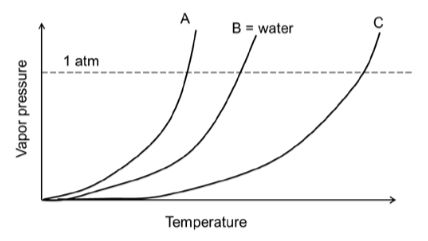
35. According to the above figure, what is the order of intermolecular force among the three species? (A) A > B > C (B)A < B < C
36. Again, according to the figure for vapor pressure vs. temperature, which curve could be of mercury? (A) curve A (B)curve C
37. What is diffusion? (A) The motion of a gas through a barrier with a hole in it (B)The gradual mixing of gases due to the motion of the gas molecules (C) The motion of gas particles from one container to another (D)The tendency of some molecules to want to form clusters
38. What is a London dispersion force? (A) London dispersion forces are attractions between polar molecules. (B)London dispersion forces are induced dipole-induced dipole attractions. (C) London dispersion forces are the attractions between ions. (D)London dispersion forces are the same as covalent bonds.
39. Which statement regarding surface tension is not true? (A) It is measured as energy per unit area, such as joules per square meter (J/m2). (B) The weaker the intermolecular forces, the higher the surface tension. (C) The surface tension is independent on the intermolecular forces.
40. Why do polar substances dissolve in polar solvents even if \( \Delta H_{\text{solvation}} \) is positive? (A) The entropy of the solution is higher than the entropy of the solute and solvent separated. (B) A positive \( \Delta H_{\text{solvation}} \) is a driving force for a chemical reaction. (C) The solution is more ordered than the solute and solvent taken separately. (D) A solution has a greater number of solute-solvent interactions than do the solute and solvent.
(1) Ionization energy
(2) Lattice energy
(3) Electron affinity
(4) Ion pairing energy
(5) Bond energy
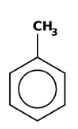
2. Please explain why benzene and toluene have similar molecule structures but very different melting points: 5.5 °C for benzene and -95°C for toluene.
 阿摩線上測驗
登入
 (A) Tetrahedral (B) Trigonal pyramidal (C) Trigonal planar (D) T-shaped