所屬科目:研究所、轉學考(插大)◆普通化學
1. An unknown substance dissolves readily in water but not in benzene (a nonpolar solvent). Molecules of what type are present in the substance? (A) neither polar nor nonpolar (B) polar (C) either polar or nonpolar (D) nonpolar (E) none of these
2. Which of the following is a strong acid? (A) HF (B) KOH (C) HClO4 (D) HClO (E) HBrO
3. In the reaction C(s) + O2(g) → CO2(g) carbon is __________. (A) the reducing agent (B) the electron acceptor (C) reduced (D) the oxidizing agent (E) more than one of these
4. Which gas has the highest density? (A) He (B) Cl2 (C) CH4 (D) NH3 (E) all gases the same
5. If M is the molar mass, R the gas constant, T the temperature, and P its pressure, which of the following expressions represents the density of a gas? (A)\( \frac{PM}{RT} \) (B)\( \frac{RM}{PT} \) (C)\( \frac{RMP}{T} \) (D)\( \frac{RTM}{p} \) (E)\(\frac{RT}{PM} \)
6. A gas absorbs 0.0 J of heat and then performs 15.8 J of work. The change in internal energy of the gas is (A) 31.6 J (B) 15.8 J (C) –31.6 J (D) –15.8 J (E) none of these
7. Calculate the work associated with the expansion of a gas from 42.0 L to 79.0 L at a constant pressure of 14.0 atm. (A) 518 L·atm (B) –518 L·atm (C) –1.11 × 10³ L·atm (D) 588 L·atm (E) 1.11 × 10³ L·atm
8. What is the specific heat capacity of a metal if it requires 169.6 J to change the temperature of 15.0 g of the metal from 25.00°C to 32.00°C? (A) 0.619 J/g°C (B) 11.3 J/g°C (C) 24.2 J/g°C (D) 1.62 J/g°C (E) 275 J/g°C
9. Choose the correct equation for the standard enthalpy of formation of CO(g), where ΔHf° for CO = –110.5 kJ/mol (gr indicates graphite). (A) 2C(gr) + O2(g) → 2CO(g), ΔH° = –110.5 kJ (B) C(gr) + O(g) → CO(g), ΔH° = –110.5 kJ (C) C(gr) + O2(g) → CO(g), ΔH° = –110.5 kJ (D) C(gr) + CO2(g) → 2CO(g), ΔH° = –110.5 kJ (E) CO(g) → C(gr) + O(g), ΔH° = –110.5 kJ
10. Which of the following statements best describes the Heisenberg uncertainty principle? (A) The exact position of an electron is always uncertain. (B) The velocity of a particle can only be estimated. (C) It is impossible to accurately know both the exact location and momentum of a particle. (D) The location and momentum of a macroscopic object are not known with certainty. (E) The location and momentum of a particle can be determined accurately, but not the identity of the particle.
11. Which of the following best describes an orbital? (A) space where electrons are unlikely to be found in an atom (B) space which may contain electrons, protons, and/or neutrons (C) the space in an atom where an electron is most likely to be found (D) small, walled spheres that contain electrons (E) a single space within an atom that contains all electrons of that atom
12. If n = 2, how many orbitals are possible? (A) 3 (B) 4 (C) 2 (D) 8 (E) 6
13. How many electrons can be described by the quantum numbers n = 2, l = 2, ml = 2? (A) 0 (B) 2 (C) 6 (D) 10 (E) 14
14. Which of the following combinations of quantum numbers is not allowed? (A) n = 1, l = 1, ml = 0, ms = (B) n = 3, l = 0, ml = 0, ms = - (C) n = 2, l = 1, ml = -1, ms = (D) n = 4, l = 3, ml = -2, ms = - (E) n = 4, l = 2, ml = 0, ms =
15. Which of the following processes represents the ionization energy of bromine? (A) Br(s) Br+(g) + e– (B) Br(l) Br+(g) + e– (C) Br(g) Br+(g) + e– (D) Br(s) Br+(s) + e– (E) Br2(g) Br2+(g) + e–
16. Which of the following groups contains no ionic compounds? (A) HCN, NO2, Ca(NO3)2 (B) PCl5, LiBr, Zn(OH)2 (C) KOH, CCl4, SF4 (D) NaH, CaF2, NaNH2 (E) CH2O, H2S, NH3
17. In which pair do both compounds exhibit predominantly ionic bonding? (A) SCl4 and HF (B) Na2SO3 and NH3 (C) KI and O3 (D) BaF and H2O (E) RbCl and MgS
18. Atoms with greatly different electronegativity values are expected to form (A) no bonds (B) covalent bonds (C) triple bonds (D) ionic bonds (E) none of these
19. Which of the following bonds is least polar? (A) C—O (B) H—C (C) S—Cl (D) Br—Br (E) They are all nonpolar.
20. For the elements Ba, F, and P, the order of increasing electronegativity is: (A) Ba < F < P (B) Ba < P < F (C) P < F < Ba (D) F < Ba < P (E) none of these
21. In which case is the bond polarity incorrect? (A) δ+H–Fδ– (B) δ+K–Oδ– (C) δ+Mg–Hδ– (D) δ+Cl–Iδ– (E) δ+Si–Sδ–
22. Which of these is an isoelectronic series? (A) Na+, K+, Rb+, Cs+ (B) K+, Ca2+, Ar, S2– (C) Na+, Mg2+, S2–, Cl– (D) Li, Be, B, C (E) none of these (A-D)
23. Which of the following ionic compounds has the largest lattice energy (i.e., the lattice energy most favorable to a stable lattice)? (A) BaO (B) BeO (C) CsI (D) NaBr (E) BaS
24. How many of the following molecules possess dipole moments?
BH3, CH4, PCl5, H2O, HF, H2 (A) 1 (B) 2 (C) 3 (D) 4 (E) 5
25. Which of the following is the correct order for molecules from most to least polar? (A) CH4 > CF2Cl2 > CF2H2 > CCl4 > CCl2H2 (B) CH4 > CF2H2 > CF2Cl2 > CCl4 > CCl2H2 (C) CF2Cl2 > CF2H2 > CCl2H2 > CH4 = CCl4 (D) CF2H2 > CCl2H2 > CF2Cl2 > CH4 = CCl4 (E) CF2Cl2 > CF2H2 > CCl4 > CCl2H2 > CH4
26. Which of the following molecules are nonlinear?
NO2–, C2H2, N3–, HCN, CO2, H2O2 (A) C2H2, HCN (B) CO2, N3– (C) NO2–, H2O2 (D) N3–, NO2– (E) all are linear
27. The bond angles about the carbon atom in the formaldehyde molecule, H2C=O, are about: (A) 120° (B) 60° (C) 109° (D) 180° (E) 90°
28. The hybridization of the central atom in O3 is: (A) sp (B) sp2 (C) sp3 (D) dsp3 (E) d2sp3
29. Which of the following does not contain at least one pi bond? (A) H2CO (B) CO2 (C) C2H2 (D) C3H8 (E) All of the above (A-D) contain at least one pi bond.
30. How many electrons are involved in pi bonding in benzene, C6H6? (A) 12 (B) 30 (C) 3 (D) 6 (E) 18
31. In a 0.1 molar solution of NaCl in water, which one of the following will be closest to 0.1? (A) The mole fraction of NaCl. (B) The mass fraction of NaCl. (C) The mass percent of NaCl. (D) The molality of NaCl. (E) All of these are about 0.1.
32. Which of the following chemical or physical changes is an endothermic process? (A) the evaporation of water (B) the combustion of gasoline (C) the mixing of sulfuric acid and water (D) the freezing of water (E) none of these
33. Rank the following compounds according to increasing solubility in water.
I. CH3–CH2–CH2–CH3 II. CH3–CH2–O–CH2–CH3
III. CH3–CH2–OH IV. CH3–OH (A) I < III < IV < II (B) I < II < IV < III (C) III < IV < II < I (D) I < II < III < IV (E) None of these (A-D) is correct.
34. Indicate the mass action expression for the following reaction: 2X(g) + Y(g) 3W(g) + V(g) (A) [X]2[Y][W]3[V] (B)\( \frac{[W]^3 [V]}{[X]^2 [Y]} \) (C)\( \frac{[3w][v]}{[2x][y]} \) (D)\( \frac{[x]^2 [y]}{[w]^3 [v]} \) (E) none of these
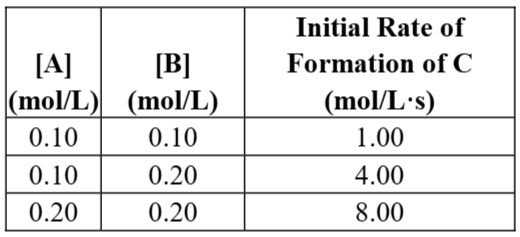
35. For a reaction in which A and B react to form C, the following initial rate data were obtained:
What is the rate law? (A) Rate = k[A][B] (B) Rate = k[A]2[B] (C) Rate = k[A][B]2 (D) Rate = k[A]2[B]2 (E) Rate = k[A]3
36. Which letter shows the activation energy using a catalyst?
(A) a (B) b (C) c (D) d (E) e
37. Which letter shows the change in energy for the overall reaction?
38. Which of the following atoms or ions has three unpaired electrons? (A) N (B) O (C) Al (D) S2– (E) Ti2+
39. Which of the following substances contains two pi bonds? (A) C2H4 (B) C3H8 (C) C2H2 (D) C2H6 (E) CH4
40. How many milliliters (mL) of 18.2 M H2SO4 are needed to prepare 600.0 mL of 0.10 M H2SO4? (A) 0.30 mL (B) 109 mL (C) 3.3 mL (D) 1.6 mL (E) 4.3 mL
 阿摩線上測驗
登入
阿摩線上測驗
登入
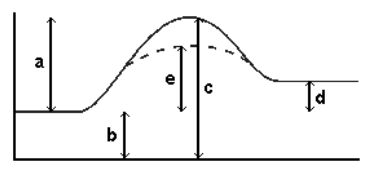 (A) a (B) b (C) c (D) d (E) e
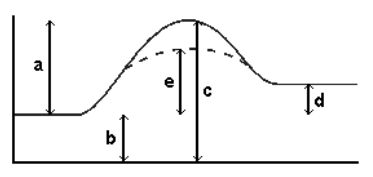 (A) a (B) b (C) c (D) d (E) e