所屬科目:研究所、轉學考(插大)◆普通化學
1. A 100-mL sample of water is placed in a coffee cup calorimeter. When 1.0 g of an ionic solid is added, the temperature decreases from 21.5°C to 20.8°C as the solid dissolves. For the dissolving of the solid(A) ΔH < 0(B)ΔS_univ > 0(C) ΔS_sys < 0(D) ΔS_surr > 0(E) none of these
2. For a particular chemical reactionΔH = 5.5 kJ and ΔS = -25 J/KUnder what temperature condition is the reaction spontaneous?(A) When T < -220 K.(B)When T < 220 K.(C) When T > 220 K.(D) The reaction is not spontaneous at all temperatures.(E) The reaction is spontaneous at any temperature.
3. Iron is biologically important in the transport of oxygen by red blood cells from the lungs to the various organs of the body. In the blood of an adult human, there are approximately 2.60 x 10¹³ red blood cells with a total of 2.90 g of iron. On the average, how many iron atoms are present in each red blood cell? (molar mass (FE ) = 55.85 g)(A) 8.33 x 10⁻¹⁰(B)1.2 x 10⁹(C) 3.12 x 10²²(D) 2.60 x 10¹³(E) none of these
4. On a relative basis, the weaker the intermolecular forces in a substance,(A) the greater its heat of vaporization.(B)the more it deviates from ideal gas behavior.(C) the greater its vapor pressure at a particular temperature.(D) the higher its melting point.(E) none of these
5. A solution consists of a mixture of benzene and toluene and is allowed to come to equilibrium with its vapor. The vapor is then condensed and found to contain 50.0 mole percent of each component. Calculate the composition (mole percent) of the original solution. The vapor pressures of pure benzene and toluene at this temperature are 750. torr and 300. torr, respectively.(A) 28.6% benzene(B)40.0% benzene(C) 50.2% benzene(D) 71.0% benzene(E) none of these
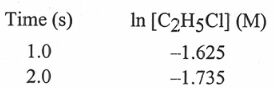
6. the gas-phase decomposition of ethylene chloride.C₂H₅Cl → productsExperiment shows that the decomposition is first order.The following data show kinetics information for this reaction:What is the rate constant for this decomposition?(A) 0.29/s(B)0.35/s(C) 0.11/s(D) 0.02/s(E) 0.22/s
7. Which of the following statements is true?(A) An endothermic reaction shifts toward reactants when heat is added to the reaction.(B)Catalysts are an effective means of changing the position of an equilibrium.(C) The concentration of the products equals that of reactants and is constant at equilibrium.(D) When two opposing processes are proceeding at identical rates, the system is at equilibrium.(E) None of these statements is true.
8. The equilibrium constants ($Ka$) for HCN and HF in H$2$O at 25°C are 6.2 x 10$^{-10}$ and 7.2 x 10$^{-4}$, respectively. The relative order of base strengths is:(A) F$^-$ > H$_2$O > CN$^-$(B)H$_2$O > F$^-$ > CN$^-$(C) CN$^-$ > F$^-$ > H$_2$O(D) F$^-$ > CN$^-$ > H$_2$O(E) none of these
9. The heat of vaporization for 1.0 mole of water at 100°C and 1.0 atm is 40.6 kJ/mol. Calculate $\Delta S$ for the process H$2$O(l) $\rightarrow$ H$2$O(g) at 100°C.(A) 109 J/K mol(B)-109 J/K mol(C) 406 J/K mol(D) -406 J/K mol(E) none of these
10. A strip of copper is placed in a 1 M solution of copper nitrate and a strip of silver is placed in a 1 M solution of silver nitrate. The two metal strips are connected to a voltmeter by wires and a salt bridge connects the solutions. The following standard reduction potentials apply:$$\mathrm{Ag}^{+}(\mathrm{aq}) + \mathrm{e}^{-} \rightarrow \mathrm{Ag}(\mathrm{s}) \quad E^{\circ} = +0.80 \mathrm{V}$$$$\mathrm{Cu}^{2+}(\mathrm{aq}) + 2\mathrm{e}^{-} \rightarrow \mathrm{Cu}(\mathrm{s}) \quad E^{\circ} = +0.34 \mathrm{V}$$When the voltmeter is removed and the two electrodes are connected by a wire, which of the following does not take place?(A) Electrons flow in the external circuit from the copper electrode to the silver electrode.(B)The silver electrode increases in mass as the cell operates.(C) Some positive copper ions pass through the salt bridge from the copper half-cell to the silver half-cell.(D) Negative ions pass through the salt bridge from the silver half-cell to the copper half-cell.(E) none of these
11. Which of the following statements concerning the complex ion \( \text{Co(en)}_2\text{Cl}_2^+ \) is true? (en = ethylenediamine, \( \text{NH}_2\text{CH}_2\text{CH}_2\text{NH}_2 \))?(A) The complex ion contains Co(I).(B)The complex ion exhibits cis and trans geometric isomers, but no optical isomers.(C) The complex ion exhibits two geometric isomers (cis and trans) and two optical isomers.(D) Since en is a strong field ligand (large $\Delta$), the complex ion is paramagnetic.(E) The geometric isomers of the complex ion have identical chemical properties
12. How many isomers are there of "dichloroethene"?(A) 2(B)3(C) 4(D) 5(E) 6
13. Name the following:$$\begin{array}{c} \mathrm{CH}{2}\mathrm{CH}{3} \\ | \\ \mathrm{CH}_{3}-\mathrm{C}-\mathrm{C}\equiv\mathrm{C}-\mathrm{H} \\ | \\ \mathrm{H} \end{array}$$(A) 1-hexyne(B)2-ethynyl butane(C) 2-ethyl-3-butyne(D) 3-methyl-1-pentyne(E) 3-methyl-4-pentyne
14. Which of the following statements is (ar(E) true?I. An excited atom can return to its ground state by absorbing electromagnetic radiation.II. The energy of an atom is increased when electromagnetic radiation is emitted from it.III. The energy of electromagnetic radiation increases as its frequency increases.IV. An electron in the $n = 4$ state in the hydrogen atom can go to the $n = 2$ state by emitting electromagnetic radiation at the appropriate frequency.V. The frequency and wavelength of electromagnetic radiation are inversely proportional to each other.(A) II, III, IV(B)III, V(C) I, II, III(D) III, IV, V(E) I, II, IV
15. The hybridization of the central atom in $\mathrm{I}_{3}$ is:(A) sp(B)sp$^{2}$(C) sp$^{3}$(D) dsp$^{3}$(E) d$^{2}$ sp$^{3}$
(10%) 1. Biochemists have discovered more than 400 mutant varies of hemoglobin, the blood protein that carries oxygen throughout the body. A physician studying a variety associated with a fatal disease first finds its molar mass (M). She dissolves 21.5 mg of the protein in water at 5.0°C to make 1.50 mL of solution and measures an osmotic pressure of 0.00475 atm. What is the molar mass of this variety of hemoglobin? (R = 0.0821 atm-L/mol-K)
(a) \( \mathrm{PbS}{(s)} + \mathrm{O}{2(g)} \rightarrow \mathrm{PbO}{(s)} + \mathrm{SO}{2(g)} \)
(b) \( \mathrm{KMnO}{4(aq)} + \mathrm{CaC}{2}\mathrm{O}{4(s)} + \mathrm{H}{2}\mathrm{SO}{4(aq)} \rightarrow \mathrm{MnSO}{4(aq)} + \mathrm{K}{2}\mathrm{SO}{4(aq)} + \mathrm{CaSO}{4(s)} + \mathrm{CO}{2(g)} + \mathrm{H}{2}\mathrm{O}{(f)} \)
(15%) 3. Ascorbic acid (\( \text{H}_2\text{C}_6\text{H}_6\text{O}_6 \); \( \text{H}_2\text{Asc} \) for this problem) known as vitamin C, is a diprotic acid (\( \text{K}_{\text{a}1} = 1.0 \times 10^{-5} \) and \( \text{K}_{\text{a}2} = 5 \times 10^{-12} \)) found in citrus fruit. Calculate [\( \text{H}_2\text{Asc} \)], [\( \text{HAsc}^- \)], and [\( \text{Asc}^{2-} \)] of 0.050 M \( \text{H}_2\text{Asc} \).
(20%) 4. In black-and-white film developing, excess AgBr is removed from the film negative by "hypo", an aqueous solution of sodium thiosulfate (\( \text{Na}_2\text{S}_2\text{O}_3 \)), which forms the complex ion \( \text{Ag}(\text{S}_2\text{O}_3)_2^{3-} \). Calculate the solubility of AgBr in (a) \( \text{H}_2\text{O} \); (b) 1.0M hypo. \( \text{K}_f \) of \( \text{Ag}(\text{S}_2\text{O}_3)_2^{3-} \) is \( 4.7 \times 10^{13} \) and \( \text{K}_{\text{sp}} \) of AgBr is \( 5.0 \times 10^{-13} \).
 阿摩線上測驗
登入