所屬科目:研究所、轉學考(插大)◆普通化學
1. According to Bronsted and Lowry acid-base theory, what is the definition of a base? (A)A base is a hydroxide donor in aqueous solution. (B) A base increases the concentration of hydroxide ion. (C)A base is a hydrogen ion acceptor in aqueous solution. (D)A base is an electron pair donor in an aqueous solution.
2. Which of the following is NOT a characteristic of gaseous compounds? (A)They are either nonpolar or weakly polar molecules. (B) The atoms are held together by covalent bonds. (C)They are strong electrolytes. (D)They have low molecular weights.
3. Given a constant amount of gas and constant pressure, the relationship between temperature and volume is (A)volume is inversely proportional to the absolute temperature. 背面尚有試題 第 1 頁,共 4 頁 國立高雄大學九十八學年度轉學招生考試試題(轉 2 年級) 系所: 科目:普通化學 生命科學系 是否使用計算機:否 考試時間:80 分鐘 本科原始成績:100 分 (B) volume is proportional to the temperature in degrees Celsius. (C)volume is proportional to the absolute temperature. (D)the product of volume times temperature is a constant.
4. A reaction of A that is thought to be second order with respect to A is studied by measuring concentration as a function of time. How would the rate constant (k) for this reaction be determined? (A)The slope of a graph of 1/[A] versus time is equal to k. (B) The slope of a graph of ln[A] versus time is equal to -k. (C)The slope of a graph of ln[A] versus time is equal to k. (D)The slope of a graph of [A] versus time is equal to k.
5. What is an adhesive force? (A)The intermolecular interactions between molecules in a liquid (B) The forces that make droplets of water form on a surface (C)The attractive forces between the liquid and a substance (D)The forces that allow insects to walk easily on water
6. What is capillary action? (A)The ability of liquids to spread across the surface of a liquid or solid (B) The tendency of liquids to resist flow through a narrow tube (C)The resistance of liquids to increase their surface area (D)The tendency of polar liquids to rise in a small-diameter glass tubing
7. The formation constant for the complex \( [\text{Hg}(\text{NH}_3)_4]^{2+} \) is \( 1.8 \times 10^{19} \). What is the concentration of \( \text{Hg}^{2+} \) in a solution prepared by adding 10 ml of 0.010 M \( \text{HgCl}_2 \) to 10 ml of 0.100 M aqueous ammonia? (A) \( 5.6 \times 10^{-18} \) M (B) \( 9.3 \times 10^{-21} \) M (C) \( 4.4 \times 10^{-17} \) M (D) \( 3.4 \times 10^{-16} \) M
8. What will occur if 10 ml of 0.500 M sodium acetate solution is added to 90 ml of 0.100 M silver nitrate solution (\( K_{\text{sp}} \) for silver acetate is \( 2.0 \times 10^{-3} \))?(A)The solution will become acidic. (B) The solution will remain clear. (C)A precipitate will form. (D)Two immiscible liquid layers will form.
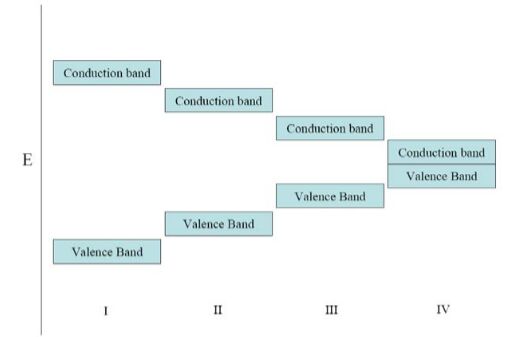
9. Based on the preceding diagram, which band system would correspond to an insulator? (A)Band I (B) Band II (C)Band III (D)Band IV
10. In contrast to molecular formulas, structural formulas show (A)the total number of each type of atom. (B) the arrangement of the atoms in three dimensions. (C)which atoms are bonded to each other. (D)how the compound will behave physically.
11. What is the correct formula for the dichromate ion? (A) \( \text{Cr}^{3+} \) (B) \( \text{CrO}_4^{2-} \) (C) \( \text{Cr}_2\text{O}_7^{2-} \) (D) \( \text{CrO}_4^{-} \)
12. Many ionic compounds occur as hydrates. What is a hydrate? (A)A compound that contains hydrogen (B) A compound that contains loosely bound water molecules (C)A compound that dissolves easily in water (D)A compound that decomposes in the presence of water
13. In an oxidation reduction reaction, which of the following is NOT true? (A)There must be an oxidant and a reductant. (B) The number of electrons lost in the reduction must be gained in the oxidation. (C)The oxidant gains electrons. (D)The reactant that is oxidized loses electrons.
14. When sodium chloride dissolves in water to form an aqueous solution, which of the following is NOT true? (A)The sodium ions are surrounded by water molecules with the hydrogen atoms directed inward. (B) Each of the cations and anions are surrounded by their own shell of water molecules. (C)The sodium ion and chloride ion are separated from each other by many water molecules. (D)The sodium and chloride ions are each hydrated by water molecules.
15. A solution of lead from a battery plant has a concentration of 3.65 × 10⁻⁷ M. What is this concentration in ppb? Assume the solution has a density of 1.000 g/ml. (Pb: 207.2 amu.) (A)75.6 ppb (B) 6.57 ppb (C)365 ppb (D)1361 ppb
16. In naming an ionic compound, which of the following is NOT true? (A)If a metal forms more than one cation, the charge is put in parentheses as a Roman numeral. (B) The name of the cation is given first, followed by the name of the anion. (C)The number of anions and cations are specified using the prefixes mono, di, etc. (D)If a metal forms only one cation, the charge is not specified.
17. Potassium permanganate (KMnO4) reacts with oxalic acid (C2H2O4) according to the reaction \[ \text{KMnO}_4 + \text{C}_2\text{H}_2\text{O}_4 + \text{H}_2\text{SO}_4 \rightarrow \text{MnSO}_4 + \text{CO}_2 + \text{H}_2\text{O} + \text{K}_2\text{SO}_4. \quad (\text{not balanced}) \] What volume of 0.250 M KMnO4 is required to react with 3.225 g of oxalic acid? (A) 143 ml (B) 287 ml (C) 35.7 ml (D) 57.3 ml
18. The compound NO2 is an exception to the octet rule because (A) this compound is not an exception to the octet rule. (B) the compound has an odd number of electrons. (C) the compound has more than one double bond. (D) the N atom must be surrounded by more than eight electrons to form two bonds.
19. What is the electron pair geometry for a molecule with five pairs of electrons around the central atom? (A)tetrahedral (B) trigonal bipyramidal (C)octahedral (D)trigonal pyramidal
20. In an ionic solid, the energy that holds the ions in a three-dimensional array is the (A)bond energy. (B) ionization energy. (C)lattice energy. (D)interaction energy.
1. Design a galvanic cell experiment to measure the solubility product, i.e., \( \text{K}_{\text{sp}} \), for \( \text{PbSO}_4 \). Specify the concentrations and electric voltmeter reading in your experiment with parameters and express the obtained \( \text{K}_{\text{sp}} \) value in terms of these parameters. The standard potential for the reduction half-reaction \( \text{PbSO}_4(s) + 2\text{e}^- \rightarrow \text{Pb}(s) + \text{SO}_4^{2-} \) at \( 25 \text{ °C} \) is -0.36 V. (10 points)
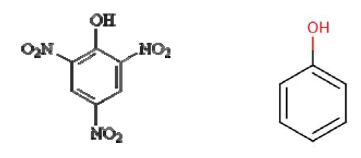
2. Given in the following are the structures of picric acid (left) and phenol (right). Please compare the acidity and explain your answer in very detail. (10 points)
4. Draw the MO diagram of Ne2 by assuming two Ne atoms approaching along the y-axis. In your diagram specify 2px, 2py, and 2pz orbitals. Predict the stability and the bond order of Ne2. (15 points)
 阿摩線上測驗
登入
 (A)The solution will become acidic. (B) The solution will remain clear. (C)A precipitate will form. (D)Two immiscible liquid layers will form.